Simulation Training and Programs
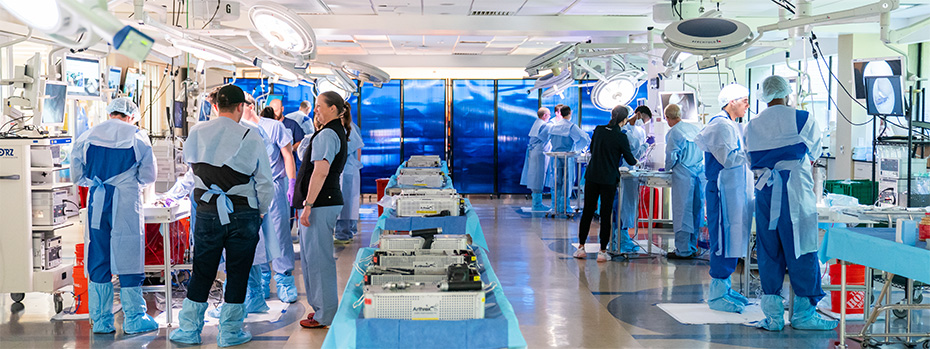
At OHSU, simulation is a core part of health care education. You’ll practice in realistic clinical settings, gain confidence and strengthen your clinical skills in a safe environment.
On this page, find details about:
Dental simulation
Dental students at OHSU use simulation to prepare for clinical practice. Simulation is integrated into the curriculum to help you develop both technical and communication skills.
Training includes:
- Develop hand skills. Build technical skills using dental manikins and task trainers.
- Practice pediatric care. Use simulations to learn techniques for treating children and adolescents.
- Strengthen communication. Practice patient interviews and communication with standardized patients to build confidence.
- Improve teamwork. Work alongside other students to improve collaboration.
Medical simulation
M.D. program simulation
In the M.D. program, you’ll use simulation throughout your training to learn and build proficiency in clinical skills. You'll also receive feedback to guide your learning and formal assessments to measure your progress in standardized, structured simulated clinical settings.
Build essential skills through training. You’ll:
- Respond to emergencies. Use manikin-based simulations to practice urgent scenarios.
- Perform procedures. Gain hands-on experience through task training and manikin-based simulations.
- Sharpen diagnostic skills. Work with standardized patients and virtual reality simulation to strengthen clinical reasoning.
- Communicate with patients and teams. Build skills in patient interviews, counseling and teamwork.
Learn more about the M.D. program.
Graduate medical education simulation
Residents and fellows at OHSU use simulation across specialties to build advanced clinical skills in a safe, supportive environment. Simulation strengthens your technical skills, clinical decisions and team-based care.
Your training includes:
- Master surgical techniques. Practice open, laparoscopic, endoscopic and microscopic procedures with task trainers, virtual reality and tissue-based simulation.
- Manage critical situations. Train with high-fidelity manikins in real-time scenarios to build crisis resource management, emergency response and complex patient care skills.
- Strengthen procedural skills. Practice specialty procedures with ultrasound guidance, airway management and other hands-on techniques.
- Improve team communication. Train with interprofessional teams in simulated codes and clinical scenarios to strengthen leadership, collaboration and patient safety.
Emergency medicine simulation
The emergency medicine simulation program gives you hands-on experience responding to critical and urgent events working with interprofessional teams.
Training includes:
- Manage critical events. Use manikin-based and virtual reality simulations to respond to adult and pediatric emergencies.
- Perform urgent interventions. Build procedural skills under pressure.
- Develop rapid decision-making. Practice assessing situations quickly and making evidence-based decisions.
- Train in specialty scenarios. Practice STEMI care (treatment of severe heart attacks), trauma response and pediatric emergency care.
- Train in real clinical settings. Work in actual emergency departments alongside nursing staff and health care teams through in situ simulation.
Faculty, residents and other health care professionals can participate in the emergency medicine simulation program to strengthen team-based care and manage crises.
Nursing simulation
As a nursing student at OHSU, you'll use simulation across your education, from basic skills to advanced practice. Simulation prepares you for patient care through safe, repeatable practice and immediate feedback.
Nursing students train in Portland and at regional campuses across Oregon in Ashland, Bend, Klamath Falls, La Grande and Monmouth, giving you access to high-quality simulation close to home.
Training includes:
- Build foundational skills. Practice vital signs, medication administration and patient assessments early in your training.
- Advance through complex care. Practice acute and critical care scenarios, including obstetrics, pediatrics and end-of-life care.
- Strengthen teamwork skills. Work with interprofessional teams to improve communication and collaboration.
- Practice ultrasound for nerve blocks. Learn ultrasound-guided peripheral and truncal nerve blocks to support regional anesthesia care.
Learn more about OHSU’s nursing programs.
Nurse anesthesia simulation
In the nurse anesthesia program, you’ll use high-fidelity manikins, virtual reality and standardized patients to prepare for anesthesia care in complex and high-risk situations.
Training includes:
- Practice airway management. Gain experience with intubation, ventilation and related skills.
- Respond to crises. Train for rare but high-stakes emergencies in a safe setting.
- Perform anesthesia procedures. Practice induction, maintaining anesthesia during surgery and safely waking patients.
- Strengthen team communication. Work alongside faculty and other clinicians across health professions to improve collaboration in critical moments.
Learn more about the Nurse Anesthesia D.N.P. program.
Pharmacy simulation
Pharm. D. students gain hands-on experience in simulation at both OSU and OHSU, building skills for patient care and clinical practice.
Training includes:
- Physical assessment skills. Practice examination skills using high-fidelity manikins at OSU.
- Clinical skills and patient interaction. Work with standardized patients at OHSU to practice interviews, examinations and communication.
Physician assistant simulation
In the Physician Assistant program, you’ll engage in simulation-based learning to build confidence and competence in a safe, supportive environment.
Training includes:
- Clinical communication and physical exam skills. Learn to communicate clearly, take thorough histories, educate patients, and perform routine and sensitive exams through standardized patient simulation.
- Clinical skills. Build proficiency in key procedures such as local anesthetic administration, superficial wound closure, incision and drainage of abscesses, skin biopsy, large joint injection, Papanicolaou (Pap) smear collection and more.
- Critical care skills. Learn to respond in high-acuity situations through manikin-based training that covers basic and advanced life support, thoracentesis, paracentesis and endotracheal intubation.
- Point-of-care ultrasound (POCUS). Build core imaging skills through hands-on ultrasound training.
Simulation in the Physician Assistant program lets you repeat skills, get feedback from instructors, and gain confidence before clinical rotations.
In situ simulation
OHSU brings interprofessional simulation training directly to clinical sites statewide through in situ simulation. You’ll practice in hospital units and community clinics alongside full health care teams, including nurses, physicians, respiratory therapists and other clinicians who deliver care in those settings every day.
We collaborate across academic institutions, within the OHSU community and throughout Oregon to provide high-quality, team-based simulation that strengthens coordination across disciplines, improves patient care and enhances safety in health care systems.
In situ partnerships include:
- Pediatric readiness. In partnership with community hospitals across Oregon, clinical teams prepare to care for pediatric patients through hands-on simulation in their own settings. Nurses, physicians and other clinicians practice pediatric resuscitation and emergency care together while testing protocols, resources and communication.
- Emergency medicine. Emergency department teams train together in high-stakes scenarios where they work. Nurses, physicians, respiratory therapists and other emergency clinicians practice crisis resource management, refine communication and identify potential safety threats in the physical environment. This coordinated training supports safer, faster response during adult and pediatric emergencies.
- Pediatric intensive care unit. Interprofessional PICU teams at OHSU Doernbecher Children's Hospital practice high-acuity pediatric scenarios directly in their unit. This approach helps identify system issues and strengthens interdisciplinary teamwork.
Simulation trainings and continuing education
OHSU offers simulation-based trainings that help you practice clinical skills and strengthen team performance:
- Simulated Code Interdisciplinary Team Training (SCITT)
OHSU members practice emergency responses in realistic team-based scenarios. - Neonatal Resuscitation Program (NRP)
Learn evidence-based interventions for newborn emergencies using manikin-based simulations. - Transition to Practice support for RNs
New graduates and experienced RNs moving to new specialties practice clinical skills and teamwork through simulated patient care before entering their new care environments.
Simulation education for high school students
On Track OHSU! gives high school students from across Oregon the opportunity to explore health care careers, including firsthand experience with simulation-based education at OHSU’s state-of-the-art simulation centers. Through these experiences, students learn what happens in clinical settings. They build confidence in professional spaces and begin to see themselves in future health careers such as nursing, medicine and allied health.
Students participate in:
- Hands-on simulation activities. Practice brief, supervised skills using simulation tools and equipment.
- Simulation observations. Shadow simulation faculty and clinical learners to see realistic care scenarios and decision-making in action.
On Track OHSU! coordinates participation through partner schools. Trained OHSU staff support each experience to ensure safety, supervision and meaningful engagement.
Study at OHSU
Explore our health and science degree programs.
Contact us
Have questions? Email us at simulation@ohsu.edu.
Standardized patient jobs
Body donation program
Request simulation services
Faculty and staff can reserve simulation resources to support teaching, research and health care training.