Clinical Simulation at OHSU
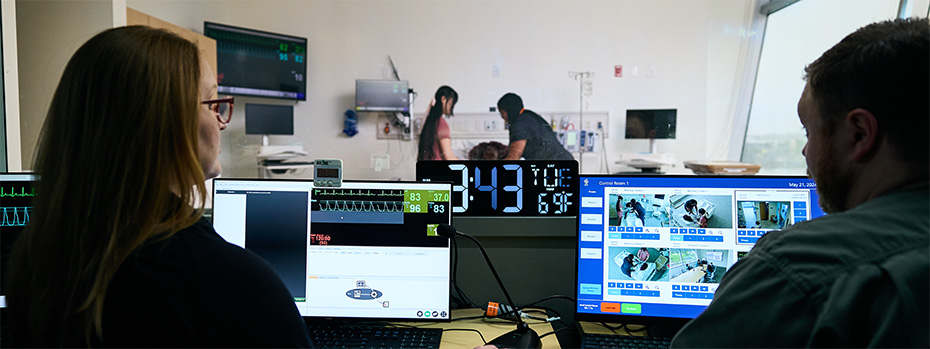
At OHSU, you’ll practice hands-on clinical skills in nationally recognized simulation centers. Using advanced technology and realistic clinical environments, you gain confidence and prepare to deliver safe patient care.
Benefits of simulation training at OHSU
- Practice with cutting-edge technology. Use lifelike manikins, virtual reality and trained standardized patients to build hands-on clinical skills safely.
- Train in realistic clinical settings. Learn patient care in spaces that replicate hospitals, clinics and home environments.
- Build hands-on skills. Practice patient care, procedures, diagnostics and critical thinking in a safe environment.
- Practice teamwork with other health students. Collaborate across professions to strengthen communication and team-based care skills.
- Access statewide simulation centers. Train in Portland or at OHSU partner sites across Oregon for convenient, high-quality simulation experiences.
- Explore specialties safely. Practice scenarios in areas like pediatrics, emergency medicine, and labor and delivery to discover your clinical interests.
Explore OHSU’s simulation centers to see where training takes place, simulation training and programs to see how training is used across health programs and types of clinical simulation training to learn about the different simulation modalities.
Simulation FAQ
-
What is simulation?
Simulation is a hands-on training method where students practice procedures and patient care in realistic settings using manikins, models, virtual reality or trained actors. Observers, peers, actors and video recordings provide feedback to help improve skills and confidence.
-
What types of simulation (modalities) can I practice in health care training?
OHSU offers a range of simulation experiences to build your skills:
- Manikin-based simulation: Practice patient care on lifelike mannequins, from newborns to adults, for procedures and emergency responses.
- Skills-training simulation: Build hands-on clinical skills in a controlled setting.
- Tissue-based simulation: Practice surgical and procedural skills on real or synthetic tissue.
- Virtual reality simulation: Perform procedures and clinical scenarios using interactive digital tools.
- Human patient simulation: Work with trained actors, known as standardized patients or sensitive exam teaching associates, to practice communication, assessment and diagnosis.
These experiences prepare you for emergency care, procedures, diagnostics and specialty scenarios.
-
How does simulation prepare me for clinical rotations?
Simulation helps you practice in realistic settings before you enter a clinical site. You gain confidence by repeating skills, learning to respond to emergencies and working in interprofessional teams.
-
Does simulation replace real patient care?
No. Simulation prepares you for real patient care but does not replace it. You practice skills and decision-making in a safe environment, then apply what you’ve learned during clinical rotations with patients.
-
What is fidelity in simulation?
Fidelity describes how closely a simulation mimics real life. OHSU uses low-, medium- and high-fidelity modalities to match learning goals, from basic skill practice to complex clinical scenarios.
-
Can I practice teamwork with other students in simulation?
Yes. Interprofessional simulation lets students across health professions work together to improve communication and team-based care.
-
Can simulation help me choose a specialty?
Yes. You can explore specialties like emergency medicine, pediatrics and labor and delivery in a safe setting to discover what interests you most.
OHSU simulation mission and vision
Mission
OHSU Simulation advances health care excellence and patient safety by preparing professionals to deliver competent, compassionate and confident care for every patient, through every learner.
Vision
Transforming how Oregon’s healthcare professionals learn, practice, and lead.
Accreditation
OHSU Simulation is accredited by the American College of Surgeons, Accredited Education Institute, (ACS AEI).
In addition, we are members of the Western States Simulation Alliance, a regional network promoting collaboration and best practices in simulation.
Study at OHSU
Explore our health and science degree programs.
Contact us
Have questions? Email us at simulation@ohsu.edu.
Standardized patient jobs
Body donation program
Request simulation services
Faculty and staff can reserve simulation resources to support teaching, research and health care training.