Street Nursing Team
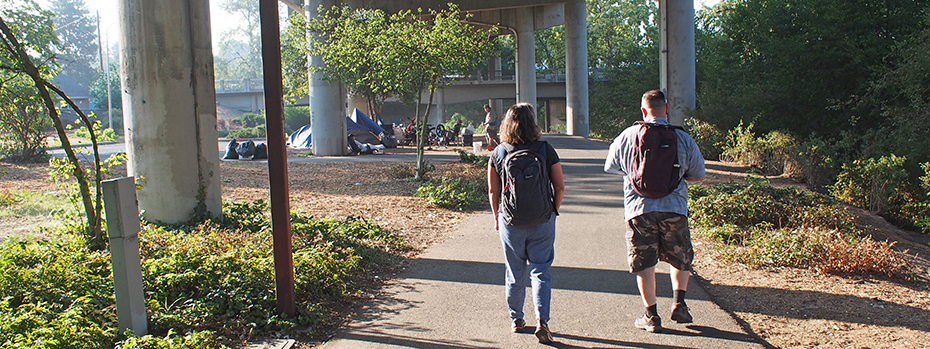
The OHSU Street Nursing Team is a grant-funded program that engages nursing students in unique clinical learning opportunities that improve health and health care access for people experiencing homelessness in southern Oregon communities (Medford, Ashland, Grants Pass, and Klamath Falls).
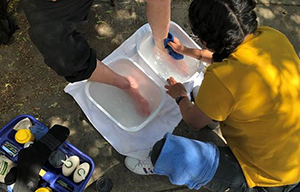
The Street Nursing Team identifies the needs of people who are experiencing homelessness and provides care coordination, wound care, foot soaks, therapeutic listening, harm education, mental health services, telehealth appointments initiated from the street, advocacy in the hospital and clinics, and referrals to other services in the area.
Quick links:
Service
OHSU's School of Nursing Ashland and Klamath Falls campuses partner with community-based organizations to provide care coordination, mental health, wound care, foot soaks, and supplies that support survival on the streets. Faculty and students use patient-led approaches to build relationships.
In the first year of the Street Nursing Team grant, 58 undergraduate and graduate nursing students engaged with 2,459 people experiencing homelessness. Of these, 813 were complex care encounters.
Competencies
To enable students to develop competency in caring for people experiencing homelessness, we have developed undergraduate competencies for care of people experiencing homelessness, which have been validated by national nursing experts.
Homelessness is a critical public health issue in Oregon, and a lack of understanding of the more significant issues at play can lead to a biased approach to caring for this population. The Street Nursing program combines didactic education on root causes of homelessness, trauma- and violence-informed care models, harm education, comorbid conditions, and mental health with an immersive clinical education approach based on approaching people experiencing homelessness with humility.
With this background, our graduates will be better prepared to address structural inequity and bias within their practice environments and bring more effective evidence-based care to all patients and especially to those who are unhoused.
The Street Nursing Team aims to engage 280 nursing students from the Ashland and Klamath Falls campuses by June 2026.
-
Academic aspects
There are two academic aspects to the Street Nursing Team program:
- Undergraduate: The didactic portion of the street team curriculum is offered to all undergraduate students at the Ashland and Klamath Falls campuses and to the Accelerated Baccalaureate students on the Ashland campus. Immersive clinical experience at foot soak clinics and on street nursing rounds are clinical practicum options in core nursing courses.
- Graduate: Students in the Psychiatric Mental Health Nurse Practitioner (PMHNP) and Master in Nursing Education programs completing clinical rotations in southern Oregon are eligible to participate on the Street Nursing Team as part for clinical course credit.
Faculty Teaching Toolkit for Care of People Experiencing Homelessness (PEH)
This toolkit is to support undergraduate nursing educators on integrating the care of people experiencing homelessness into their curriculum. Learning activities are designed to meet outcomes of each competency.
Click on Getting Started to find some easy-to-implement learning activities. Expand the toolkit section to find learning activities organized by each competency with a more detailed description to facilitate implementation and faculty development resources to go deeper into the literature and learning. The learning activities are then organized by learning activity type.
-
Getting Started
- Incorporating Simple Learning Activities into Existing Undergraduate Nursing Curriculum
-
Core Competencies and Teaching Strategies
Competency 1: Providing Respectful, Compassionate, Person-Centered Care
Content: Bias, stigma, trauma, and their impact on PEH care.
Learning Activities:
- Therapeutic Communication triad role-playing scenarios
- Trauma and Violence Informed Care Student Worksheet and optional small group discussion
- Concept-based Based Learning Activity: Substance Use Disorder and safety planning for the inpatient clinical setting
- Addressing Bias and Stigmatizing Language
- Quality Improvement Project: Chronic Wounds in PEH
- Quality Improvement Project: Reducing Emergency Department Utilization
- Reflective Care Plan
- Healthcare Provider Perceptions and Impact on Care
- Visual Map (Venn Diagram or Systems Map) and Resilience Plan
Competency 2: Evaluating Social Determinants of Health (SDOH)
Content: Impact of housing, food security, and social support on health.
Learning Activities:
Competency 3: Collaborating with Interprofessional Teams
Content: Principles of trauma-informed care and harm reduction.
Learning Activities:
Competency 4: Advocating for Improved Health and Equity
Content: Advocacy strategies and identifying gaps in PEH care. Impact of stigma toward homelessness and substance use in creating health disparities.
Learning Activities:
-
Learning activities by type
Worksheet and reflection
- Trauma and violence informed care student worksheet and optional small group discussion
- Reflection on Moral Distress and PEH
- Walk Through the System
Case study
- Therapeutic communication triad role-playing scenarios
- Chronic illness case study
- SNT ER and Stigma Case Study
- Reflective Care Plan
Discussion Guides and Fieldwork
- Icebreaker discussion: Nursing and homelessness
- Integrating harm reduction and trauma-informed care into nursing practice
- Policy analysis and homelessness
- Community Resources Scavenger Hunt
- Healthcare Provider Perceptions and Impact on Care
Concept based learning activities
Substance use disorder concept-based learning activity
Simulation
Forums
Discussion guide
Health Systems Analysis
Funding support
The Street Nursing Team is made possible through a four-year grant from the Health Resources & Services Administration (HRSA) Nurse Education, Practice, Quality and Retention- Mobile Health Training Program (HRSA 22-056) totaling $916,329 (2022-2026) and through the OHSU Foundation Philanthropic Funding.
If you would like to become a donor, please contact Tanya Sloan at sloant@ohsu.edu.
Related links
Program contacts
- Heather Voss, for questions related to program operations
- Rachel Richmond, for questions about Academic aspects including the Street Nursing Team toolkit
- Anna Hale, for questions about Street Nursing Team outreach