Children’s Pain Management and Treatment
Pediatric pain management and chronic pain care
At OHSU Doernbecher Children’s Hospital, we can help your child feel less pain so they can eat, sleep, play and heal.
Uncontrolled pain can disrupt daily life, delay healing and affect vital functions like blood pressure and heart rate. We can help your child return to normal activities with a safe, personalized care plan.
You’ll find:
- We offer the widest range of pediatric pain treatment options in Oregon.
- We partner with pain management experts across the country when needed.
- We measure success by your child’s ability to go to school, sleep well, socialize and be active.
Learn more about:
What your family can expect
Our multidisciplinary team includes pediatric doctors, nurses, psychologists, anesthesiologists, and physical therapists — all with expertise in pain care for infants, children, and teens.
- Personalized care plans tailored to your child’s unique needs
- Support both in the hospital and at home
- Partnership with your child’s primary care provider and other specialists
How to become a patient
Your child needs a referral from their primary care provider, or the provider who manages the condition causing their pain. It usually takes 4-6 weeks to process your referral. If you haven’t heard from us in four weeks, call 503-494-7246.
Your first visit
Your child’s first visit is a complete evaluation with our full team. It includes:
- Detailed review of medical history
- Physical exam
- Psychological evaluation
- Input from your family about how pain is affecting your child
- A customized treatment plan that begins that same day
Types of children’s pain we treat
We focus on treating symptoms, not diagnosing health issues. Your child’s primary care or specialist provider will diagnose any conditions before referring you to us.
Pain in the hospital
We help manage pain day and night for children in the hospital due to:
- Injuries
- Surgery
- Illness or treatment for serious conditions, like cancer
- Weaning from long-term use of sedatives or pain medications
Chronic or recurring pain at home
We also treat long-term or recurring pain conditions, including:
- Headaches and migraines
- Back pain
- Muscle and connective tissue (myofascial) pain
- Fibromyalgia
- Abdominal pain
- Post-surgical pain
- Pain from nerve damage (neuropathic pain)
- Complex regional pain syndrome (or reflex sympathetic dystrophy)
- Amplified musculoskeletal pain syndrome
- Pain related to chronic illnesses like arthritis or cancer
Understanding your child’s pain
Pain can affect your child’s mood, energy, and daily life. Every child experiences and expresses pain differently. Understanding your child’s pain is the first step toward effective treatment.
How we measure pain
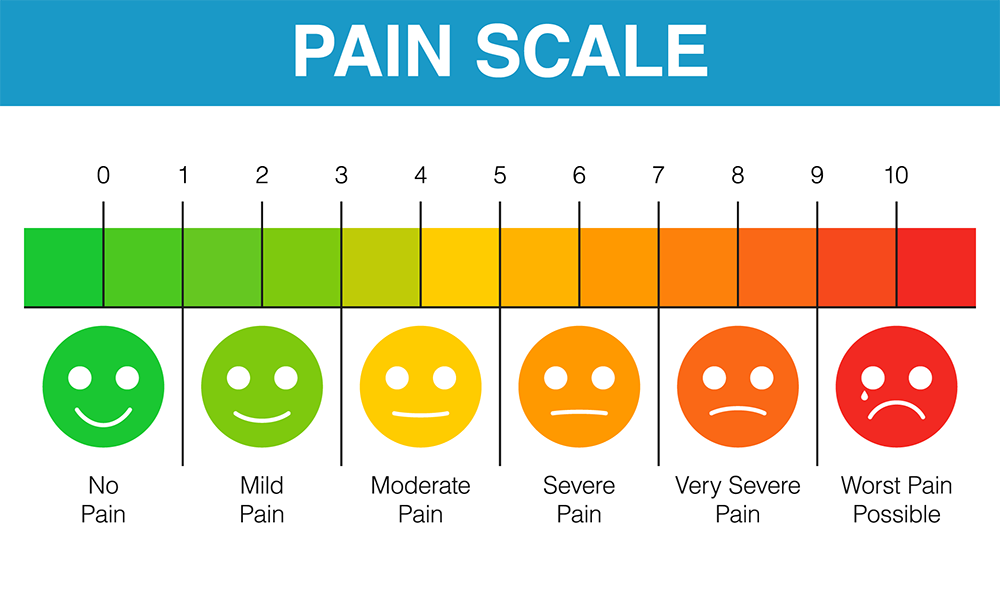
- Infants and non-speaking children: We observe behavior, facial expressions, movement, and vital signs.
- Children ages 3–7: We use a face scale to help them describe pain intensity.
- Children 7 and older: We use a 0–10 pain scale, with 0 being no pain and 10 being the worst imaginable.
You can use these methods at home too and share the results at your child’s appointments.
Pain scale
How we treat pain
We create a personalized treatment plan that supports your child’s whole health. Treatment may include both medication and non-medication strategies.
For chronic pain, we prioritize non-drug approaches. During hospitalization or after surgery, medications may be best, but we use them with caution.
Common treatments include:
- Safe use of pain medications
- Nerve blocks or injections
- Physical therapy and movement-based therapies
- Cognitive and behavioral treatments with a psychologist who has expertise in pain
- Complementary therapies like acupuncture, massage or guided imagery
- Support to stay involved in school and other activities
Safe use of pain medications
We avoid medication when possible, but it is sometimes necessary. We always balance your child’s safety with their comfort in our treatment recommendations.
Our approach to opioids and other strong medications is:
- Use only when necessary, such as after surgery or serious injury
- Prescribe short-term and monitor closely
- Rarely use for chronic pain
- Use a pain medicine agreement to help prevent misuse
Helping your child cope with pain
-
In the hospital
- Tell staff when your child is in pain and encourage your child to speak up too.
- Ask for pain relief early, when it can help most.
- Tell staff about your child’s previous experiences with pain.
Make sure you know what to expect. Ask questions like:
- How much pain will my child have?
- What options are available to relieve pain?
- Which pain management options are best for my child?
- Can you make the procedure less painful?
If pain gets worse, ask your child’s care team to contact our pain specialists. We’re available 24/7.
-
At home
Avoid triggers: Try dimming the lights, minimizing noise and providing a calm environment
Use distractions: Many children find relief when they focus on something else like watching a movie, listening to music or playing a game.
Try non-medical pain relief options:
- Ice, heat or elevation for injuries
- Massage
- A TENS unit
- Relaxation or breathing exercises
Use over-the-counter pain medications: Follow the recommendations of your child’s care provider.
If your child’s pain gets worse:
- For a mild increase in pain, contact your child’s care provider.
- If the pain is severe, go to urgent care or the nearest emergency room.
Resources for families
Comfort Ability Workshop: This OHSU workshop is for youth age 10-17 and their parents. It can help your child better manage their pain and practice coping skills.
-
Websites
- Chronic Pain Family Education Guides, The Meg Foundation for Pain
- Patients and Families Useful Links, Society for Pediatric Pain Medicine
- Managing Your Child’s Chronic Pain, Psychology Today
- Patient Resource Center, American Academy of Medical Acupuncture
- Tame the Beast
Videos
- Understanding pain in less than 5 minutes, Live Active Chiropractic
- Lorimer Moseley: Why Things Hurt, TEDx Talks
- Elliot Krane: The mystery of chronic pain, TED
- Learning How to Manage Pain During Medical Procedures, Stanford Medicine Children’s Health
- The mysterious science of pain, TED-Ed
-
Books
- Managing Your Child's Chronic Pain, by Tonya M. Palermo and Emily F. Law
- When Your Child Hurts: Effective Strategies to Increase Comfort, Reduce Stress, and Break the Cycle of Chronic Pain, by Rachel Coakley
- Pain in Children & Young Adults: The Journey Back to Normal, by Lonnie K. Zeltzer, M.D. and Paul M. Zeltzer, M.D.
- Conquering your Child's Chronic Pain, by Lonnie Zeltzer, M.D. and Christina Blackett Schlank
- When Children Feel Pain: From Everyday Aches to Chronic Conditions, by Rachel Rabkin Peachman and Anna Wilson, Ph.D.
- The Chronic Pain and Illness Workbook for Teens: CBT and Mindfulness-Based Practices to Turn the Volume Down on Pain, by Rachel Zoffness, Ph.D.
Meet our children's pain specialists
Pediatric anesthesiologists
Pediatric psychologists
-
- Michael A. Harris, Ph.D. (he/him)
- Accepting new patients
-
- Kate A. Turnage, Psy.D. (she/her)
- Accepting new patients
-
- David Wagner, Ph.D. (he/him)
- Accepting new patients
Pediatric physical therapists
-
- Britta Gurgel, PT, D.P.T., PCS (she/her)
- Accepting new patients
-
- Jessica Nason, P.T., D.P.T. (she/her)
- Accepting new patients
Pediatric pain nurses
For patients
To become a patient, ask your child’s primary care provider for a referral.
Call 503-494-7246 to:
- Make an appointment (current patients)
- Ask questions
- Check on your referral after 4 weeks
Location
Center for Health & Healing, Building 1
3303 S. Bond Avenue, 15th floor
Portland, Oregon 97239
Free parking for patients and visitors
Refer a patient
- Refer your patient to OHSU.
- Call 503-494-4567 to seek provider-to-provider advice.