Training
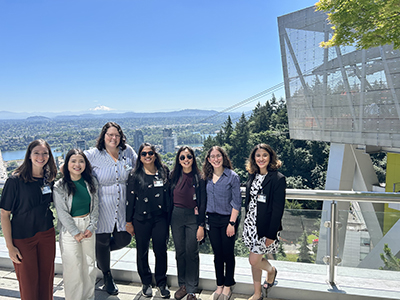
The educational goal and design of the program prepare a resident for a pediatric career of their choosing, whether it is as a general pediatrician or a subspecialist, in an academic or community-based setting. With its medium size and close interaction with faculty, the program provides residents with substantial subspecialty opportunities as well as a well-coordinated outpatient continuity clinic experience. This set-up provides ample oversight toward residents gaining confidence in autonomous medical decision making and allows them to participate actively in quality improvement and advocacy projects. The program incorporates an advanced wellness curriculum and promotes advisor and mentorship interactions. Educational activities throughout the week include departmental and divisional conferences that emphasize active learning skills.
-
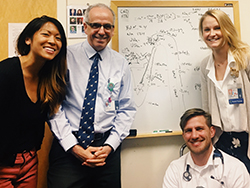
The "Beans and Brains" subspecialty team with our nephrologist, Dr. David Rozansky. Over their three years of training, our residents spend 50% of their time in ambulatory settings and 50% in inpatient settings. We believe in longitudinal exposure to both general pediatric and subspecialty medicine throughout training with increasing autonomy and supervision of more junior trainees as you progress through the curriculum. Our unique design of three-week rotations allows our residents the opportunity to rotate on more subspecialty services and enhance their learning through repetition at different stages of training. As a result of this structure, residents have Individualized Curriculum (IC) rotations that can truly be individualized and help each resident prepare for their unique career needs. Residents attend continuity clinic once each week on most rotations as well. Our clinical exposure by year includes the following:
PGY-1 rotations PGY-2 rotations PGY-3 rotations Inpatient Pediatrics x5 (days x3-4, nights x1-2) Inpatient Pediatrics x2-3 (1-2 blocks senior supervisory) Supervisory Inpatient Pediatrics x4 Outpatient General Pediatrics x2 Inpatient Hematology/Oncology Outpatient General Pediatrics x2 Newborn Nursery Outpatient General Pediatrics Pediatric Intensive Care Unit Neonatal Intensive Care Unit Neonatal Intensive Care Unit Intensive Care Unit Selective (PICU vs NICU) Emergency Medicine Pediatric Intensive Care Unit Emergency Medicine Infectious Diseases Emergency Medicine Neurology Pulmonary Subspecialty Selective x4-5* Newborn Nursery/Behavioral & Mental Health Community Advocacy & Child Health Adolescent Community Advocacy & Child Health Behavioral/Mental Health-Vacation Development-Vacation Senior Pediatric Resident Educator Experience Development-Vacation Individualized Curriculum-Vacation x2 Individualized Curriculum-Vacation x3 Individualized Curriculum-Vacation *(Hematology, Endocrine, Cardiology, Nephrology, Gastroenterology, SCAN/palliative care)
Individualized curriculum
Residents use the individualized curriculum (IC) rotations throughout the three years to gain additional experience in local clinical electives, international medicine rotations, or to advance quality improvement, advocacy, or research projects.
Sample IC Options Allergy/Immunology Critical Care Transport Ophthalmology Anesthesia Dermatology Orthopedics Behavioral Pediatrics Development Palliative Care Breastfeeding ENT PICU Nursing Child Abuse Global Health (Bangkok, Thailand) Psychiatry Community Emergency Medicine Health Promotion for at Risk Grps Research/Scholarship Community Hospital Medicine Indian Health Services (Tuba City) Sleep Medicine Community Pediatrics Metabolics/Genetics/Nutrition Toxicology Clinical sites
Inpatient and outpatient experiences for the Pediatric Residency Program include:
- Inpatient and outpatient care at Doernbecher Children's Hospital (DCH)
- Inpatient and outpatient care at Legacy Randall Children's Hospital (RCH)
- Ambulatory care at Kaiser Permanente
- Adolescent health at school-based health centers
- Outpatient care at
-
Academic Enrichment
Our Academic Enrichment conference offers residents protected time away from clinical duties to focus on essential pediatric topics. Sessions occur every other week for each resident, alternating weekly between interns and PGY-2/PGY-3 residents. Faculty deliver a core curriculum aligned with American Board of Pediatrics content specifications, using adult learning principles and incorporating hands-on, interactive sessions to enhance engagement and retention.
Morning Report
The goal of Morning Report is to improve resident communication and clinical decision-making skills in a comfortable learning environment. Under the direction of the chief residents and in the presence of faculty, residents present timely medical cases that explore various aspects of patient care objectives, including delineation of differential diagnoses, the medical work-up, and/or management care plans. The conference also incorporates interactive tutorials from allied services of the Department of Pediatrics such as radiology and dermatology. Morning report is a half-hour conference held four days per week.
Noon Conference
Noon conferences occur approximately 1-2 times per week and address longitudinal content over a three year period. Curricula include addressing health and societal inequities, legislative advocacy, global health, quality improvement initiatives and class meetings.
Pediatric Grand Rounds
Pediatric faculty, community pediatricians, residents, and students attend this weekly session. Various pediatric topics, including research advances, translational medicine, and challenging clinical cases are presented, usually in a lecture format. Guest presentations are common, and there are several endowed lectureships throughout the year that attract acclaimed physician-scientists.
Pediatric Chair's Friday Forum
The Pediatric Chair's Friday Forum is a weekly interactive conference held October-June facilitated by faculty and residents for all department members. Friday Forum is structured around six rotating themes: clinical reasoning, evidence-based medicine, morbidity and mortality, health equity rounds, research in progress, and ethics. Its overall objectives are to instill lifelong-learning practices for participants and to further develop critical-thinking skills essential to the practice of medicine and translational science. Residents often have opportunities to present at the Friday Forum.
Pediatric-Emergency Medicine M&M
A monthly conference is held jointly with the Department of Emergency Medicine to discuss pediatric patients whose initial presentation is to the emergency department. Residents and faculty from both departments attend this conference. Patients are presented by the pediatric and emergency medicine residents. The case format allows for discussion of the differential diagnosis and treatment plan, facilitating communication between the two departments.
-
To supplement residents' clinical learning, we have a number of unique additional curricula. With these experiences, residents learn more than just the day-to-day of being a resident; they learn about the "real world" and develop skills that will help prepare them for the next stage of their career and life.
Community health and advocacy curriculum
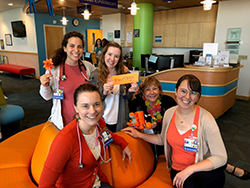
Wear Orange with our General Pediatrics team for Gun Violence Awareness. Our longitudinal advocacy curriculum equips residents with the skills to improve child health through community engagement and policy change. The curriculum includes the Child and Adolescent Community Health (CACH) rotations in the first and third year, as well as our longitudinal policy and advocacy skills training.
Anti-Discrimination and Health Equity Curriculum
Our program is committed to cultivating an equitable, inclusive, and diverse environment and to addressing inequities for our patients and families. This longitudinal curriculum includes unconscious bias training, active bystander skill development, health equity rounds, and conferences that address healthcare disparities and the role of structural racism and discrimination in healthcare.
Becoming an effective senior resident curriculum
During one intern Academic Enrichment in the spring, we focus on enhancing resident teaching and supervisory skills including workshops on subjects like giving feedback, assessing medical students, and facilitating bedside rounds.
Resilience and well-being
A variety of conferences and activities create space for trainees to build community, cultivate communication skills, and debrief difficult events. Intern collaborative experience is a weekly curriculum led by the chief residents and spans the first 10 weeks of the intern year. The goal is to facilitate interns building an essential skill set to include clear verbal and written communication, contingency planning, teaching skills, providing feedback, and working within teams. The sessions are interactive and hands-on, rather than lecture based, drawing from the principles of experiential education, pairing small-group activities with facilitator-guided debriefing and building on the group's development of trust over time. Facilitator-guided debriefing continues throughout residency within individual classes, and during our more emotionally and time intensive rotations, such as the intensive care units. This curriculum supplements the OHSU Resident and Faculty Wellness Program that provides individual coaching and counseling as well as educational workshops and wellness resources.
Quality improvement curriculum
This monthly curriculum is led by departmental quality leaders. Residents experience real-time learning about quality improvement science while working on a patient care improvement project selected by the residents.
Mock code curriculum
Serious life-threatening events occur infrequently in inpatient pediatrics. Furthermore, biennial NRP and PALS certification are insufficient to maintain critical clinical and team management skills. Through a series of “boot camps” and mock codes, residents practice managing medical emergencies and utilizing crew resource management skills in order to be well prepared when true emergencies occur.
Global health
Working alongside the OHSU Global Health Center, we have developed a longitudinal global health curriculum that draws upon the expertise of faculty at OHSU and other national and international leaders in the field. The curriculum covers both core global health subjects and enrichment curriculum. Residents have the opportunity to participate in overseas electives tailored to their career interests.
For more information or if you have any questions, please email us at: pedsres@ohsu.edu