Breast Cancer Signs and Symptoms

Breast cancer symptoms vary greatly. It’s possible to have cancer with no symptoms. It’s also possible that a symptom is not caused by cancer.
If you do have breast cancer, treatment works best when the cancer is found early. Mammograms are the best tool we have for early detection.
Signs and symptoms
Tell your doctor if you have any of these signs or symptoms. Even if you don’t have breast cancer, it’s best to know the cause so you can get the care you need.
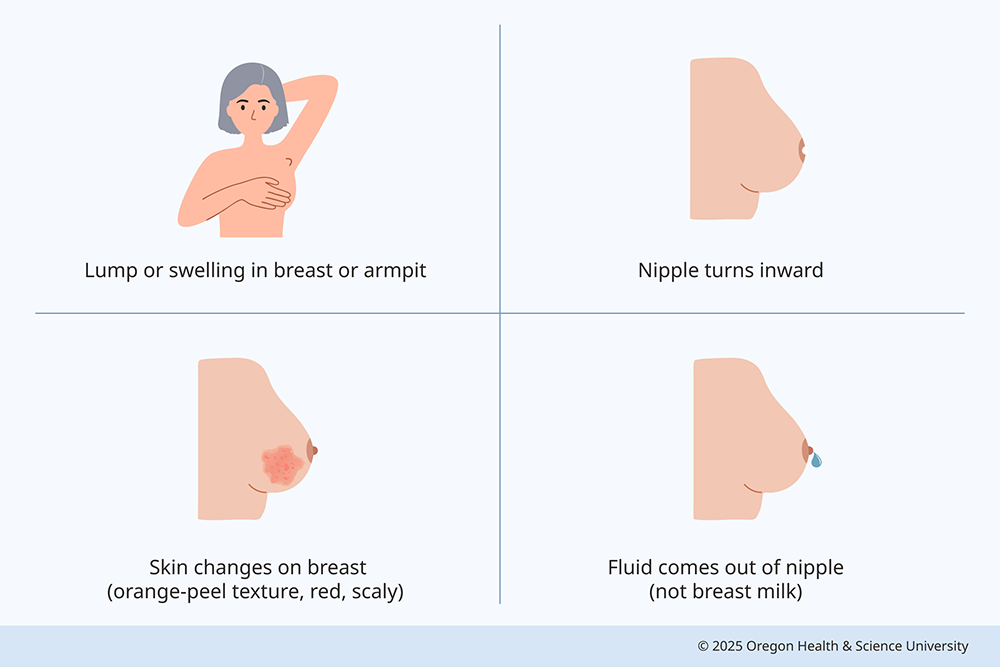
- A new breast lump
- Swelling in or near a breast, armpit or collarbone
- Skin changes on the breast, like skin that’s red, scaly or dimpled like an orange
- Changes to a nipple, especially if it turns inward
- Nipple discharge other than milk
- Persistent pain or tenderness in a breast or nipple
- Change in a breast’s size, shape, look or color
Breast Cancer Signs and Symptoms
Breast cancer risk factors
Breast cancer risk factors include:
- Age: Risk goes up with age. Most breast cancers are found after age 50.
- Genetic changes: People who have certain inherited changes are at higher risk. In 5% to 10% of cases, breast cancer can be traced to an inherited gene.
- Family history: Having a close relative with breast or ovarian cancer raises your risk.
- Medical history: If you’ve had breast cancer, you’re more likely to develop a new cancer in either breast.
- Breast density: Your mammogram will describe your breast tissue as dense or not dense. People with dense breasts are at higher risk of cancer. Dense tissue can also make it harder to find tumors.
- Race and ethnicity: Women who are non-Hispanic white or Black are more likely to get breast cancer.
- Early period: Menstruating early or going through menopause late raises risk.
In most cases, the cause of breast cancer is unknown. Most women in the high-risk group will not get breast cancer, and some women with no risk factors will.
OHSU’s Knight Cancer Institute has:
- A high-risk breast cancer screening clinic to help find cancer early
- Genetic counseling and risk assessment
Learn more
- Breast Cancer Signs and Symptoms, American Cancer Society
- Symptoms of Breast Cancer, U.S. Centers for Disease Control and Prevention
- Warning Signs of Breast Cancer, Susan G. Komen
- Breast Cancer Signs and Symptoms, National Breast Cancer Foundation
- About Breast Cancer in Men, U.S. Centers for Disease Control and Prevention
Location
OHSU Breast Center, South Waterfront
Center for Health & Healing, Building 2, ninth floor
3485 S. Bond Ave.
Portland, OR 97239
Free parking for patients and visitors
Refer a patient
- Refer your patient to OHSU.
- Call 503-494-4567 to seek provider-to-provider advice.
Cancer clinical trials
Clinical trials allow patients to try a new test or treatment.