Breast Cancer
Breast cancer is the most diagnosed cancer in women in the U.S., besides skin cancer. It makes up about 30% of new cancers in American women. This makes breast care an important part of your overall health.
The good news is that about 92% of breast cancer patients survive at least five years after diagnosis.
The National Cancer Institute recognizes OHSU Knight Cancer Institute as one of the best places in the nation for cancer care. At the Knight, you’ll find:
- World-class breast surgeons and other specialists
- 3D mammograms
- A screening clinic for patients at high risk of breast cancer
- Specialists who work together to tailor care to your needs and wishes
- A nurse who guides you through treatment
- Advanced options for breast reconstruction
- Access to clinical trials to test new treatments
Quick links
Symptoms and screening:
Diagnosis and treatment:
What makes us different
- Teamwork: Your specialists will look at your scans and test results together before your first appointment. They will be ready to discuss treatment options right away.
- Convenience: A nurse navigator will arrange your visits. You may meet your care team in one convenient appointment.
- Innovation: Our doctors have access to the latest ways to diagnose and treat every type of breast cancer. We also provide state-of-the-art breast imaging.
- Expertise: Our surgeons have advanced training in rebuilding a breast’s natural look and shape.
- Care for all: Breast cancer is most common in women but can occur in anyone with breast tissue. We provide breast imaging and care for people of any gender, including transgender patients.
What is breast cancer?
Breast Anatomy
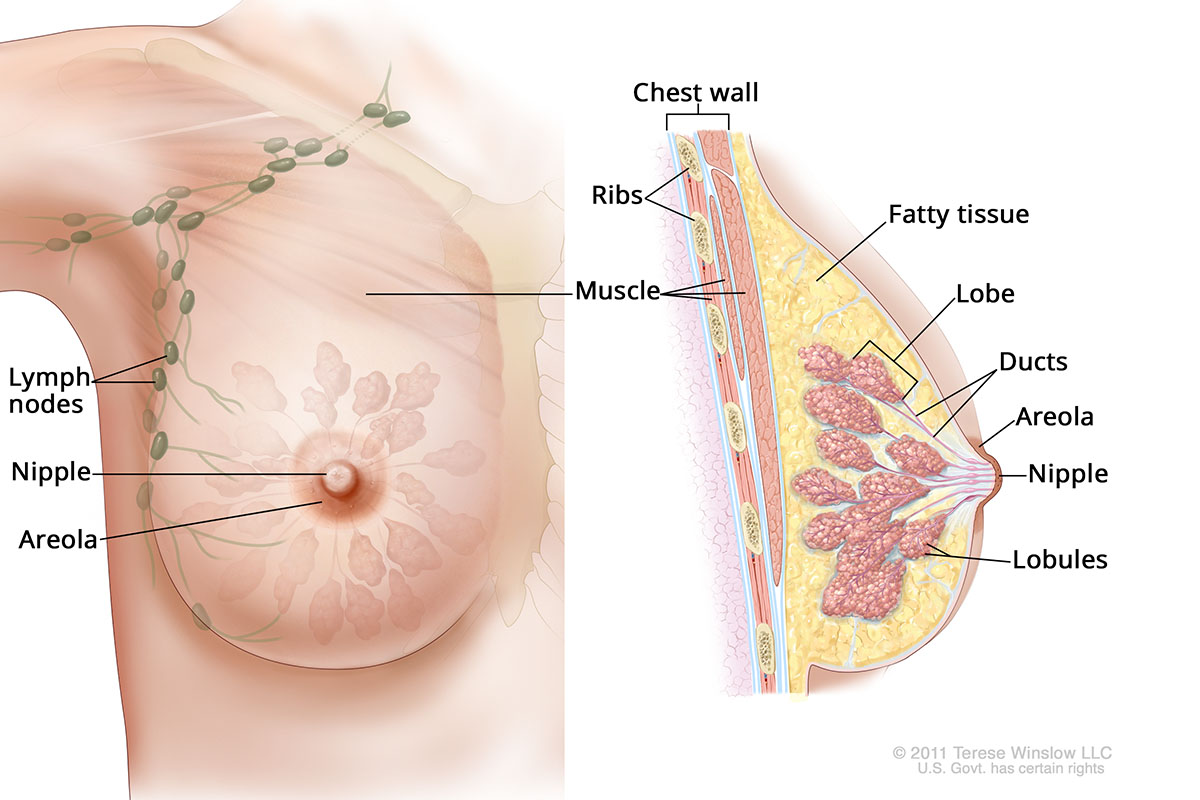
Breast cancer happens when cells in one or both breasts grow out of control to form tumors. Some tumors are big enough to be felt, but not all breast lumps are cancer. Any breast lump or change should be checked by a health care professional.
Breast cancer usually starts in:
- Lobules, the milk-producing glands.
- Ducts, the thin tubes that carry milk from the lobules to the nipples.
Breast cancer types
There are several types of breast cancer. They start in different parts of the breast and have their own features. We will match you to the treatments most effective for your type.
Adenocarcinoma: This is the most common type. It starts in parts of the breast that make or carry milk. Adenocarcinoma includes:
- Ductal carcinoma in situ: Abnormal cells are found in ducts. This type isn’t cancer but could turn into it.
- Invasive ductal carcinoma: Cancer cells have grown outside a duct into nearby tissue.
- Lobular carcinoma: Each breast has lobules that make milk. Cancer cells have spread from a lobule to nearby tissue.
Less common types include:
- Triple negative breast cancer: In this type, the tumor has no “receptors” — proteins that doctors can match to medications. That makes this type harder to treat.
- Inflammatory breast cancer: This uncommon type causes breast swelling, warmth and redness. Skin on the breast has an orange-peel texture. This type tends to strike younger women, and needs prompt treatment.
Who gets breast cancer?
About 321,000 cases of breast cancer are diagnosed in women each year in the United States. More than 4.2 million U.S. women live with or have survived breast cancer. Overall, about one in eight women will be diagnosed sometime in her life.
Most cases are found in women and people assigned female at birth who are over 50. But younger women, men and, rarely, children, can get breast cancer, too. About 2,700 cases a year are diagnosed in men.
Breast cancer survival rates
About 92% of U.S. women with breast cancer live at least five years after diagnosis. When cancer is diagnosed before it has spread from the breast, the rate rises to more than 99%.
It’s important to know that these are averages and can’t predict what will happen to you. Survival rates are based on data from across the U.S. comparing patients with the general population.
Some types of breast cancer have more discouraging rates. No matter what type you have, your care team will strive to give you the longest and best-quality life possible.
Clinical trials and research
Clinical trials are research studies on humans. Trials may test new ways to prevent, find, diagnose or treat breast cancer.
The Knight is a leader in clinical trials for breast cancer. Our trials include an only-at-OHSU program for patients with advanced breast cancer. Ask your care team if a clinical trial is right for you.
Learn more
- Breastcancer.org
- Breast Cancer — Patient Version, National Cancer Institute
- Breast Cancer, American Cancer Society
- Male Breast Cancer Treatment, National Cancer Institute
Location
OHSU Breast Center, South Waterfront
Center for Health & Healing, Building 2, ninth floor
3485 S. Bond Ave.
Portland, OR 97239
Free parking for patients and visitors
Refer a patient
- Refer your patient to OHSU.
- Call 503-494-4567 to seek provider-to-provider advice
Cancer clinical trials
Clinical trials allow patients to try a new test or treatment.
Read more
Learn more about OHSU Knight Cancer Institute treatments:
News
Read about research breakthroughs, patient care and other topics on our OHSU News site.