Interventional Cardiology Treatments and Procedures

Interventional cardiology offers minimally invasive procedures to fix problems with your heart and blood vessels. Our team at OHSU Knight Cardiovascular Institute offer more of these procedures than anywhere else in Oregon.
Unlike traditional open heart surgery, these procedures don’t require major surgery. Instead, they use a thin, flexible tube called a catheter to reach your heart.
The benefits of interventional cardiology procedures include:
- Shorter hospital stays. Most people will go home the same day or the next day.
- Faster recovery times. Full recovery can take less than a week, compared to 6 to 12 weeks for open heart surgery.
- Lower risk of complications. Minimally invasive surgery has fewer risks than traditional surgery.
- Reduced pain and scarring. Tiny incisions (cuts) heal much faster with less scarring than open heart surgery.
- Improved quality of life. Interventional cardiology procedures can quickly fix issues causing pain and discomfort.
- Lower costs than open heart surgery. These procedures have shorter hospital stays than open heart surgery, which saves you money.
The interventional cardiology team at OHSU Knight Cardiovascular Institute are experts at these catheter-based procedures.
OHSU offers:
Cardiac catheterization
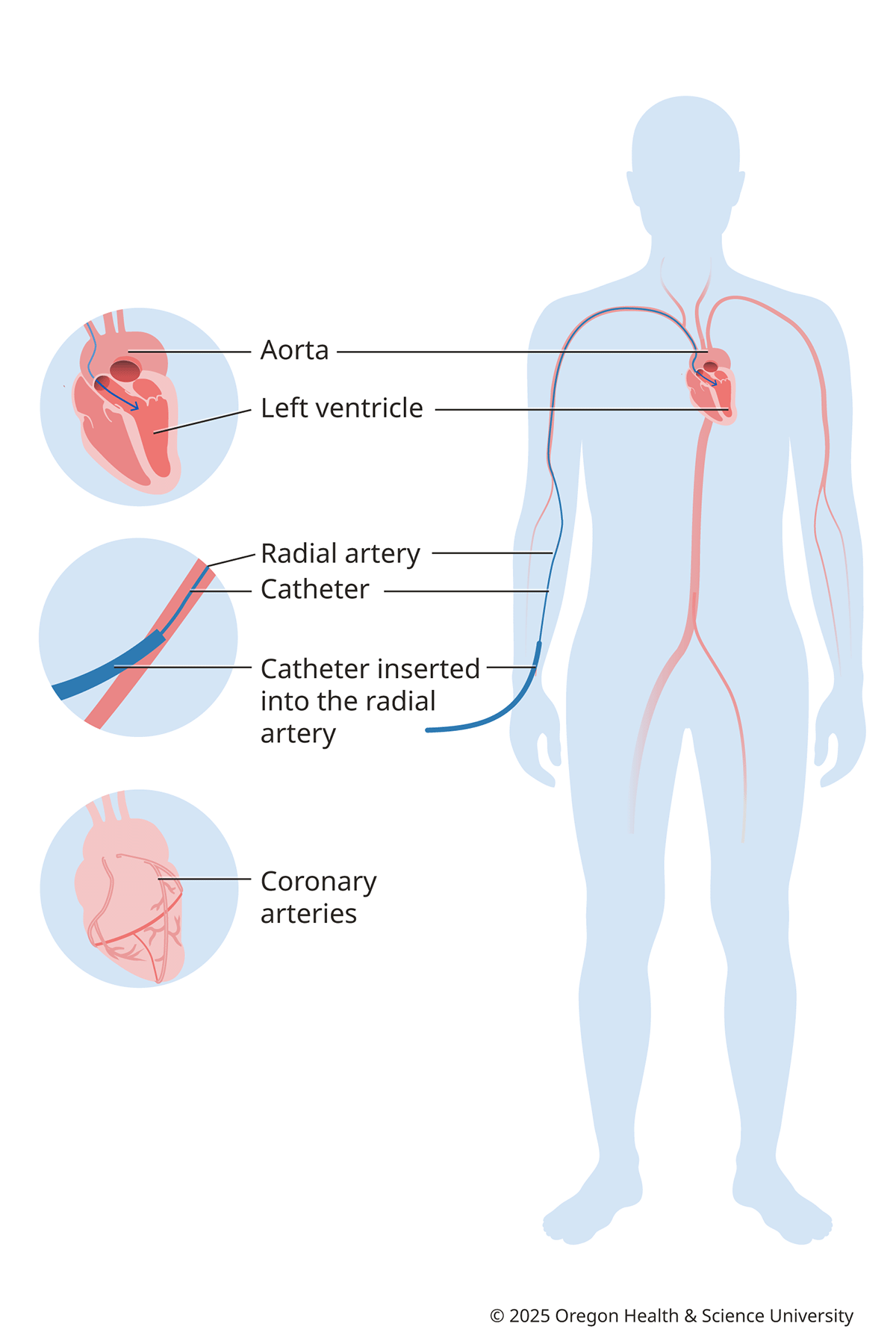
Cardiac catheterization is a procedure to check how well your heart is working. It’s also called heart catheterization.
Your doctor gently puts a thin, flexible tube called a catheter in your arm or leg. They guide the tube all the way to your heart and put special dye through the tube. Then your doctor can take X-ray pictures and see how blood flows through your heart and its arteries.
You might get cardiac catheterization if you have chest pain, shortness of breath or other signs of a heart problem. If your doctor finds a blockage, they may be able to fix it right away using a procedure like percutaneous coronary intervention.
Heart Catheterization
Procedures to open blocked arteries
The buildup of plaque in your arteries is called atherosclerosis. This plaque is made up of fats, cholesterol and other substances that narrow your arteries and make it harder for blood to get to your heart.
Many things can cause atherosclerosis, including smoking, high blood pressure, high cholesterol and diabetes. Left untreated, it can lead to a heart attack or stroke.
Interventional cardiologists have several ways to treat narrowed or blocked arteries.
-
Percutaneous coronary intervention (angioplasty)
Doctors often use percutaneous coronary intervention (PCI) if you’re having a heart attack or chest pain (called angina). PCI can also open arteries if you have chronic total occlusion (CTO), when your arteries are blocked or nearly blocked for three months or more.
Your doctor puts a catheter into a blood vessel in your arm or leg. At the end of the catheter is a tiny balloon. When it reaches the blocked spot, your doctor inflates the balloon to push the blockage aside and open the vessel. Sometimes they place a small metal tube called a stent to help keep it open.
If doctors find a blockage during cardiac catheterization, they can do a PCI right away. PCI is also called angioplasty.
-
Drug-coated balloon angioplasty
A drug-coated balloon angioplasty is a new way to treat narrow or blocked blood vessels. During the procedure, your doctor puts a catheter with a tiny balloon at the end into a blood vessel in your arm or leg. It’s like a percutaneous coronary intervention, but the balloon is coated with medicine that helps prevent the blood vessel from getting blocked again. The balloon is inflated to open up the blood vessel, and the medicine helps the vessel stay open and heal.
-
Coronary atherectomy
Coronary atherectomy clears out hard blockages in the blood vessels of the heart. It’s often used if the blockage is difficult to treat with a percutaneous coronary intervention.
Your doctor puts a catheter into a blood vessel, usually in your arm or leg, and guides it to your heart. At the tip of the catheter is a tiny device that carefully breaks up or removes the blockage, making it easier for blood to flow to your heart. Sometimes doctors will place a small metal tube called a stent to keep the artery open.
-
Thrombolysis
Thrombolysis is a treatment to break up blood clots. Blood clots can block blood vessels and stop blood from flowing to your heart, brain or lungs. This can cause a heart attack, stroke or pulmonary embolism.
In thrombolysis, your doctor gives you medicine called thrombolytics (also called a clot buster) that helps dissolve the clot. You can get the medicine through a needle in a vein or through a catheter, which is guided directly to the clot through a blood vessel.
-
Intravascular lithotripsy
Intravascular lithotripsy is a procedure to break up hard calcium deposits inside blood vessels. Doctors use a catheter with a small device on the tip that sends high-energy sound waves. These sound waves break up the hard calcium so your blood vessels can open again and blood can flow more easily.
Renal denervation
Renal denervation is a procedure that helps lower high blood pressure (hypertension) when medicine isn’t enough. It works by calming down nerves in the kidneys that may be sending signals that keep blood pressure too high.
Your doctor guides a catheter through a blood vessel (usually in your leg) to your kidney arteries. They use a small burst of heat or ultrasound energy to treat the nerves around those arteries. This helps the nerves stop sending signals that raise blood pressure.
Alcohol septal ablation
Alcohol septal ablation is a procedure to treat hypertrophic cardiomyopathy. In this condition, part of the heart muscle is too thick, which can make it hard for your heart to pump blood.
To fix this, your doctor guides a catheter through a blood vessel to your heart. Then they inject a small amount of alcohol into a tiny artery that feeds the thick part of the heart muscle. The alcohol causes that part of the muscle to shrink over time, which helps your heart pump better.
Heart valve repair or replacement
If you have heart valve disease, your doctor might recommend a transcatheter procedure to repair or replace a damaged valve. In these procedures, which are done through a catheter, an interventional cardiologist and heart surgeon work together.
OHSU is the only hospital in Oregon that can use transcatheter procedures to repair or replace any heart valve.
-
Transcatheter aortic valve replacement
Transcatheter aortic valve replacement (TAVR) is a procedure to replace a damaged aortic valve. The aortic valve controls blood flow from your heart to the rest of your body. Sometimes, the valve is narrow or damaged, making it harder for blood to flow.
Your doctor guides a catheter through a blood vessel (usually in your leg) to your heart. At the end of the catheter is a new aortic valve. Your doctor places the new valve in the right spot, pushing the old valve aside, so blood can flow freely again.
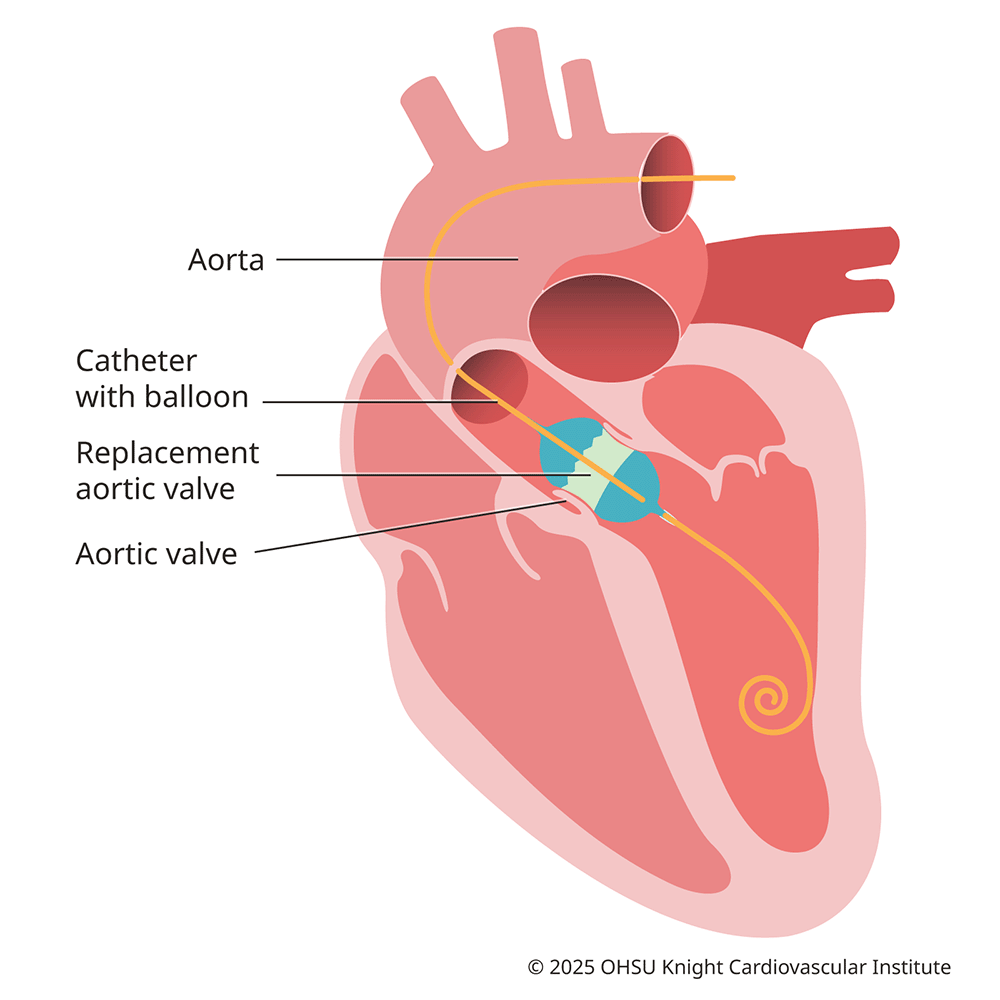
OHSU's team is the only one in Oregon that can repair or replace all four of the valves of the heart using a catheter. We are national leaders in these minimally invasive procedures. -
Transcatheter mitral valve repair
The mitral valve helps control blood flow through your heart. Sometimes it doesn’t close properly, which lets blood leak backward. This can make you feel tired or short of breath.
Instead of doing open heart surgery, doctors use a catheter. They put it into a large vein in your leg and carefully guide it up to your heart. Then they use special tools through the catheter to clip or repair the leaky valve, so it closes better and your blood flows the right way. Transcatheter mitral valve repair is also known as transcatheter edge-to-edge repair.
You may stay in the hospital for one to three days. Full recovery may take a few more weeks.
Structural heart defect closures
Some people are born with an abnormality in the heart structure (congenital heart defect). Others develop a defect in their heart later. It’s important to treat these structural problems in the heart to prevent heart failure or severe heart disease.
Interventional cardiologists use catheters along with tiny devices to close holes in your heart.
-
Atrial septal defect closure
Atrial septal defect closure is a procedure to fix a hole in the heart. Some people are born with a small opening between the two upper parts of their heart. This is called an atrial septal defect. If the hole is too big, it can let too much blood flow the wrong way, which can make the heart work harder.
To close the hole, doctors use a catheter, which they guide through a blood vessel (usually in the leg) up to the heart. Then, they place a special patch or device over the hole to seal it shut. The device stays in the heart and becomes part of the heart wall over time.
-
Left atrial appendage closure
Atrial appendage closure is a procedure that helps prevent blood clots in people who have atrial fibrillation (AFib). AFib can make your heart beat unevenly, which can cause blood to pool and form clots in a part of the heart called the left atrial appendage.
To fix this, your doctor places a small parachute-shaped Watchman device that seals off that part of the heart so clots can't form there. They gently move a catheter through a blood vessel (usually in the leg) up to the heart. Then they place the Watchman device, kind of like putting a cap on a bottle.
-
Patent foramen ovale closure
Patent foramen ovale (PFO) closure is a procedure to fix a small hole in the heart. Everyone is born with this hole, but for most people, it closes on its own after birth. If it doesn’t close, it's called a PFO. This hole can sometimes let blood flow the wrong way and may raise the risk of stroke in some people.
To close the hole, your doctor guides a catheter through a blood vessel (usually in the leg) up to the heart. A special closure device, like a tiny umbrella, is placed to seal the hole. The device stays in your heart and becomes part of the heart wall over time.
Location
Center for Health & Healing, Building 1, South Waterfront
3303 S. Bond Ave.
Portland, OR 97239
Free parking for patients and visitors
Refer a patient
- Refer your patient to OHSU.
- Call 503-494-4567 to seek provider-to-provider advice.