Heart Attack (Myocardial Infarction)

Call 911 if you suspect a heart attack
A heart attack is a medical emergency. Go to the nearest hospital and do not drive yourself.
If you come to OHSU with heart attack symptoms, you’ll find:
- Fast response times. You’ll get an electrocardiogram (EKG) within 10 minutes of arriving at the emergency room, and if you are having a heart attack you’ll get treatment within 90 minutes.
- Excellent care. We were the first institution in the country to be named a Cardiac Center of Excellence by DNV GL Healthcare.
- Cardiovascular ICU. Our cardiovascular intensive care unit offers the highest level of critical care to help you recover from a heart attack.
- Expert care teams. If you come to the emergency room with heart attack symptoms, a team of cardiologists, emergency room physicians, cardiac catheterization lab specialists and rapid response team members are ready to treat you.
- Seamless transfers. Our team ensures a smooth transfer process if you need to come from another hospital to OHSU for advanced procedures or special treatment.
What is a heart attack?
A heart attack happens when blood flow to your heart is reduced or blocked, preventing oxygen from reaching your heart. This can cause permanent damage or death. A heart attack is also called a myocardial infarction.
You need to go to the hospital immediately if you’re having a heart attack. Treatment is necessary to restore blood flow and oxygen to your heart.
Signs of a heart attack
Many people believe that heart attacks are sudden and powerful, like those you see on TV. The truth is that recognizing a heart attack isn’t always easy.
Most heart attacks start slowly with mild pain or discomfort. Symptoms may come and go or vary in intensity. You may feel like you have the flu, indigestion or a pulled muscle.
Men and women can have different heart attack symptoms.
Symptoms of a heart attack in both men and women
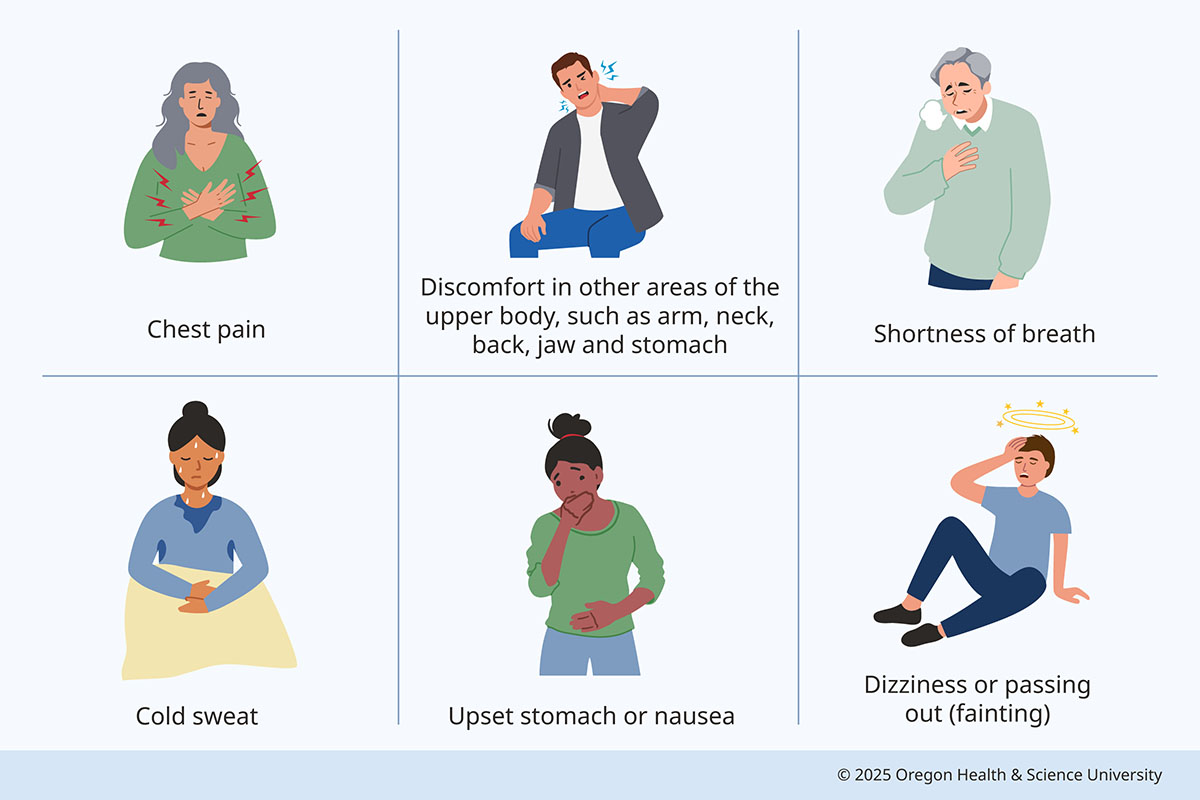
Chest pain. Most heart attacks cause discomfort in the center of the chest that lasts for more than a few minutes, or goes away and comes back. It may feel like pressure, squeezing, fullness or pain.
Discomfort in other areas of the upper body. You may feel pain in your:
- Arm
- Back
- Neck
- Jaw
- Stomach
Shortness of breath. Often comes before or along with chest discomfort.
Other symptoms. Some people might break out in a cold sweat or experience nausea or light-headedness.
Heart Attack Signs and Symptoms for Everyone
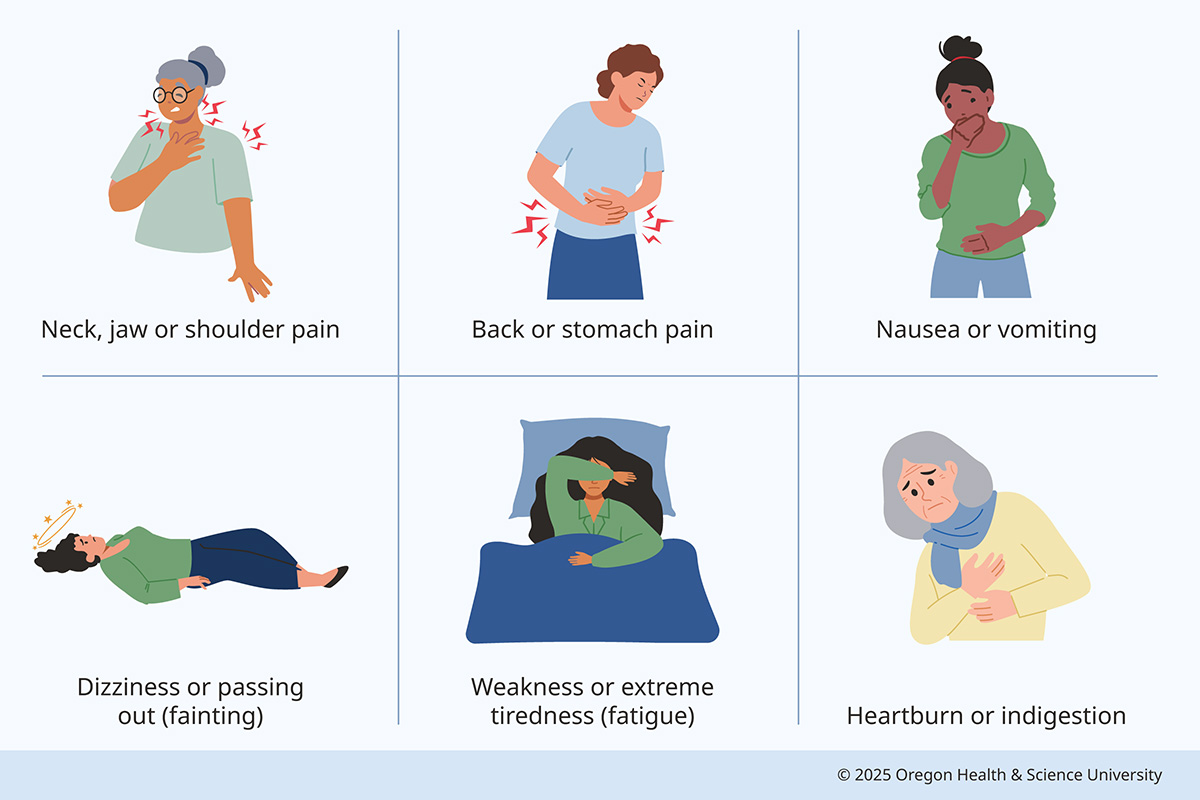
Symptoms of a heart attack more common in women
- Neck, jaw, shoulder, back or stomach pain
- Nausea or vomiting
- Lightheadedness or dizziness
- Unusual fatigue
- Heartburn or indigestion
Heart Attack Signs and Symptoms for Women
What to do if you think you’re having a heart attack
- Call 911. Act fast if you or someone you are with is having a heart attack. Paramedics can start treating you in the ambulance.
- Don’t drive yourself to the hospital. Driving yourself is dangerous for you and others. You could lose consciousness and cause an accident. It could also delay your treatment.
- Chew an aspirin. If you can, chew one 325 mg or four 80 mg aspirin pills while you wait for the ambulance. It’s important to chew the pills, not swallow them. Chewing helps the aspirin absorb faster into your bloodstream, which may reduce heart damage.
- Don’t ignore your symptoms. Some people might mistake a heart attack for indigestion or heartburn. But during a heart attack, time is muscle. The longer you delay treatment, the more likely you are to permanently damage your heart.
Hands-only CPR for cardiac arrest
Sometimes, a heart attack can lead to cardiac arrest. That’s when your heart stops beating. A person in cardiac arrest will stop breathing and lose consciousness.
If you’re with someone who goes into cardiac arrest, hands-only CPR can save their life. Here’s how to do it:
- Call 911, if you haven’t already.
- Place one hand on top of the other and push down hard in the center of the chest. You want to push 100 to 120 beats per minute. Familiar songs with that beat include “Stayin’ Alive” by the Bee Gees and “Crazy in Love” by Beyoncé.
Learn more about how to perform hands-only CPR from the American Heart Association.
Diagnosing a heart attack
If you arrive at OHSU’s emergency room with heart attack symptoms, you’ll get an electrocardiogram (EKG) within 10 minutes. If you arrive via ambulance, you will likely get an EKG in the ambulance on your way to the hospital.
An EKG measures electrical activity in your heart and can quickly detect a heart attack. EKGs are usually the first test you'll get if you have heart attack symptoms.
If more testing is needed, you might get:
- Blood tests, which can detect proteins in your blood that appear after a heart attack.
- Echocardiogram, which creates an image of your heart to show how well it’s working.
- Myocardial contrast echocardiogram, which shows whether any parts of the heart are not getting enough blood and can quickly identify serious heart problems.
- Cardiac catheterization, which uses a thin, flexible tube to measure blood flow to your heart.
Heart attack treatment
We focus on restoring blood flow to your heart as quickly as possible. The most common treatment for heart attacks is called percutaneous coronary intervention (PCI).
In this procedure, doctors guide a catheter (a thin, flexible tube) through your artery to find the blockage. They inflate a tiny balloon to widen the artery to allow normal blood flow. Finally, they place a mesh-like tube called a stent into the artery to help it stay open.
If you’re having a heart attack, you’ll receive treatment within 90 minutes of arriving at OHSU’s emergency room.
Cardiac rehab
It takes time and support to recover from a heart attack. OHSU's cardiac rehabilitation program can help you start an exercise routine and healthy eating habits.
How to prevent a heart attack
Many heart attacks are preventable. OHSU’s preventive cardiology team can help you avoid a heart attack in the first place or keep you from having another one.
Steps you can take to lower your risk of a heart attack include:
Live a heart-healthy lifestyle.
- Don’t smoke
- Get regular exercise
- Maintain a healthy weight
- Manage stress
- Eat nutritious foods
- Limit alcohol
- Sleep 7-9 hours a night
Monitor your risk factors.
- Age
- Being overweight or obese
- Gender
- Diabetes
- High blood pressure
- High cholesterol
Seek medical attention early.
- Get regular checkups
- Tell your provider if you notice any new symptoms
Resources
- Hands-Only CPR, American Heart Association
- My Heart Healthy Plate, OHSU Knight Cardiovascular Institute
- Understand Your Risks to Prevent a Heart Attack, American Heart Association
- Lifestyle Changes to Prevent a Heart Attack, American Heart Association
For patients
- Call 911. You can start getting care in the ambulance.
- Get to the nearest hospital. Do not drive yourself.
- Chew an aspirin. Chew one 325 mg or four 80 mg aspirin pills while you wait for the ambulance.
Location
OHSU and Doernbecher Emergency Room
3181 SW Sam Jackson Park Road
Portland, OR 97239
Free valet parking, 9 a.m. to 10 p.m.
OHSU Health partners
Adventist Health Portland
10300 SE Main St.
Portland, Oregon 97216
Hillsboro Medical Center
335 SE 8th Ave.
Hillsboro, Oregon 97123