Neuropathology Fellowship
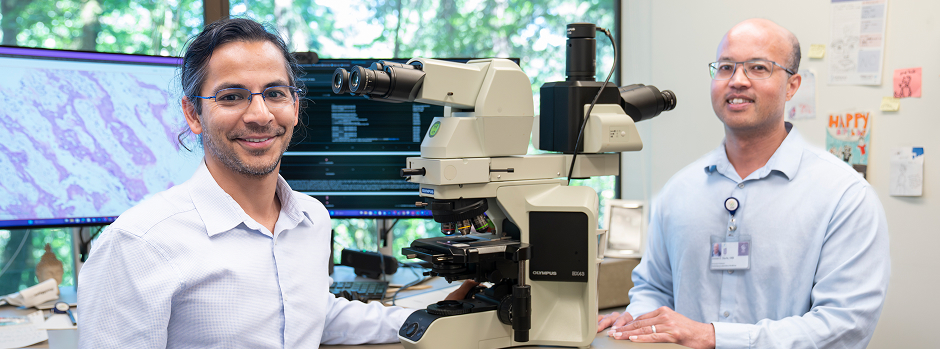
Build subspecialty expertise as a neuropathologist
The OHSU Department of Pathology and Laboratory Medicine offers two training pathways in neuropathology: a standalone, two-year ACGME-accredited fellowship and a four-year integrated pathway for medical school graduates.
ACGME-accredited neuropathology fellowship
This two-year program offers training in surgical, autopsy, neuromuscular and molecular neuro-oncologic pathology. You will develop diagnostic expertise across the full spectrum of adult and pediatric neuropathology.
Integrated AP/NP pathway for medical school graduates
Over four years, you'll complete two years of anatomic pathology residency and two years of neuropathology fellowship. The program is designed for medical school graduates who have experience in the field and are committed to pursuing a neuropathology career.
Explore more:
Why train with us?
As the only academic medical center in Oregon, we offer comprehensive training with exposure to the full spectrum of diseases of the nervous system. Our neurosurgical case volume is approximately 550 in-house cases per year, not including eye pathology. We maintain an active consultation service with approximately 120 cases per year, including some of the most challenging cases in the region.
Our muscle/nerve biopsy service averages two to three cases per week. In collaboration with the OHSU Knight Diagnostic Laboratories, our neuropathologists interpret and sign out next-generation DNA sequencing for an average of three to four central nervous system tumors per week. The Oregon Brain Bank supports the Oregon Alzheimer’s Disease Research Center at OHSU and contributes to excellent training in neurodegenerative disease pathology.
Our neuropathology faculty have expertise in pediatric pathology, surgical pathology and molecular pathology, contributing to a diverse training, research and educational environment. In addition, we offer:
- Focused rotations on eye pathology. In collaboration with ophthalmologic pathologists at the Casey Eye Institute. Duration and structure is flexible based on trainee’s career goals.
- Focused rotations in forensic neuropathology.
- Graduated clinical responsibility. Fellows gradually increase their ownership of cases and by late training act as junior attendings.
- Leading-edge molecular evaluation of central nervous system tumors. In partnership with OHSU Knight Diagnostic Laboratories, our faculty evaluate DNA/RNA sequencing results and genome-wide DNA methylation analysis for CNS tumors.
- Exceptional research in neurodegenerative disease, including access to Oregon Brain Bank
- Strong mentorship and career planning. If goals are met after 12 to 15 months of training, the second year of our training program can be tailored to future career goals. Our fellows have gone on to successful careers in academics, private practice and medical examiner offices.
- AP/NP integrated pathway for medical school graduates. It combines anatomic pathology residency and neuropathology fellowship training in four years.
Fellowship objectives
Training prepares you to provide high-quality neuropathology care across a range of settings. You will build strong diagnostic skills, collaborate with clinical teams and follow emerging technology. The program also supports professional growth and research to improve patient care.
You will develop and graduate with skills in:
- High-quality clinical neuropathology consultations across surgical, autopsy and neuromuscular pathology
- Established and evolving biomedical, clinical and cognitive sciences as applied to neuropathology diagnosis
- Molecular oncologic results and histologic findings for integrated brain tumor diagnosis
- Collaboration with neurosurgeons, neurologists, oncologists and other clinical colleagues
- Professional and ethical care for diverse patient populations
- Diagnostic and consultative practices, assimilating scientific evidence to continuously improve patient care
- Working within a healthcare system to provide optimal pathology services
- Clinical or basic science research, including opportunities through the Oregon Brain Bank and Oregon Alzheimer’s Disease Research Center
Curriculum
The fellowship is built around clinical service rotations covering the full spectrum of neuropathology, with research and teaching integrated throughout. You will manage the clinical service under rotating faculty supervision, gaining progressive responsibility in adhering to ACGME requirements.
Surgical neuropathology
Fellows review up to 600 CNS surgical pathology cases each year from adult and pediatric neurosurgical services at OHSU Hospital and Doernbecher Children’s Hospital. You will interpret frozen sections and evaluate surgical specimens across a range of diseases. You will participate in multidisciplinary tumor boards for adult and pediatric neuro-oncology and gain independence in presenting and discussing your cases in this format.
Autopsy neuropathology
Training includes about 200 autopsy brains each year. These cover a wide range of adult and pediatric conditions, such as neurodegenerative, traumatic, toxic/metabolic and other neuropathological disorders. Fellows perform and supervise brain dissections and complete final neuropathology reports.
Neuromuscular pathology
Training exposes fellows to approximately 130 muscle and nerve biopsies per year. You'll develop expertise in interpreting skeletal muscle and peripheral nerve specimens using histochemistry, immunohistochemistry and electron microscopy.
Molecular neuro-oncology
Fellows work with OHSU Knight Diagnostic Laboratories to interpret molecular test results. These include next-generation sequencing, FISH and genome-wide DNA methylation profiling. You will integrate these findings with histology to make diagnoses aligned with current WHO brain tumor standards.
Research
Fellows collaborate with faculty mentors on research projects aligned with their career goals. You may also work with faculty across neurosurgery, radiology, neurology, neurosciences and psychiatry. Fellows are expected to present work at a national meeting and to develop a project for publication in a peer-reviewed journal.
Opportunities include clinical and basic science research through the Oregon Alzheimer’s Disease Research Center and the Oregon Brain Bank, led by Randy Woltjer, M.D., Ph.D.
How to apply
Follow the unique application guidelines for each neuropathology training program.
Standalone neuropathology fellowship for residency graduates
The standalone two-year fellowship is open to candidates who have completed residency training in anatomic pathology or anatomic/clinical pathology. This fellowship does not participate in a match.
Submit your standalone fellowship application and required materials to Stacey Davis, administrative coordinator, at davissta@ohsu.edu.
- Next fellowship: July 1, 2029–June 30, 2030
- Applications are reviewed on a rolling basis and accepted until positions are filled.
AP/NP integrated pathway for medical school graduates
The AP/NP pathway is for medical school graduates who want to complete both anatomic pathology residency training and neuropathology fellowship in four years. You will spend your first two years in anatomic pathology rotations as a resident. After residency, you will transition directly into the two-year ACGME-accredited neuropathology fellowship.
AP/NP applicants apply through the Electronic Residency Application Service (ERAS) as part of the OHSU Pathology residency application cycle.
OHSU recruits one AP/NP position approximately every other year.
Fellowship eligibility
To qualify for the fellowship, you must:
- Hold an M.D. or D.O. degree (or foreign equivalent with ECFMG certification)
- Have completed at least two years of Anatomic Pathology training in an ACGME- or RCPSC-accredited program
- Have passed the USMLE Step three examination
- Be legally authorized to work in the United States, or eligible to obtain work authorization
- Be willing and able to take and pass the ABP Neuropathology examination upon completion of training
- Obtain an Oregon medical license prior to the start of the fellowship. OHSU provides funding to cover application fees for limited licenses.
Required application materials
- Completed fellowship application (standalone fellowship only)
- Curriculum vitae
- Personal statement or letter of intent
- Three letters of recommendation (emailed directly from the writer or institution)
- Medical school diploma
International medical school graduates must submit a valid ECFMG certificate.
If selected for an interview, you will also provide:
- ECFMG certificate (if applicable)
- USMLE certificate and scores
- JPEG headshot photo (optional)
Before starting the fellowship, you'll need to provide a letter verifying previous training and employment as a physician.
Learn more about applying to OHSU residencies and fellowships
Interview process
Selected applicants interview with neuropathology faculty in one-on-one meetings. You may also meet with other OHSU faculty based on your interests. Candidates give a 20 to 30-minute presentation on a neuropathology topic. All interviews are conducted online.
Fellowship leaders
Program director
-
-
Appointments and titles
- Associate Professor of Pathology & Laboratory Medicine, School of Medicine
-
Areas of interest
- Diagnostic surgical and autopsy neuropathology
- Using molecular testing to characterize brain tumors to enable the best possible disease classification, prognostication, and treatment.
-
Associate program director
-
-
Appointments and titles
- Assistant Professor of Pathology & Laboratory Medicine, School of Medicine
-
Other fellowship faculty
-
-
Appointments and titles
- Associate Professor of Pathology & Laboratory Medicine, School of Medicine
-
-
-
Appointments and titles
- Assistant Professor of Pathology & Laboratory Medicine, School of Medicine
-
-
-
Appointments and titles
- Professor of Pathology & Laboratory Medicine, School of Medicine
-
Additional faculty include pathologists from OHSU Casey Eye Institute and neuromuscular specialists from the Department of Neurology.
Recent fellowship alumni
Anfisa Baiandurova, M.D., 2022–2024 fellowship graduate
Assistant Medical Examiner, Cook County, Chicago, IL
Melanie Hakar, D.O., 2019–2022 fellowship graduate
Neuropathologist, Assistant Professor of Pathology, OHSU
Aaron M. Halfpenny, D.O., 2019–2022 fellowship graduate
Neuropathologist, Kaiser Permanente, Portland, OR
Frequently asked questions
Is this fellowship ACGME-accredited?
Yes. The OHSU neuropathology fellowship is ACGME-accredited.
How long is the fellowship?
The standalone neuropathology fellowship is two years. The AP/NP integrated pathway is four years total: two years of anatomic pathology residency followed by two years of ACGME-accredited neuropathology fellowship training.
What is the AP/NP integrated pathway and how is it different from the standard fellowship?
The AP/NP pathway is designed for medical school graduates who want to complete residency and fellowship in four years, rather than the traditional five to six years (three to four years of residency plus the two-year fellowship). OHSU recruits one AP/NP position approximately every other year through ERAS. Traditional fellowship applicants apply directly to the program after completing residency.
Will I get pediatric neuropathology exposure?
Yes. The service receives cases from Doernbecher Children’s Hospital alongside the adult service, so fellows see a full age range of surgical, autopsy and neuromuscular pathology.
What research opportunities are available?
Research is considered an essential part of the training program. A particular strength is access to the Oregon Brain Bank at OHSU, directed by faculty member Randy Woltjer, M.D., Ph.D. Fellows can also pursue projects in collaboration with faculty across neurosurgery, radiology, neurology, neurosciences, psychiatry and other OHSU departments.
Does the fellowship participate in a match?
No. The standalone neuropathology fellowship does not participate in a unified match. Applications are accepted directly and reviewed on a rolling basis. AP/NP pathway candidates apply through ERAS as part of the residency match.
Can international medical graduates apply?
Yes. International medical school graduates must submit a valid ECFMG certificate as part of their application. Learn more about applying to residencies and fellowships.
What is the fellowship salary?
Stipend and benefits are commensurate with postgraduate training level. Find details about resident and fellow employee benefits from the Graduate Medical Education Department.
Apply now
Fellowship starts July 1, 2029.
Standalone applicants
Apply through OHSU
AP/NP applicants
Apply through ERAS
Contact us
Stacey Davis, administrative coordinator
davissta@ohsu.edu
503-494-8276
Matthew Wood, M.D., Ph.D., fellowship director
woodma@ohsu.edu
Pathology fellowships
Choose from eight programs.
Find faculty
Meet our team.
Faculty careers
Find pathology faculty jobs at OHSU.
Continuing medical education
Find grand rounds and more.
Graduate medical education
Find tools and resources for graduate medical students.