Hematopathology Fellowship
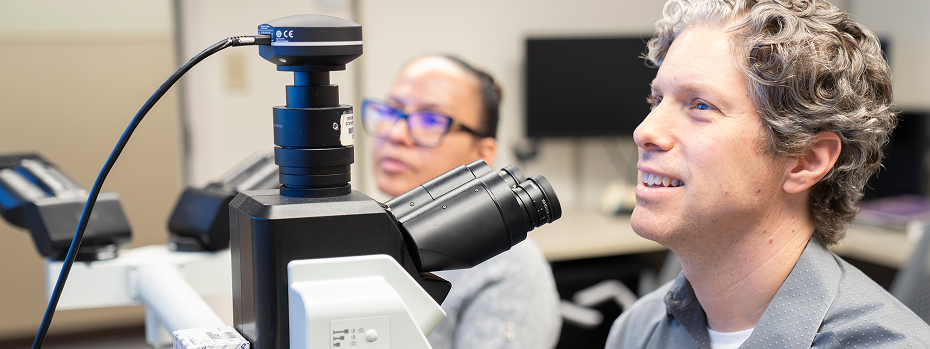
Build expertise across adult and pediatric hematopathology
The OHSU Department of Pathology and Laboratory Medicine offers two positions per year in our one-year ACGME-accredited hematopathology fellowship.
As a fellow, you will see a varied and complex case mix at Oregon’s only academic medical center. This includes cases from an active bone marrow transplant program and pediatric cases from OHSU Doernbecher Children’s Hospital. You will be well prepared for a career in either academic or community practice.
Explore more:
Why train with us?
At OHSU, we value educating the next generation of pathologists. Our department has a dedicated Vice Chair of Education, Mandy VanSandt, D.O., who also directs the residency program. This structural investment reflects our department's commitment to teaching.
You will find:
- Training alongside seven board-certified hematopathologists and expert faculty in molecular genetic, surgical and other pathology subspecialties
- Complex adult and pediatric cases from OHSU Hospital, OHSU Doernbecher Children’s Hospital, regional laboratories and private groups
- An active bone marrow transplant program, with approximately 3,500 bone marrow specimen and 400 lymph node/tissue biopsies per year
- Hands-on training in advanced ancillary techniques, including flow cytometry, next-generation sequencing, FISH, cytogenetics, and immunohistochemistry, as part of daily diagnosis
- Oregon's only academic medical center, a major regional referral destination, and access to the Knight Cancer Institute
- Collaborative, inclusive culture in a department invested in education and well-being
Fellowship objectives
You’ll be prepared to pass the American Board of Pathology hematology examination and to succeed in either academic medicine or community practice. You will develop and graduate with skills in:
- Diagnostic interpretation of bone marrow biopsies and aspirates across the full range of neoplastic and non-neoplastic hematologic disorders
- Diagnostic interpretation of lymph node, body fluid and other tissue specimens for hematologic disease
- Workup of extramural consultation cases referred from regional laboratories and private groups
- Interpretation of flow cytometry, including gating strategies for minimal residual disease evaluation
- Interpretation of cytogenetic, FISH and molecular studies, including targeted next-generation sequencing
- Coagulation testing interpretation
- Compassionate, clear communication with referring clinicians and multidisciplinary teams
- Teaching of residents and medical students
- Engagement in clinical or translational research within the Hematopathology Section
Curriculum
The fellowship is built around clinical service rotations across bone marrow, lymph node and body fluid, coagulation and molecular/cytogenetic services, with teaching and scholarly activity intertwined.
You will train throughout the year, with progressive responsibility under faculty supervision in keeping with ACGME requirements.
Bone marrow service
You’ll be exposed to about 3,500 bone marrow specimens per year, drawn from active bone marrow transplant patients and outpatient adult and pediatric service patients.
With supervision, you will prepare reports, order ancillary testing and integrate clinical history, morphology, flow cytometry and molecular results into final diagnoses.
Lymph node, body fluid and extramural consultation
You will review approximately 400 lymph node and tissue biopsies each year. You will also see peripheral blood and body fluid specimens, along with consultation cases referred from regional laboratories and private groups across the Pacific Northwest.
Coagulation and molecular/cytogenetic services
You will rotate through coagulation and molecular/cytogenetic laboratories, giving you direct exposure to test selection, interpretation and laboratory operations. The experience prepares you for laboratory medical director roles many of our faculty hold.
Teaching and research
As a fellow, you may lead teaching conferences for pathology residents and consult with residents and faculty inside and outside the department. You will also collaborate with faculty mentors on clinical research within Hematopathology.
How to apply
Submit your fellowship application and required materials to Stacey Davis, administrative coordinator, at davissta@ohsu.edu.
The fellowship participates in the Pathology Fellowship Match through the Society for Hematopathology. You must participate in the match in addition to submitting OHSU application materials.
- Next fellowship: July 1, 2028–June 20, 2029
- Applications are reviewed on a rolling basis and accepted until positions are filled.
Fellowship eligibility
To qualify you must:
- Have completed three years of anatomic pathology or clinical pathology training, or four years of anatomic and clinical pathology training, in an ACGME- or RCPSC-accredited program
- Hold an M.D. or D.O. degree (or foreign equivalent with ECFMG certification)
- Be board eligible or board certified in anatomic pathology, clinical pathology or anatomic and clinical pathology
- Have passed the USMLE Step three examination
- Be legally authorized to work in the United States, or eligible to obtain work authorization
- Be willing and able to take and pass the ABP hematology examination upon completion of training
- Obtain a full Oregon medical license prior to the start of the fellowship. OHSU provides funding to cover application fees for limited licenses.
Required application materials
- Completed fellowship application
- Curriculum vitae
- Personal statement or letter of intent
- Three letters of recommendation (emailed directly from the writer or institution)
- Medical school diploma
International medical school graduates must submit a valid ECFMG certificate.
If selected for an interview, you will also provide:
- Dean’s letter
- ECFMG certificate (if applicable)
- USMLE certificate and scores
- JPEG headshot photo
Before starting the fellowship, you'll need to provide a letter verifying previous training and employment as a physician.
Learn more about applying to OHSU residencies and fellowships
Fellowship director
-
-
Appointments and titles
- Associate Professor of Pathology & Laboratory Medicine, School of Medicine
-
Areas of interest
- Hematopathology, Molecular pathology, and Surgical pathology
- Application of novel methods in molecular pathology towards diagnosis, early detection and minimal residual disease in hematopoietic neoplasms
-
Meet our fellows
Anam Hamid, M.B.B.S., 2026–2027
Marc Nakashima, M.D., 2026–2027
Arpan Samaddar, M.D., 2025–2026
Recent fellowship alumni
Raidelys Avila Diaz, M.D., 2025–2026 fellowship graduate
Pathologist, Retipath Pathology
Eric Nomura, M.D., 2024–2025 fellowship graduate
Hematopathologist, St. Charles Health Systems
Mariam Ratiani, M.D., 2024–2025 fellowship graduate
Pathologist, Sonic Healthcare, Portland, OR
Trent Irwin, M.D., 2023–2024 fellowship graduate
Dermatopathologist/Hematopathologist, UW Medical Center
Eric (Hao Gang) Chen, M.D., 2023–2024 fellowship graduate
Assistant professor of pathology, MD Anderson
Lukas Streich, M.D., 2022–2023 fellowship graduate
Staff Pathologist, Hospital Pathology Associates
N.T. (Ngoc) Tran, M.D., 2022–2023 fellowship graduate
Hematopathologist, Kaiser Permanente Regional Laboratory
Benjamin Cook, M.D., 2022–2023 fellowship graduate
Pathologist, Madigan Army Medical Center
Ibrahim Hajjali, M.D., 2021–2022 fellowship graduate
Pathologist, Keck Hospital of USC
Byron Barskdale, Jr, M.D., 2021–2022 fellowship graduate
Pathologist, Cascade Pathology Services/ Legacy Laboratories
Todd Williams, M.D., 2020–2021 fellowship graduate
Hematopathologist, assistant professor of pathology, OHSU, Hematopathology Fellowship Program Director
Frequently asked questions
Is the hematopathology fellowship ACGME-accredited?
Yes. The OHSU hematopathology fellowship is ACGME-accredited and participates in the pathology fellowship match through the National Residency Matching Program (NRMP) for 2028–2029, endorsed Society for Hematopathology.
How long is the fellowship and how many fellows are accepted?
The fellowship is one year, running July 1 through June 30. We accept two fellows per year.
Will I get pediatric hematopathology exposure?
Yes. The service receives cases from Doernbecher Children’s Hospital alongside the adult service, so fellows train across the full age spectrum during the year.
Is the fellowship suited for those interested in academic pathology?
The fellowship prepares fellows for either academic or community careers. Several of our faculty also serve as laboratory medical directors, and the curriculum is built to support either path.
Can international medical graduates apply?
Yes. International medical school graduates must submit a valid ECFMG certificate as part of their application. Learn more about applying to residencies and fellowships.
What is the fellowship salary?
Stipend and benefits are commensurate with postgraduate training level. Find details about resident and fellow employee benefits from the Graduate Medical Education Department.
Contact us
Stacey Davis, administrative coordinator
davissta@ohsu.edu
503-494-8276
Jennifer Dunlap M.D., fellowship director
dunlapj@ohsu.edu
Pathology fellowships
Choose from eight programs.
Find faculty
Meet our team.
Faculty careers
Find pathology faculty jobs at OHSU.
Continuing medical education
Find grand rounds and more.
Graduate medical education
Find tools and resources for graduate medical students.