Pathology Residency Program Curriculum
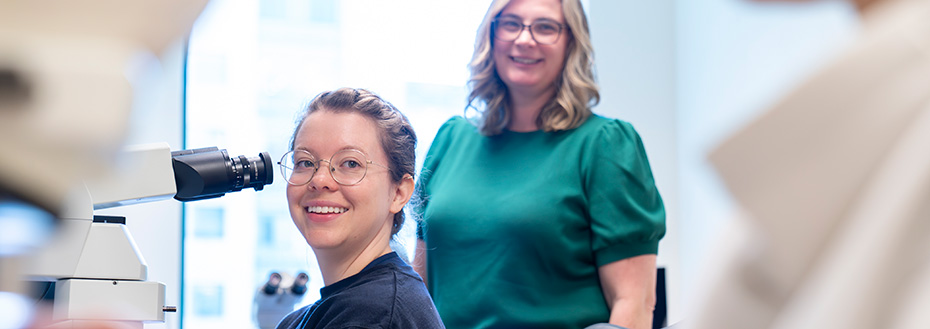
Build expertise in anatomic and clinical pathology
The OHSU Pathology and Laboratory Medicine Residency prepares you for independent practice in community pathology and academic medicine. The four-year program offers curriculum in anatomic and clinical pathology, with a focus on diagnostic judgment, scholarly development and clinical consulting.
Throughout the training, you will:
- Attain broad competency in anatomic pathology and clinical pathology (AP/CP) through structured didactics and high-volume, diverse cases.
- Learn to interpret complex laboratory and pathology findings and communicate them clearly to other clinicians.
- Use electives and projects to align training with your goals.
- Gain experience across multiple practice settings and health systems, preparing for a range of professional environments.
- Build leadership and collaboration skills within a department focused on education and mentorship.
Explore more:
Curriculum overview
Our broad, flexible training prepares you for a range of careers in pathology. Balanced AP/CP curriculum, elective time and exposure to diverse practice settings help you build skills for community practice, subspecialty training or academic medicine. You can expect:
- One-on-one mentoring from expert pathology faculty
- State-of-the-art pathology laboratories and advanced diagnostic tools
- Seven pathologist assistants who manage grossing, so you spend more time reading and interpreting specimens.
- Cohorts of 16 residents with 19% from under-represented backgrounds
- One hour of protected education time every weekday, 8–9 a.m., plus protected grand rounds time
Research and clinical care training mix
Residents complete 192 weeks of anatomic and clinical pathology training, with extensive exposure to diagnostic services and opportunities for scholarly work.
- Flexible curriculum guides individualized training while ensuring you meet essential AP and CP competencies
- Core AP/CP rotations provide a solid base of knowledge and technical skills and prepare residents for advanced fellowship training
- Elective time allows residents to deepen subspecialty experience, explore additional practice settings or pursue academic and research interests aligned with their goals
AP/CP curriculum and rotations
Training combines core rotations, electives and structured teaching. It is designed to build strong diagnostic and technical skills while supporting fellowship preparation and career development.
- Anatomic pathology training includes autopsy, surgical pathology and cytopathology and fine needle aspiration biopsy and diagnosis.
- Subspecialty exposure includes dermatopathology, neuropathology, hematopathology and renal pathology.
- Clinical pathology training includes blood banking, chemistry, hematology, toxicology, microbiology, cytogenetics, molecular diagnostics and immunology.
Sample AP/CP training structure
| Training area | Overview | Key details |
|---|---|---|
| Core AP and CP training | 192 total weeks in AP and CP | Balanced anatomic and clinical pathology training across four years |
| Training sites | OHSU, Veterans Administration Medical Center, Kaiser Regional Laboratory and the medical examiner’s office | Residents gain experience in academic, VA, community laboratory and forensic settings. |
| Call experience | First-call responsibilities in AP and CP; on average, one night out of nine | Faculty are available for backup and duty-hour relief when needed. |
| Didactic curriculum | More than 100 instructional hours over two years | Residents complete two cycles of AP and laboratory medicine didactics before boards. |
| Conferences | Multiple interdisciplinary conferences held daily | Residents attend rotation-relevant conferences and often present. |
| Elective and career development | Flexible training environment for individual goals | The curriculum supports fellowship preparation, academic development and varied career paths. |
Required AP and CP experiences
| Area | Experiences at OHSU | Details |
|---|---|---|
| Anatomic pathology core | Autopsy, surgical pathology and cytopathology, including fine needle aspiration biopsy and diagnosis | Core AP rotations provide foundational diagnostic and technical training. |
| AP subspecialty exposure | Cytopathology, dermatopathology, electron microscopy, forensic pathology, immunohistochemistry, Neuropathology, hematopathology and renal pathology | These include broad subspecialty exposure and fellowship readiness experiences. |
| Clinical pathology core | Blood banking, chemistry, hematology, toxicology, microbiology, cytogenetics, molecular diagnostics and immunology | CP training emphasizes practical laboratory medicine experience and board preparation. |
| Research and scholarship | Clinicopathologic research and the role of pathologists as consultant physicians | Residents are encouraged to present and engage in scholarly work. |
| Teaching and conferences | AP and laboratory medicine didactic curriculum, plus daily interdisciplinary conferences | Structured teaching supports progressive learning across residency. |
Didactics and conferences
Your education doesn’t stop at the end of your shift. The residency program includes protected time for didactic learning and continuing medical education throughout the year.
The anatomic pathology and laboratory medicine didactic curriculum includes more than 100 instructional hours delivered over two years, allowing residents to complete two full cycles before board examinations. In addition, the department offers multiple interdisciplinary conferences each day. Residents attend conferences relevant to their rotations and are encouraged to participate actively in case presentations and teaching.
Pathology grand rounds
All residents are required to pursue individual scholarly activity and present annually at Pathology grand rounds. The CME program regularly invites nationally recognized visiting speakers, keeping your knowledge current across the specialty.
Conferences and interdisciplinary learning
OHSU Pathology’s conference schedule includes multiple interdisciplinary conferences, such as tumor boards, unknown slide sessions, subspecialty teaching conferences and more. A departmental AP and CP didactic curriculum of more than 100 instructional hours covers the full breadth of the specialty over two years, giving you two complete cycles before your board examinations.
Faculty mentoring
OHSU Pathology residents work closely with faculty who are committed to education and professional development. You will have access to guidance in career planning, fellowship selection and scholarly activity. We also provide regular feedback and mentorship throughout training.
Apply now
Apply through ERAS.
Questions?
Contact Anya Coleman, education coordinator.
colemaan@ohsu.edu
503-494-8276
Continuing medical education
Find grand rounds and more.
Graduate medical education
Find tools and resources for graduate medical students.