Pathology Residency Program at OHSU
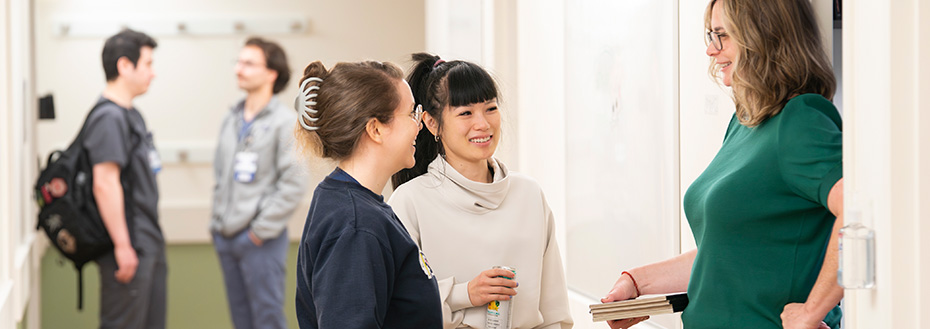
Train with pathology leaders to build your future
Advance your career at one of the nation’s largest general pathology residency programs. The OHSU Pathology and Laboratory Medicine Residency Program offers ACGME-accredited four-year training in anatomic and clinical pathology. You’ll have access to a diverse and busy caseload, enthusiastic and dedicated mentors, and a robust research environment.
Our program prepares you for a career as a well-rounded community pathologist, subspecialist or academic pathologist. You will find:
- A traditional anatomic pathology and clinical pathology (AP/CP) residency and an integrated anatomic pathology/neuropathology (AP/NP) program with neuropathology
- Five training sites, including OHSU, Portland VA Medical Center, Kaiser Regional Laboratory, the Oregon medical examiner’s office and the American Red Cross
- An integrated four-year pathway to become a neuropathologist
- State-of-the-art molecular and genetic testing capabilities through OHSU Knight Diagnostic Laboratories
- Life and work in Portland, known for its vibrant culture and natural beauty
Explore more:
Why train with us
You’ll train with experts at Oregon’s only academic health center. We have a breadth and complexity of cases combined with a culture of resident camaraderie that few programs can match. Here’s what sets us apart.
More time at the microscope
With seven dedicated pathologist assistants, you’ll spend less time preparing specimens and more time studying tissue. That helps you focus on building diagnostic skills and working with faculty mentors.
Protected education time
From 8 to 9 a.m., Monday through Friday, your time is protected for didactic lectures and slide sessions. Grand rounds time is protected too. Your education isn’t squeezed around clinical demands; it’s built into the schedule from day one.
Two training pathways
OHSU offers two routes to a career in pathology.
- The traditional four-year AP/CP residency (four residents per class) prepares you for the full breadth of pathology practice.
- The integrated AP/NP pathway includes two years of anatomic pathology training followed by two years in OHSU’s ACGME-accredited Neuropathology fellowship. The program prepares you for board eligibility in four years, compared to the traditional five or six. We recruit one AP/NP candidate every other year.
Collaborative work-life balance
We actively support a healthy work-life balance and a collaborative, inclusive environment. We guide you to graduate not just as a skilled diagnostician, but as a thoughtful physician and colleague.
You will also have resources to support your well-being. Staffed by OHSU clinicians, our Resident and Faculty Wellness Program offers tools and services to help residents and faculty thrive.
Easy access to pathology fellowships
Pursue pathology fellowships and training right after residency. We offer ACGME-accredited and non-ACGME fellowship pathways in hematopathology, molecular genetic pathology, neuropathology, cytopathology and blood banking/transfusion medicine, pancreaticobiliary, gynecologic pathology and more.
Apply now
Apply through ERAS.
Questions?
Contact Anya Coleman, education coordinator.
colemaan@ohsu.edu
503-494-8276
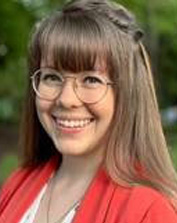
“Completing my residency and fellowship training at OHSU has been a fantastic experience. This department embodies the enticing dichotomy of having a smaller department full of collegial, approachable attendings that are passionate about education and a case load that regularly presents unique, complex diagnostic challenges on both the AP and CP services. Encompassing the top-tier educational setting at OHSU, Portland is a phenomenally accessible and vibrant hub for diverse culinary and cultural experiences – the perfect pairing for a rigorous day at work.”
Find faculty
Meet our team.
Faculty careers
Find pathology faculty jobs at OHSU.
By the numbers
16 residents
100% CP board pass rate
84% AP board pass rate
Residency program objectives
You’ll develop expertise across anatomic and clinical pathology supported by dedicated faculty mentors. You’ll train as a skilled diagnostician, adept at critical thinking, problem solving and collaboration with interprofessional teams.
Curriculum and rotations provide a solid foundation across anatomic pathology and clinical pathology. Residents carry first-call responsibilities for both, averaging one call night in nine, with faculty available for backup and support.
Flexible curriculum for your career goals
Beyond core rotations, elective time lets you go deeper in a subspecialty, extend technical skills or pursue research. Whether you’re headed to community practice, a fellowship or an academic career, your training can reflect your values and goals.
Research and scholarship
Research is an integral part of training at OHSU. You’ll be expected to pursue individual scholarly activity and present annually at Pathology Grand Rounds. Financial support is available for presenting at regional or national conferences.
Faculty mentorship
Our enthusiastic and dedicated teaching faculty are with you all four years for sign-out, lectures and research. The close-knit program ensures genuine one-on-one time with attendings, not just supervision at a distance.
Continuing medical education
Find grand rounds and more.
Graduate medical education
Find tools and resources for graduate medical students.
How to apply
Follow these steps to join us as an OHSU pathology resident. We use the NRMP matching system to rank and interview candidates. Applications are accepted exclusively through ERAS.
Meet requirements
Gather before you apply:
- Curriculum vitae
- Medical school transcripts (M.D. or D.O. within the last five years)
- Medical school performance evaluation (MSPE)
- COMLEX and USMLE transcripts (210 minimum score)
- Personal statement
- Three letters of recommendation
- Photo
- ECFMG certificate (international graduates)
Submit your application
Apply through ERAS starting in October. Positions are filled through the National Resident Matching Program (NRMP).
- 16 residents total; 4 new AP/CP residents per year.
- We also recruit one AP/NP (integrated Anatomic Pathology/Neuropathology) candidate every other year.
- Select the OHSU Pathology and Laboratory Medicine program in ERAS.
Interview
If invited, you’ll interview via video conference. Invitations go out in late October, after ERAS opens.
Your interview day includes:
- Welcome and program overview with program director Mandy VanSandt, D.O.
- One-on-one interviews with the program director and AP and CP faculty
- Multiple one-on-one and small-group conversations with current residents
Residency program leaders
Our faculty and program leaders are physician-scientists committed to advancing pathology education for the next generation. We support your success throughout training and continue to invest in your growth beyond residency.
Residency program director and vice chair for education
-
-
Appointments and titles
- Associate Professor of Pathology & Laboratory Medicine, School of Medicine
-
Areas of interest
- Blood Banking/Transfusion Medicine
- Gastrointestinal pathology
- Education
-
Assistant residency program director
-
-
Appointments and titles
- Assistant Professor of Pathology & Laboratory Medicine, School of Medicine
-
Areas of interest
- Blood Banking/Transfusion Medicine
- Electrophoresis
- Autopsy
- Education
-
Assistant residency program director
-
-
Appointments and titles
- Assistant Professor of Pathology & Laboratory Medicine, School of Medicine
-
Frequently asked questions
Find answers to common questions or contact our education coordinator Anya Coleman at colemaan@ohsu.edu for more information.
-
Resident selection
How many residents do you accept each year?
We accept four new AP/CP residents per year through the NRMP, and one integrated AP/NP candidate every other year. Our program has 16 active residents across four classes.
Is there a minimum USMLE score?
A minimum USMLE score of 210 is preferred. There is no strict cut-off.
Is there a graduation cut-off?
We prefer candidates who have graduated or practiced medicine within the last five years.
How many applicants do you interview each year?
We interview approximately 40 applicants each year.
What is the difference between the AP/CP and AP/NP pathways?
The AP/CP (anatomic and clinical pathology) pathway is a traditional four-year ACGME-accredited residency.
The AP/NP (anatomic pathology/neuropathology) integrated pathway combines two years of anatomic pathology residency with two years of OHSU’s ACGME-accredited neuropathology fellowship, for a total of four years. The AP/NP training offers a faster path than traditional five-to-six-year options to become a neuropathologist.
-
Benefits and salary
What benefits do residents receive?
As OHSU employees, residents choose from medical, dental, vision, prescription and life insurance with optional disability and family coverage. OHSU pays most monthly premium costs. See GME Employment and Benefits for full details.
Are there additional department benefits?
Yes. The department provides an educational allowance of $800 per year ($1,500 for chief resident), use of a laptop computer and financial support for approved travel when presenting at professional conferences.
What is the resident salary?
OHSU GME bases salaries on postgraduate training level. See current salary and pay levels.
-
Diversity and culture
How inclusive is the program culture?
The School of Medicine fosters a respectful culture where everyone is welcome. We actively support diversity and inclusion across our training programs and departments throughout OHSU.
-
USMLE and COMLEX requirements
Is there a minimum USMLE score?
A minimum USMLE score of 210 is preferred, but there is no strict cut-off.
Do you accept COMLEX scores for D.O. candidates?
Yes.
Are D.O. applicants required to submit USMLE scores?
No.
-
International medical graduates (IMGs)
Do you accept international medical graduates?
Yes. International medical graduates must have a valid Educational Commission for Foreign Medical Graduates (ECFMG) certificate by their hire date.
Is ECFMG certification required before applying?
A valid ECFMG certificate is required before the July 1 program start date. It is not required to apply.
What types of visas do you offer?
Applicants who are not U.S. citizens must be legally able to work in the U.S. or eligible to obtain authorization to work. Requests for information or visa applications should be made to the GME office.