Healthcare Safety Solutions to Expand Simulation Training for Rural Emergency Responders
Oregon’s rural emergency medical services (EMS) providers now have more access to realistic, hands-on simulation training and readiness planning thanks to support from Oregon’s Rural Health Transformation Program (RHTP).
Casi Wilson, owner of Healthcare Safety Solutions, has long provided these trainings and planning support to Oregon’s rural hospitals to help them prepare for irregular but high-risk patient emergencies.
She said her team has always tried to include local EMS providers in the hospital trainings. “But it really wasn't solely focused on the work that they do; it was kind of an add-on,” she said.
That changed when Healthcare Safety Solutions was selected as a recipient of the Oregon RHTP program's first round of Immediate Impact Awards to expand its work with EMS providers. Through the funding, the organization will deliver 12 EMS simulation trainings across the state this year and 20 additional trainings next year.
Wilson said the program has opened the door to work more closely with EMS, including fire, police and other smaller agencies that often lack access to educational funding through traditional grant opportunities.
"I think EMS oftentimes don't have access to educational opportunities due to funding restrictions,” Wilson said. “They oftentimes also don't always have access to any sort of equipment that they might want or need because of funding.
"And that is the difference with the RHTP funding, is it's opened access to these other agencies that haven't had it before."
Preparing for neonatal emergencies
Wilson said many agencies have requested training focused on adult sepsis and respiratory distress. However, she estimates that approximately 70% of training requests center on pediatric emergencies and maternal and neonatal care.
As recent maternity ward closures across Oregon force some expecting mothers to travel longer distances to reach care, rural emergency responders are at times called on to fill the gap and prepare for more high-risk maternal and neonatal emergencies.
"It puts a lot of stress, I think, on these smaller communities when they're having to travel an hour, two hours to get OB services," Wilson said.
"Co-partners in developing the education”
Before developing a training program, Healthcare Safety Solutions meets with local agencies to understand their needs, the types of patients they serve and the potential situations they are most concerned about encountering.
"They are co-partners in developing the education,” Wilson said, adding that Healthcare Safety Solutions then tailors skills-based training to help providers respond confidently when those situations arise.
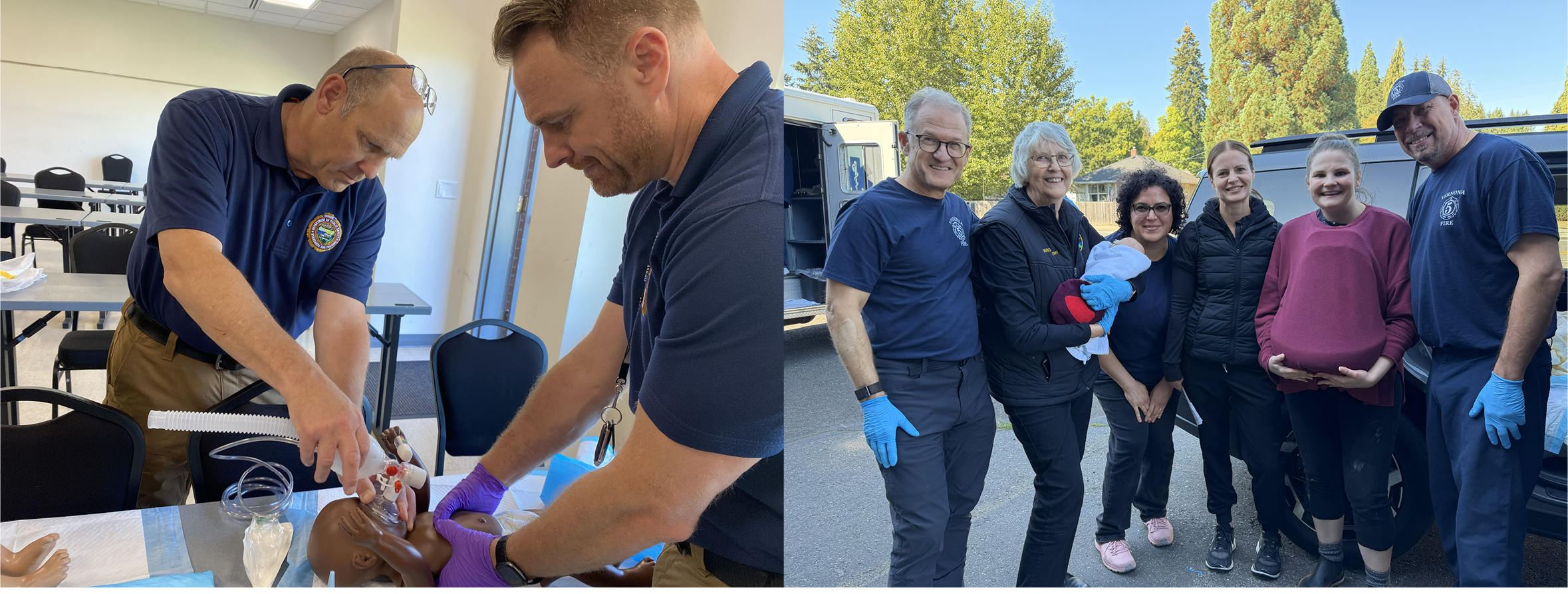
Healthcare Safety Solutions provides procedure labs and hands-on education that lead into progressive simulations, allowing participants to put their learning into practice. Instead of taking place in a classroom or conference room, the trainings are designed to reflect the environments where emergency responders actually work, whether on the side of the road or in the back of an ambulance. The simulations also recreate the stress of real-world emergencies.
Wilson said one training, which simulated a childbirth emergency in a vehicle, included a mother crying, that was performed by a simulated patient, which adds to the realism and helping emergency responders feel as though they were responding to a real-life situation.
Addressing educational and operational gaps
Following each training, Healthcare Safety Solutions works with agencies to develop a continuous readiness plan to help them maintain skills and preparedness.
During the readiness planning process, she said the team often identifies not only educational gaps but also operational gaps. For example, one police agency discovered that pediatric airway equipment was not included in all of its emergency kits. After identifying the issue, the agency was able to equip all officers with the necessary supplies. A rural fire district found missing equipment and outdated protocols, including medication dosing guidance, and was able to make updates that were better aligned with current standards of practice.
Wilson said those kinds of updates can have a significant impact on patient care and outcomes. She said that if there is sustained funding for the trainings after the RHTP, “our hope is ... that we would be able to come back maybe on a yearly basis and continue that work with them [with] check-ins in between.”
Find more information on RHTP here.