Cubital Tunnel Syndrome
The OHSU Nerve Center offers access to neurologists, surgeons and rehabilitation specialists who work as a team to relieve pain from cubital tunnel syndrome. You’ll find:
- Providers specially trained to treat cubital tunnel syndrome, which affects muscle movement.
- Rehabilitation specialists with expertise in nerves, and in the arm, elbow and hand to help you find relief at work and home.
- State-of-the-art diagnostic testing to evaluate nerve damage.
- The latest treatment options, including a less-invasive surgery that’s not widely available.
Understanding cubital tunnel syndrome
What is cubital tunnel syndrome?
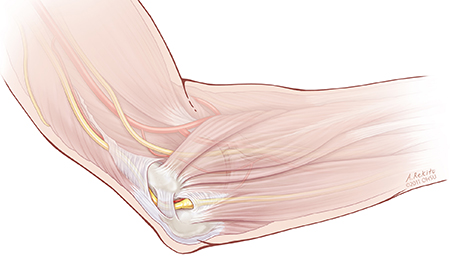
In cubital tunnel syndrome, the ulnar nerve is compressed or pinched. This condition is also called ulnar nerve entrapment at the elbow.
The ulnar nerve runs from the neck to the fingers through a tube, or tunnel. When bumped at the elbow, it can cause the "funny bone" sensation.
Pressure can keep the nerve from working properly. Over time, pressure can lead to nerve damage, with pain and numbness in the forearm or hand.
Ulnar Nerve Entrapment (Cubital Tunnel Syndrome)
Who gets cubital tunnel syndrome?
Cubital tunnel syndrome is the second most common nerve compression disorder, after carpal tunnel syndrome. It’s relatively rare, though. Each year, doctors diagnose fewer than 25 cases for every 100,000 people.
Cubital tunnel syndrome develops in people of all ages. It affects twice as many men as women. Researchers don’t know why.
You may be at higher risk if you:
- Work that requires you to bend your elbow often or that puts prolonged pressure on your elbow.
- Spend a lot of time with your elbow flexed (for example, while talking on the phone).
- Have had trauma, such as a blow, to your ulnar nerve.
- Have physical differences that increase risk, such as a different cubital tunnel shape.
- Are obese or have diabetes, rheumatoid arthritis or thyroid disease.
What causes cubital tunnel syndrome?
Holding a position or tool for an extended period of time, or repeating a task over time, can stretch or pinch the ulnar nerve. Swelling, scar tissue or ongoing fluid buildup can also put pressure on the nerve.
Cubital tunnel syndrome symptoms
If you notice symptoms, it’s best to talk with a doctor right away. Left untreated, cubital tunnel syndrome can leave permanent nerve damage.
Symptoms include:
- Numbness and a feeling of “pins and needles” in your hand, especially in the ring finger and pinkie
- Hand weakness, especially in the ring finger and pinkie
- Pain inside the elbow that burns or feels sharp like an ice pick
- Worse symptoms when the elbow is bent for a long time or at night
Diagnosing cubital tunnel syndrome
At your first visit, our team will do a thorough physical exam and ask you about your medical history. Tests may include:
Electromyography: Your doctor sends a mild electrical current to a needle placed in the muscle. The test measures how well the nerve is supplying electrical signals that cause the muscle to contract. If the nerve isn’t working properly, this helps locate nerve damage.
Nerve conduction velocity test, or nerve conduction study: Your doctor stimulates the nerve with an electrical impulse and measures how fast it moves through the nerve. Nerve signals that are slower than expected can indicate the type and severity of damage.
Learn more about tests for nerve disorders.
Cubital tunnel syndrome treatments
Most patients find relief with treatment. Treatment at OHSU may include:
- Splinting or bracing: A splint to block the elbow from bending at night can reduce nerve injury and pain. This treatment aims to correct your arm position and is usually effective after about a month. A protective pad over the elbow can prevent pressure on the nerve during the day.
- Rehabilitation therapy: We can help you learn how to move and work in ways that avoid pain and nerve injury. Our specialists include experts in neurologic rehabilitation and in hand, arm and elbow therapy.
- Surgery: In severe cases, your care team may recommend surgery to release pressure on the nerve. Most people find lasting relief. Our expert surgeons can do this surgery through a small incision.
Learn more
- Cubital Tunnel Syndrome, American Society for Surgery of the Hand
- Ulnar Nerve Entrapment at the Elbow (Cubital Tunnel Syndrome), American Academy of Orthopaedic Surgeons
For patients
Referral: To become a patient, please ask your doctor for a referral.
Locations
Parking is free for patients and their visitors.
We offer clinics for nerve conditions on our Marquam Hill and South Waterfront campuses.
Refer a patient
- Refer your patient to OHSU.
- Call 503-494-4567 to seek provider-to-provider advice.