Fetal Care Program Treatments and Services
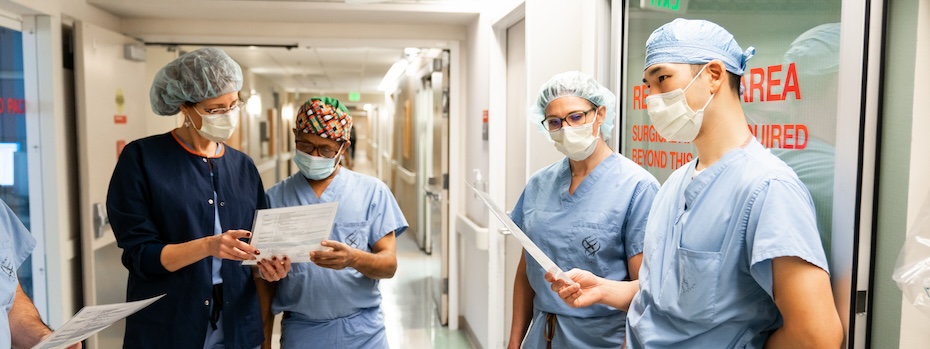
OHSU’s Fetal Care Program offers the most advanced treatments and services between Seattle and San Francisco. Whether you need imaging, genetic tests or a procedure, we’re here for you and your baby at every step.
We are the only place in Oregon that:
- Does fetal surgery for myelomeningocele, a type of spina bifida
- Provides care for twin-twin transfusion syndrome throughout pregnancy
Imaging
Imaging helps us look inside your body. We’ll talk with you about what we see and what it means. Imaging scans include:
- Ultrasound: This uses sound waves to show images of your baby’s body. In some cases, you may have high-resolution 3D or 4D ultrasound.
- Fetal echocardiogram: This shows how your baby’s heart is developing and moving. A fetal heart care specialist will explain your results.
- Fetal MRI: This shows detailed images of the developing brain, lungs and other organs. It can help doctors diagnose complex conditions.
Learn more about ultrasound and fetal monitoring at OHSU.
Genetic counseling and testing
Genetic tests can help find conditions or risk of conditions caused by gene changes. A genetic counselor can talk with you about your test options and help you understand the results.
Tests include:
- Amniocentesis: Your care team removes a small sample of the fluid surrounding your baby. Doctors look at the fluid to check for certain genetic or chromosomal conditions. The sample also provides other information about your baby’s health.
- Chorionic villus sampling (CVS): Your care team collects a small sample of your placenta to test for certain genetic or chromosomal conditions. This test can often provide answers earlier in pregnancy than amniocentesis.
- Umbilical blood sampling: Your care team takes a bit of blood from the umbilical cord. Doctors can test the sample for a blood disorder, infection or other condition. This can be done while you’re pregnant or after you give birth.
Treatments
Heart medications
You may take medication during pregnancy to help treat a problem with your baby’s heart, such as:
- A heartbeat that is not regular or that is too fast or too slow (fetal arrhythmia)
- Rhythm problems in the baby’s heart because of antibodies passed to the baby by a parent with lupus, an immune system disorder
- Complications of structural heart defects
Learn more about fetal heart care at OHSU.
Other medications
You may take medication during pregnancy to help treat a condition your baby has, such as:
- Trikafta, for cystic fibrosis
- Levothyroxine, for congenital hypothyroidism
Procedures
EXIT (ex utero intrapartum treatment) procedures
EXIT procedures help babies with breathing issues or other trouble at birth.
In an EXIT procedure, we partly deliver the baby and provide treatment while the baby is still attached to your body. We offer three types of EXIT procedures:
- EXIT-to-airway: We place a breathing tube or do surgery called a tracheotomy to clear the baby’s airway.
- EXIT-to-ECMO: We use a treatment called ECMO (extracorporeal membrane oxygenation). A machine outside your body supports the baby’s heart and lungs.
- EXIT-to-resection: If your baby has an abnormal growth that is causing breathing or heart issues, we remove it.
Fetal surgery
We provide several types of fetal surgery.
- Fetoscopic repair: This uses cuts about as wide as a pencil. The surgeon inserts a tube with a camera called a fetoscope to guide the repair. The baby stays in the uterus. OHSU is one of the few places in the U.S. that offers this surgery for spina bifida.
- Open fetal surgery: This uses the same cut as for a cesarean section. The surgeon opens the uterus, partly delivers the fetus, makes the repair and puts the baby back. We provide open fetal surgery for a range of conditions.
- Ultrasound-guided surgery: This uses sound waves to give the surgeon images of the baby and the surgical tools.
Intrauterine transfusion
Intrauterine transfusion helps babies with severe anemia (too few red blood cells). We inject donated blood into the umbilical cord.
Laser therapy for twin-twin transfusion syndrome (TTTS)
Laser therapy is the preferred treatment for twin-twin transfusion syndrome, when there is uneven blood flow between twins sharing a placenta. TTTS happens in 10% to 15% of these pregnancies. OHSU has the only program in Oregon with care for TTTS from diagnosis through delivery.
Learn more about our care for twin-twin transfusion syndrome.
Shunts
A shunt is a small tube used to drain extra fluid. Babies may get a shunt before birth for:
- Pleural effusion: When fluid builds around the lungs.
- Lower urinary tract obstruction (LUTO): When urine is blocked from leaving the bladder. This can force urine back into the kidneys and lower the level of amniotic fluid. LUTO can damage the kidneys and keep the lungs from developing properly.
Treatment after birth
Some conditions diagnosed before birth can be treated only after delivery. We can help you plan a safe delivery and can care for you and your baby after birth. Our program connects to the birth suites at OHSU Hospital and the neonatal intensive care unit at OHSU Doernbecher Children’s Hospital.
Learn more:
Ending a pregnancy for medical reasons
You may face a difficult and deeply personal decision if your pregnancy involves a fetal anomaly or a risk to your health. You can talk with us about your options, including not continuing the pregnancy. You’ll find compassion and respect, along with the level of support you prefer during and after your care.
You’ll have access to:
- A fetal nurse care coordinator
- Genetic counselors and tests
- Social workers, who support you emotionally, connect you with mental health and other services, and help you navigate your care
- Our Bridges Pediatric Palliative Care Program, which helps families with hard decisions
- Care for pregnancy loss
- Abortion
You can talk with us about whether you wish to have your care after delivery at OHSU.
For patients
- Appointments: Please ask your provider for a referral.
- Questions: Call 503-418-4300.
Location
OHSU Center for Women’s Health
Kohler Pavilion, seventh floor
808 S.W. Campus Drive
Portland, OR 97239
Free parking for patients and visitors
Refer a patient
- Urgent referrals: 503-418-2843
- Other referrals: Fax our referral form to 503-346-8215.
- Call 503-494-4567 or email fetalcare@ohsu.edu to seek provider-to-provider advice.