CPAM and Other Congenital Lung Malformations
CPAM and other congenital lung malformations happen when extra tissue or other anomalies develop in an unborn baby’s lungs. These conditions are rare and treatable. CPAM is the most common.
OHSU’s Fetal Care Program has the most advanced care for CPAM in Oregon. You’ll find:
- One of the few programs in the U.S. with care for you and your baby in the same place
- A team of specialists with deep experience managing and treating CPAM
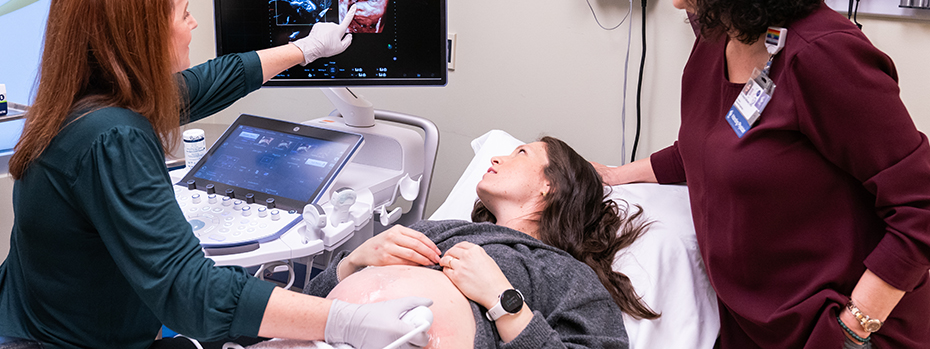
- State-of-the-art imaging
- A care plan tailored to you and your baby, with the option of surgery before birth for some cases
- Help planning your delivery
- Access to a Level IV Neonatal Intensive Care Unit, the top level of NICU care
- Support for newborns who have trouble breathing
What is CPAM?
CPAM, or congenital pulmonary airway malformation, happens in about 1 in 10,000 to 35,000 births. Congenital means the condition is present before birth. Pulmonary means having to do with the lungs.
Airway malformation means one or both lungs have abnormal growths. These growths, or masses, can keep the lungs from developing or working properly. Doctors often don’t know what causes these masses.
Growths vary in size and type. Smaller masses may not cause symptoms or need treatment until after birth. Larger masses may need treatment before birth. If masses grow large enough, they can:
- Cause breathing problems
- Press on the heart
- Push other organs in the chest out of place
- Increase the baby’s risk of getting a lung infection or later developing lung cancer
Other congenital lung malformations
We also provide care for:
- Bronchial atresia: An airway (bronchus) between the windpipe and the lungs doesn’t develop properly.
- Bronchopulmonary sequestration (BPS): Abnormal tissue grows inside or outside the lungs without connecting to airways.
- Congenital lobar emphysema (CLE): The airways are blocked, causing one or more of the lung’s lobes to inflate too much.
Diagnosing CPAM
CPAM is often found on a 20-week ultrasound, a scan to check how a baby is developing. Signs of masses may include cysts (fluid-filled sacs).
You may have a follow-up scan called an MRI to get a more detailed image of your baby’s lungs.
CPAM care before birth
We’ll help you choose the best care plan for you and your baby. Your plan may include:
- Ultrasound: You have a scan every 1 to 2 weeks to check whether a mass is growing.
- Steroids: You get medication to shrink a mass or slow its growth.
- Shunts: We may place a tube called a shunt to drain and shrink a mass.
- Surgery: We may recommend removing a large or growing mass before birth.
- Delivery: With smaller masses, you may be able to deliver your baby close to home. With larger masses, we may recommend that you deliver at OHSU.
Your care team will include experts in:
- Radiology, for advanced imaging
- Fetal and pediatric surgery, to help you decide whether and when to have surgery
- Fetal cardiology, for your baby’s heart care
- Genetics, for counseling and testing
- Neonatology, for newborn care
- Nursing, to coordinate your tests and appointments
- Social work, for emotional and mental health support and help navigating your care
CPAM care after birth
If your baby has trouble breathing at birth: If needed, we will remove lung masses right after birth. Follow-up care may include:
- A tube (shunt) to drain fluid and help the lung work
- An IV for nutrition and pain medication
- A stay in the NICU until your baby can breathe and feed on their own
If your baby breathes normally at birth: We will follow up with a CT scan to check lung masses when your baby is 4 to 6 months old. If a mass needs to be removed, we’ll help you choose the best time.
Resources
- Congenital Lung Malformation Society
- Congenital Pulmonary Airway Malformation (CPAM), Fetal Health Foundation
For patients
- Appointments: Please ask your provider for a referral.
- Questions: Call 503-418-4300.
Location
OHSU Center for Women’s Health
Kohler Pavilion, seventh floor
808 S.W. Campus Drive
Portland, OR 97239
Free parking for patients and visitors
Refer a patient
- Urgent referrals: 503-418-2843
- Other referrals: Fax our referral form to 503-346-8215.
- Call 503-494-4567 or email fetalcare@ohsu.edu to seek provider-to-provider advice.