Fetal Surgery for Spina Bifida
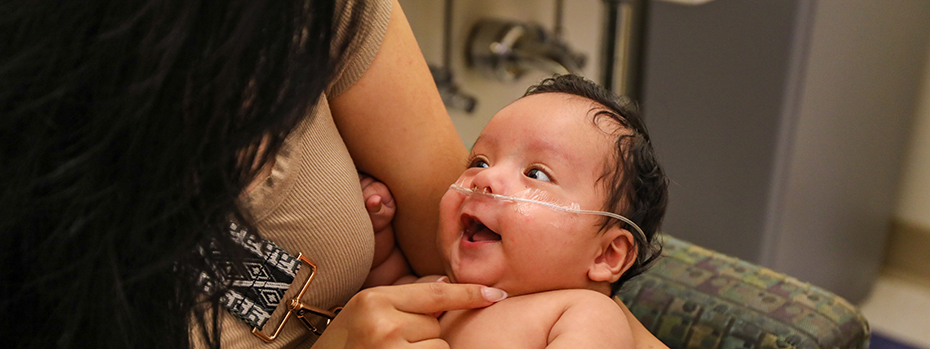
Spina bifida happens when a baby’s spine doesn’t close all the way in early pregnancy, leaving a gap. OHSU Doernbecher Children’s Hospital is among the few U.S. hospitals that can close the gap before a baby is born. At most other hospitals, the gap is closed two to three days after birth.
Our team did the first fetal surgery for spina bifida in the Pacific Northwest and north of Los Angeles. Doing surgery before birth doesn’t cure spina bifida. But doing surgery sooner can lessen spinal cord damage.
Research shows that many babies who have fetal surgery for spina bifida:
- Need less support to walk
- Score higher for mental development and muscle control
- Have less need for shunts to drain extra brain fluid
- Have an easier time with bladder and bowel control
At OHSU you’ll find:
- The Pacific Northwest’s only fetal care program that keeps you and your baby in one place throughout your care
- Oregon’s only spina bifida program for babies, children and teens
- A pediatric spine clinic that brings together experts in neurology, orthopaedics and other specialties
- Support and resources for your family’s travel, lodging and other needs
What to expect
Our team’s expertise includes:
- Maternal-fetal medicine
- Neonatology
- Prenatal screening and genetics
- Neurology and neurosurgery
- Pediatric surgery
- Fetal surgery
You and your baby will have a full evaluation that includes:
- Ultrasound: This scan uses sound waves to show images of your baby’s body.
- Fetal MRI: This scan shows detailed images of your baby’s brain and spine.
You’ll meet with a maternal-fetal medicine specialist and fetal surgeon. You may also meet with specialists in:
- Pediatric neurosurgery, for other repairs to your baby’s brain or spinal cord
- Pediatric neurology, for your baby’s brain, spinal cord or nerve care
- Neonatology, for care of newborns with complex conditions
- Pediatric cardiology, for your baby’s heart care
- Imaging, for detailed pictures of your baby’s body
- Social work, to connect you with resources your family may need
- Genetic counseling, for information, guidance and support about possible genetic conditions and your test options
This evaluation helps you and your care team better understand your baby’s condition. We'll talk with you about whether fetal surgery is the best option for you and your baby. In some cases, it makes more sense to wait until after your baby is born.
Understanding fetal surgery
We provide two types of fetal surgery:
- Fetoscopic repair: The surgeon makes tiny cuts for special instruments. These include a tube with a tiny camera called a fetoscope to guide the repair. The baby stays in the uterus.
- Open fetal surgery: The surgeon makes the same cut as for a cesarean section. The surgeon partly delivers the baby, makes the repair and puts the baby back.
Fetal surgery usually takes three to five hours. You’ll have general anesthesia, which is safe for the baby.
As with any surgery, fetal surgery has risks:
- The closure may not be complete, requiring more surgery.
- The baby’s spinal cord may be damaged.
- The sac holding the baby may break, leading to an early birth.
Your care team will talk with you about your options and risks. We’ll help you make the best decision for you and your baby.
Follow-up care
After your surgery, you’ll stay in the hospital for three to four days. When you go home, you’ll need to limit activity for two to four weeks.
You’ll have visits with your doctor and our team for the rest of your pregnancy. This includes:
- Ultrasounds every one to two weeks
- A fetal MRI four to six weeks after your surgery
We can help you plan for childbirth. You’ll have access to our Level IV neonatal intensive care unit. A Level IV NICU provides the most advanced care for newborns with complex needs.
After birth, your baby will get follow-up care from a team of specialists:
- A pediatrician, for general care
- A pediatric general surgeon, in case your baby needs surgery to help with digestion
- A pediatric neurosurgeon, for brain and spinal cord care
- A pediatric gastroenterologist, for digestive care
- A pediatric urologist, for kidney and bladder care
- Physical and occupational therapists, for muscle development
Resources
- Spina Bifida Program, OHSU Doernbecher Children’s Hospital
- Spina Bifida Association
- Spina Bifida, National Library of Medicine
For patients
- Appointments: Please ask your doctor for a referral.
- Questions: Call 503-418-4300.
Location
OHSU Center for Women’s Health
Kohler Pavilion, seventh floor
808 S.W. Campus Drive
Portland, OR 97239
Free parking for patients and visitors
Refer a patient
- Urgent referrals: 503-418-2843
- Nonurgent referrals: Fax our referral form to 503-346-8215.
- Call 503-494-4567 or email fetalcare@ohsu.edu to seek provider-to-provider advice.