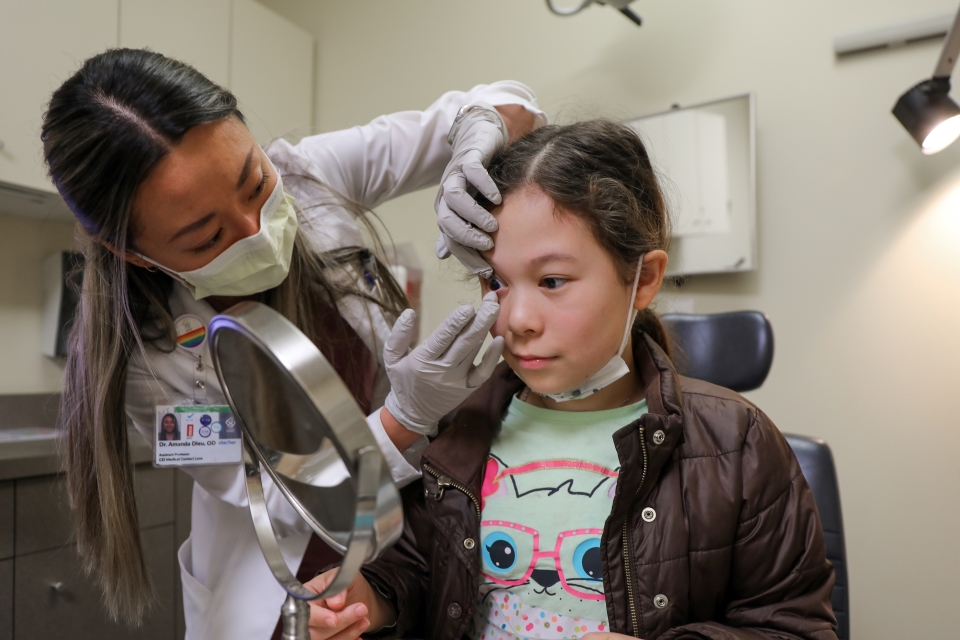
Comprehensive monitoring and treatment distinguish Casey’s pediatric myopia program
Myopia management treatments have become increasingly available in recent years. While these are not new, they are still not routine for many of the children who need them.
In the Elks Children’s Eye Clinic at Casey Eye Institute, this care is being expanded to more patients through one of the most comprehensive pediatric myopia management programs anywhere.
Led by Amanda Dieu, O.D., and Margaret Overstreet, O.D., both assistant professors of ophthalmology at Oregon Health & Science University, the program is distinguished by its use of systematic biometric monitoring and access to multiple evidence-based interventions in a single location. Drs. Dieu and Overstreet use specialized axial length measurement equipment, which is not available through most optometry practices, along with the full range of FDA-approved myopia control treatments to slow the progression of childhood nearsightedness.
Understanding the myopia epidemic
It is well known that myopia, or nearsightedness, occurs when the eyeball grows longer than normal, causing distant objects to appear blurry. It’s less well known that myopia is a rapidly escalating global health crisis. By 2050, projections indicate that half the world's population will have myopia. The rise in this common condition is driven by increased indoor time and screen exposure among children.
When the eyeball elongates excessively, it creates serious long-term health risks, including glaucoma, retinal detachment, and other vision-threatening conditions. Traditional treatment approaches have focused solely on correcting vision with stronger prescriptions each year without addressing the underlying progression.
Evidence-based interventions for myopia
In their clinic, Dieu and Overstreet use scientifically validated treatment modalities to slow myopia development. Low-dose atropine eye drops administered at bedtime slow eyeball growth through pharmacological intervention. MiSight daily disposable soft contact lenses utilize advanced optical design to provide clear vision while simultaneously preventing eyeball elongation. The Stellest lens is an FDA approved specialty glasses lens for slowing myopia progression. Finally, orthokeratology lenses worn overnight temporarily reshape the corneal surface to reduce myopia and prevent further myopic progression.
Clinical trials have demonstrated that these interventions could reduce myopia progression by approximately 50%. A child whose prescription might progress from -3 to -7 diopters could instead advance only to -5 diopters with treatment—a clinically significant difference that substantially reduces long-term vision complications
Comprehensive monitoring protocols
The treatment’s effectiveness is monitored objectively. "We measure every child's eyeball length every six months, using specialized equipment that most practices don't have," explains Dr. Dieu. "This lets us track whether our treatments are actually preventing the eye from growing too long, not just improving vision."
The clinic serves patients from across Oregon, Washington, and Idaho—regions where local providers typically lack access to this level of specialized pediatric myopia management.
Addressing barriers to pediatric eye care
The main barrier to comprehensive myopia treatment is financial rather than medical. MiSight contact lenses cost approximately $1,000 annually, while low-dose atropine eye drops cost $125 every few months. Most insurance plans classify these as preventive treatments and provide no coverage. This limits the availability of treatment to children whose parents can cover the extra cost. So in addition to providing these evidence-based treatments, Casey’s goal is to make them accessible to more children.
Previously, philanthropic support has enabled the clinic to provide no-cost care to families for whom treating childhood myopia is a financial hardship. The assistance addresses a critical gap in pediatric eye care access—as parents are well aware.
"The gratitude from families is immense. Parents understand they're not just getting help with glasses but helping protect their child from vision problems such as glaucoma or retinal detachment later in life," says Dieu.
Long-term outcomes and vision preservation
Many patients continue myopia management treatment through adolescence, then transition to standard contact lenses as young adults. This extended treatment period maintains refractive error within normal ranges and protects long-term ocular health.
"Myopia management in child eye care is not just helping patients right now, it's helping them 30 years from now. This treatment has a lifetime impact," says Overstreet.
As myopia rates continue to climb, the Casey Eye Institute program offers a model for shifting pediatric eye care from reactive to preventive.
With comprehensive monitoring and multiple treatment options available in one location, the clinic provides a resource for children across the Pacific Northwest who need specialized intervention. For providers, knowing where to refer patients who would benefit from early myopia management can mean the chance to make a major difference in a child’s long-term eye health.