Research and Scholarship
At the Department of Family Medicine, our research focuses on understanding and transforming health care through innovation. To accomplish this, the research section nurtures collaboration and uses quantitative, qualitative, and mixed methods in advanced ways to conduct research that informs and is informed by primary care practice.
Our research section is comprised of 14 research faculty and over 30 staff. In FY25, we had over $11.4 million in federal (NIH, AHRQ, CDC, etc.) and foundation (American Cancer Society, etc.) research funding.
News
- Leaders in Latino Health respond to the current moment
- Oregon Academy of Family Physicians From the Hill Update: The AGING Initiative: Building a Leading Resource for Aging Research at OHSU
- A Framework for Evaluating Primary Care Investment
- Family Medicine Faculty Co-Edit book Primary Care in a Public Health Emergency: Lessons from the Front Lines of the COVID-19 Pandemic
Read more news.
Research Faculty Profile
Summer/Fall 2026
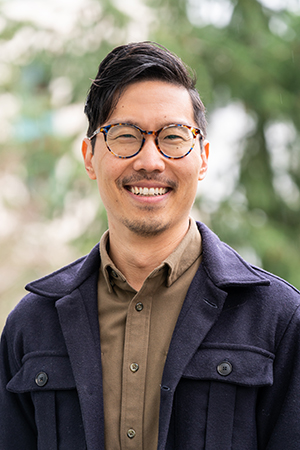
Research Profile: Brian Park, M.D., M.P.H.
My research begins with a health justice question: how do we change not just what health systems do, but who has the power to shape them?
That question has been a throughline in my work as a family physician, public health researcher, director of RELATE Lab, and community health justice leader in OHSU’s Health Equity Organization. I study and help build the relational, institutional, and community-led infrastructure that allows health systems to move from naming inequity to sharing power, repairing harm, and changing practice.
RELATE Lab is the main research home for this work. We take the “Lab” part seriously—just not in the way people might first imagine. For us, a lab is less a physical place than a stance: curiosity over certainty, learning over proving, and a willingness to try, study, adapt—and try again. I think of it as a hub for community partnership, organizing, and applied research in health justice, where scholarship, leadership development, community organizing, and systems change come together. We try to think in systems and act in relationships: understanding the structures that shape health while building the trust, courage, and shared power needed to change them.
Our research uses community-based participatory approaches, mixed methods, and evaluation to study relational leadership, community power, belonging, psychological safety, and co-creation. That includes surveys, interviews, outcomes, and publications, but also patient and community leadership teams, story-based organizing, conflict, and repair. Health systems will not become more equitable by producing more evidence alone; they must build the capacity to act differently on what they know.
Through the Relational Leadership Institute, we train clinicians, staff, and leaders in relational and equity-centered skills: listening, naming power, building belonging, navigating conflict, repairing harm, and moving from shared values to shared action. The institute has trained hundreds of participants, with evaluations showing statistically significant improvements in well-being and sense of community, and has expanded beyond OHSU to the University of North Carolina and the University of Utah.
Through Health Equity and Leadership (HEAL), we work with patient and community leaders not as advisors at the margins, but as people shaping priorities and policy agendas. To me, community engagement is not simply about bringing community voice into institutional decisions; it is about changing who gets to make them.
And now, through RISE, supported by the Robert Wood Johnson Foundation, we are deliberately working in the space between healthcare institutions and communities—asking what relationships, skills, structures, resources, and forms of accountability make it possible to move beyond episodic consultation toward shared leadership and durable systems change. In many ways, RISE brings together the two sides of RELATE’s work: building relational capacity within healthcare, while also building power with and from communities.
In OHSU’s Health Equity Organization, I also help lead Place-Based Health, which brings health services, prevention, and community health work into culturally affirming spaces. These efforts center people, place, and power by recognizing community members as experts, honoring neighborhood and cultural contexts, and co-creating programs with people too often excluded from institutional decision-making.
My path into this work is shaped by story. I am a child of Korean immigrants, a former aspiring filmmaker, and a family physician who came into medicine through questions of language, belonging, dignity, and power. Before medicine, I studied psychology and film, which taught me to pay attention to perspective: who gets to tell the story, whose voice is centered, and what is left outside the frame. Family Medicine gave me a home because it refused to separate the person from the family, the family from the community, and any of them from the systems and policies shaping their lives.
Some of the work I value most is helping move community voice into community power. That includes HEAL’s role in advancing a $67 million city investment in affordable housing, supporting a statewide medication label translation law, and co-creating the Re-Entry Healing Clinic, Oregon’s first primary care home designed with and for people returning from incarceration. Across this work, I have helped secure more than $8 million to support relational leadership, community partnership, organizing, and health equity. But the metrics are only part of the story. What stays with me are moments when a patient leader realizes they are not there to be inspirational, but influential; when a clinician sees community engagement as accountability; when a team discovers that repair is not a detour from the work, but the work itself.
What keeps me at OHSU Family Medicine is that this department understands primary care as a place where fractures show up early, and repair begins. It is one of the few academic homes where leadership, organizing, policy, belonging, and clinical care can be understood as parts of the same health justice project.
In the next 5-10 years, I hope our field becomes less satisfied with documenting inequity and more committed to changing who has the power to define, design, and govern health care. I hope RELATE Lab continues to grow as a bridging institution, helping health systems, community organizations, patients, and leaders build relationships and shared practices that move from analysis to action. I hope leadership development moves toward collective capacity, community engagement moves beyond consultation toward shared governance, and research asks not only “What works?” but “Who decided what counts as working, who benefits, and who has the authority to change it?”
I have come to think that love and justice need each other. Love without justice can become niceness; justice without relationship can become abstraction. If one thread connects my work, it is this: I want health systems to become more capable of love as a practice of justice—love expressed not through sentimentality, niceness, or avoidance, but through accountability, shared power, repair, and material change. To me, the aspiration is not simply to depend on remarkable individuals to bring love into institutions despite how they are designed; it is to make dignity, belonging, accountability, and shared power central to the design itself. Family Medicine has always been at its best when it refuses to accept the world as it is and insists on practicing toward the world as it could be.
Visit RELATE Lab to learn more!