About the PA Program at OHSU
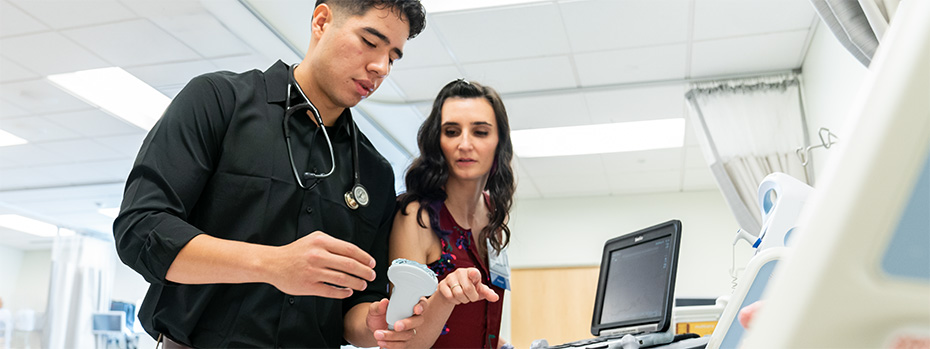
The OHSU PA program prepares physician associates through high-quality education. This page provides information about our program, including mission, goals, outcomes and competencies.
On this page:
Program background
Founded in 1995, the OHSU PA program prepares physician associates to deliver primary care in medically underserved communities. Our first class graduated in 1997, and we became a division of the School of Medicine in 2001.
Our 26-month, full-time program leads to a Master of Physician Associate Studies. The curriculum includes 12 months of didactic coursework and 14 months of clinical training. We enroll 60 students each year, with classes starting in June.
Mission
The OHSU Physician Associate Program serves as a model of excellence in PA education. We prepare you to provide patient-centered, evidence-based and culturally appropriate healthcare to diverse populations. We promote lifelong learning, leadership and service.
Program goals
Goal 1
Admit students from varied backgrounds and experiences to enhance and diversify the physician associate workforce.
-
Benchmarks and performance
The U.S. population is growing more diverse, but gaps in healthcare representation persist. The OHSU PA program strengthens and diversifies the healthcare workforce through a holistic admissions process that considers each applicant as a whole person. We weigh experiences, perspectives, academic achievement and potential to serve patients and communities alongside academics. Students with varied backgrounds and skills strengthen learning and drive creativity, innovation and high-quality patient care.
Benchmark: At least 50% of students in each cohort will come from a diverse background.
Diversity definitions
The PA program considers many aspects of diversity, including educational, environmental and economic disadvantage and students from underrepresented racial or ethnic groups. The program defines these terms as follows:
Disadvantaged: An individual who has experienced significant economic, cultural, educational or family adversity.
Underrepresented racial or ethnic groups:
- Hispanic or Latino, any race (except Spanish from Spain or Portuguese from Portugal)
- American Indian or Alaska Native
- Black or African American
- Native Hawaiian or other Pacific Islander
From a rural area: A student who spent most childhood years in a frontier area or rural town. A rural town has 40,000 people or fewer and sits at least 10 miles from a city of that size or larger.
First-generation college student: Neither parent completed a four-year college or university degree.
Percent (%) of each cohort meeting definition for each demographic Cohort Contributes to diversity Disadvantaged background Underrepresented racial or ethnic group First-generation college student From a rural area Benchmark met/not me Class of 2028 78% 76% 30% 46% 28% Met Class of 2027 74% 69% 31% 50% 38% Met Class of 2026 85% 78% 37% 63% 46% Met Class of 2025 71% 56% 34% 34% 32% Met Class of 2024 56% 34% 31% 25% 6%* Met Class of 2023 57% 40% 40% 27% 3%* Met *Includes students from an isolated rural area only. The definition for rural environment was broadened to include towns < 40,000 and at least 10 miles from a community of that size or larger beginning with the class of 2025.
Goal 2
Prepare graduates to enter clinical practice with the knowledge and skills to be competent PAs.
-
Benchmarks and performance
Our academically rigorous, integrated curriculum uses varied teaching methods, learning approaches and clinical experiences to prepare graduates to meet physician associate competencies and accreditation standards.
Benchmark 1: At least 90% of each cohort will score at the satisfactory or advanced level on the PAEA End-of-Curriculum (EOC) exam.
The EOC exam is an objective, standardized, comprehensive multiple-choice test that measures a PA student's medical knowledge as one component of graduation readiness. Scores range from 1,200 to 1,800 and fall into three performance levels:
- Limited: below 1,400
- Satisfactory: 1,400-1,554
- Advanced: 1,555-1,800
We began administering the EOC exam in 2023.
Cohort Satisfactory or advanced medical knowledge Benchmark met/not met Class of 2024 100% Met Class of 2023 100% Met Benchmark 2: 100% of students in each cohort will achieve satisfactory scores in clinical reasoning on preceptor evaluations.
Clinical reasoning is the student's ability to:
- Formulate a most likely diagnosis based on an appropriate history, physical exam and diagnostic workup for a variety of acute, chronic and emergent conditions across the lifespan.
- Recommend appropriate laboratory and diagnostic studies based on the chief complaint, history and physical exam across the lifespan.
- Determine appropriate interventions and a management plan, including pharmacologic, non-pharmacologic and health screening recommendations, based on the history, physical exam and diagnostic workup.
Students complete 11 rotations during the clinical year. A score of 80% or higher is satisfactory.
Cohort Satisfactory scores in clinical reasoning skills Mean preceptor score Benchmark met/not met Class of 2024 100% 87.1% Met Class of 2023 100% 87.1% Met Class of 2022 100% 89.2% Met Class of 2021 100% 86.8% Met Class of 2020 100% 90.2% Met Benchmark 3: Students will, on average, agree or strongly agree that the curriculum prepared them for clinical practice, based on the end-of-program survey.
Beginning with the class of 2023, students rate the following statement at program completion: "Overall, the program's curriculum was effective in preparing me for clinical practice."
Students respond using this scale:
- 1 = Strongly disagree
- 2 = Disagree
- 3 = Neutral
- 4 = Agree
- 5 = Strongly agree
Cohort Mean rating Benchmark met/not met Class of 2024 4.4 Met Class of 2023 4.2 Met
Goal 3
Prepare graduates to provide patient-centered, culturally responsive care to diverse and underserved communities.
-
Benchmarks and performance
The curriculum builds students' understanding of how social determinants of health, health inequities, personal biases, racism, language barriers and health literacy affect care quality. Students engage in instructional and experiential activities to strengthen their ability to deliver effective, quality care to patients with diverse beliefs, attitudes, values and backgrounds. Students also gain insight into the complexities and rewards of working with rural and medically underserved communities.
Benchmark 1: For each cohort, at least 20% of patient encounters during the clinical year — 1 in 5 — will occur with rural and/or medically underserved patients.
During the clinical phase, students track each patient encounter and note whether the patient is from a rural or medically underserved area. Medically underserved includes both rural and urban areas.
Cohort year Mean percentage of rural patient encounters Mean percentage of medically underserved patient encounters Benchmark met/not met Class of 2024 23% 23% Met Class of 2023 27% 27% Met Class of 2022 29% 27% Met Class of 2021 40% 32% Met Benchmark 2: At least of 20% of students in each cohort will complete the AHEC Scholars program.
The AHEC Scholars program is a two-year certificate program that prepares students for practice in rural and urban underserved communities through coursework and clinical experiences. Students apply and are selected to participate.
This benchmark reflects the PA program's historically strong participation in AHEC Scholars.
Cohort Percent (%) of students who complete AHEC Scholars program Benchmark met/not met Class of 2024 31% Met Class of 2023 30% Met Class of 2022 30% Met Class of 2021 36% Met Class of 2020 26% Met Benchmark 3: All second year (clinical) students will earn passing scores on preceptor evaluations on their ability to provide patient-centered care.
Clinical preceptors assess student performance in patient-centered care through end-of-rotation evaluations during primary care rotations. The program updated the evaluation in 2024 to refine the question while maintaining the same purpose. Results are presented in two tables reflecting the original and updated evaluation.2020-2023 evaluations
The student demonstrated sensitivity and awareness regarding patients' culture, age, gender, abilities and care preferences.
Cohort Agree Benchmark Met/Not Met Class of 2023 100% Met Class of 2022 100% Met Class of 2021 100% Met Class of 2020 100% Met 2024-present evaluations
The student's ability to deliver accurate patient education to the patient, their family/friends and care team, centering shared decision-making, disease prevention, health awareness and equitable access to care, meets or exceeds expectations.
Cohort Percent (%) of students who meet or exceed expectations on preceptor evaluations Benchmark met/not met Class of 2024 100% Met The student identifies the impact of structural factors, social justice and equity on community health outcomes.
Cohort Percent (%) of students who meet or exceed expectations on preceptor evaluations Benchmark met/not met Class of 2024 100% Met
Accreditation status
The Accreditation Review Commission on Education for the Physician Assistant, Inc. (ARC-PA) has granted Accreditation-Continued status to the Oregon Health & Science University Physician Associate Program sponsored by Oregon Health & Science University. This status indicates that the program complies with ARC-PA Standards.
Accreditation remains in effect unless the program closes, withdraws from the accreditation process or fails to comply with the Standards, which could result in withdrawal of accreditation. ARC-PA plans the next validation review for October 2035, contingent on the program’s continued compliance with Accreditation Standards and ARC-PA policy.
PANCE board certification exam performance
To earn physician associate certification, you must pass the Physician Assistant National Certifying Exam. The National Commission on Certification of Physician Assistants administers the PANCE and serves as the only certifying body for physician associates in the United States.
Over the past five years, first-time test takers from the OHSU PA program achieved a 97.3% average pass rate on the PANCE.

Student graduation rate
98.7% of students graduated from OHSU’s physician associate program from 1995 to 2026.
| Graduated classes | Class of 2024 | Class of 2025 | Class of 2026 |
|---|---|---|---|
| Maximum entering class size (as approved by ARC-PA) | 42 | 42 | 42 |
| Entering class size | 32 | 42 | 42 |
| Graduates | 32 | 41 | 39 |
| *Attrition rate | 0 | 2.4 | 7.1 |
| **Graduation rate | 100 | 97.6 | 97.9 |
Entering class size: Number of students newly enrolled for the admission cycle plus number of students who are reentering from a different cohort.
Note: In response to the challenges of COVID-19, Oregon Health & Science University made the decision to reduce the class size for the cohorts of 2023 and 2024. The university maintained full staffing, support and services.
*Attrition rate calculation: Number of students who attritted from cohort divided by the entering class size. The number of students from the entering class who did not complete the program with the rest of the cohort, due to leave of absence, deceleration, dismissal or withdrawal.
**Graduation rate: Number of cohort graduates divided by the entering class size
Program competencies
Upon completion of the Physician Associate program, graduates will demonstrate competence in each of the following domains.
Medical knowledge (MK):
- Apply foundational medical, surgical, social and behavioral knowledge to a variety of acute, chronic and emergent medical conditions across the lifespan. (MK 1)
- Locate, appraise and integrate information from evidence-based studies to make informed decisions about patient care. (MK 2)
Clinical reasoning and problem-solving abilities (CRPSA):
- Formulate a most likely diagnosis based on an appropriate history, physical examination and diagnostic workup for a variety of acute, chronic and emergent medical conditions for patients across the lifespan. (CRPSA 1)
- Recommend appropriate laboratory and diagnostic studies relevant to the chief complaint, history and physical exam for patients across the lifespan. (CRPSA 2)
- Relevant to the history, physical examination and diagnostic workup, determine the appropriate interventions and management plan, including pharmacologic, non-pharmacologic and health screening recommendations. (CRPSA 3)
Clinical and technical skills (CTS):
- Conduct comprehensive and focused physical and behavioral health histories and examinations appropriate to the patient presentation in a patient-centered fashion. (CTS 1)
- Generate comprehensive and focused oral presentations and written documentation, accurately portraying the history, exam findings and proposed plan of care. (CTS 2)
- Demonstrate the ability to perform basic common medical and surgical procedures and clinical skills essential for entry into PA practice, including but not limited to: local anesthetic administration; superficial wound closure (e.g., simple suturing, adhesive use, stapling); incision and drainage of abscess; superficial skin biopsy; large joint injection; Papanicolaou smear; and interpretation of diagnostic tests and imaging (e.g., plain film x-rays and EKGs). (CTS 3)
Interpersonal skills (IS):
- Demonstrate interpersonal and communication skills that result in effective patient education and intentionally collaborate with members of the healthcare team. (IS 1)
- Center shared decision making with patients that considers disease prevention, health awareness and equitable access to care. (IS 2)
Professional behavior (PB):
- Demonstrate accountability and integrity in actions and decision making, and a commitment to lifelong learning. (PB 1)
- Identify the impact of structural factors, social justice, and equity on community health outcomes. (PB 2)
Class profiles
Students accepted into the OHSU PA program come from a wide range of academic and professional backgrounds.
The program attracts applicants from across the United States. Entering students bring healthcare experience from many settings, including work as EMTs, paramedics, certified nursing assistants, medical assistants, phlebotomists, scribes and naturopaths.
We welcome students from all undergraduate majors. While many enter with degrees in biology, psychology or general science, others hold degrees in humanities or social sciences and complete science prerequisites through postbaccalaureate coursework.
The table below shows data from the most recent entering classes.
| Category | 2021 | 2022 | 2023 | 2024 | 2025 |
|---|---|---|---|---|---|
| Applicants | 1,396 | 1,184 | 1,322 | 1,313 | 1,453 |
| Interviews | 144 | 136 | 175 | 153 | 148 |
| Class size | 30 | 32 | 42 | 42 | 42 |
| Average cumulative undergraduate GPA | 3.53 | 3.54 | 3.52 | 3.66 | 3.48 |
| Average BCP GPA | 3.4 | 3.46 | 3.48 | 3.56 | 3.48 |
| Average patient care hours | 4,273 | 4,222 | 5,550 | 4,483 | 4,511 |
| Average healthcare related hours | 2,500 | 1,742 | 2,372 | 1,302 | 2,210 |
| Average age | 27 | 26 | 27 | 25 | 26 |
| OR resident | 50% | 38% | 31% | 38% | 40% |
| Non-OR resident | 50% | 62% | 69% | 62% | 60% |
Scholarships available
OHSU offers a variety of scholarships that can help fund your education.
Admissions requirements
Discover what you need to apply, including prerequisites, patient care experience and application deadlines.
Become a PA preceptor
Are you a practicing clinician? Help train future PAs and earn continuing education credits.
Contact us
- Email: paprgm@ohsu.edu
- Call: 503-494-3633