MS in Healthcare Administration (MSHA) Degree Requirements
What You Will Learn in the MSHA Program
The MS in Healthcare Administration (MSHA) at Oregon Health & Science University is a fully online graduate program designed to prepare professionals for leadership roles in health care operations and management.
The program consists of 54 graduate credits completed over 21 months through a structured cohort model.
Courses are taught by faculty with deep experience in health care administration, clinical leadership, finance, and health systems management, bringing real-world perspective to every course.
Throughout the program, you will build expertise in:
- health care systems and policy
- operational improvement and quality management
- financial decision-making
- leadership and organizational management
- strategic planning and communication
Students conclude the program with a capstone consulting project, applying their skills to a real challenge facing a health care organization.
Program Snapshot
- 54 graduate credits
- 21-month program (6 terms)
- Fully online format
- Cohort learning model
- Capstone consulting project
Program Structure
The OHSU MSHA follows a cohort-based, lockstep curriculum. Students move through the program together and complete the same sequence of courses each term.
Students enroll in 9 graduate credits per term, allowing them to complete the program in six academic terms (21 months).
From a financial aid perspective, 9 credits per term qualifies as full-time enrollment.
| Term | Courses | Total Credits |
|---|---|---|
| Fall (Year 1) | MGT 560: Health Systems & MGT: 565 Leadership Skills for Healthcare | 9 |
| Winter (Year 1) | MGT 592: Strategic Communications & MGT 570: Operations and Quality Management | 9 |
| Spring (Year 1) | MGT 520: Organizational Mindsets for Managers & MGT 561: Finance Reporting | 9 |
| Fall (Year 2) | MGT 519: Program Management & MGT 572: Financial Management | 9 |
| Winter (Year 2) | MGT 564: Strategic Planning in Healthcare & MGT 578: Managerial Decision Making | 9 |
| Spring (Year 2) | MGT 522: Influencing Change in Organizations & MGT 554: Capstone Consulting Project | 9 |
Capstone Consulting Experience
The MSHA program concludes with a Capstone Consulting Project, where student teams partner with a health care organization to analyze a real operational or strategic challenge.
Working with a faculty mentor and organizational sponsor, students conduct research, analyze data, and develop evidence-informed recommendations to support decision-making.
Since the program began, MSHA students have completed 150+ consulting projects supporting hospitals, health systems, nonprofit organizations, and community partners.
Examples of recent MSHA capstone work include:
- Improving discharge planning and housing support for patients experiencing homelessness
- Expanding addiction recovery support services through nonprofit partnerships
- Improving maternal and infant health outcomes in Malawi
- Evaluating transportation barriers affecting patient care access
Beginning in 2022, students submit project abstracts to the OHSU Library.
You can explore these projects in the Capstone Abstract Collection in Healthcare Administration and Management.
MSHA Program Learning Goals and Competencies
The MSHA curriculum is designed to help you develop the knowledge and leadership capabilities needed to improve health care systems and organizations. As a competency-based program, the MSHA curriculum helps students develop and demonstrate the knowledge, skills and behaviors needed for effective leadership in health care organizations.
Competency areas of the MSHA program are:
- Communication: Communicate with clarity and brevity, tailoring messages to diverse audiences, stakeholders and organizational settings.
- Leadership and Management: Lead and manage people, teams and organizations while demonstrating professionalism, ethical behavior and self-awareness.
- Systems Thinking: Analyze the complex health care environment across clinical, operational, financial and policy domains to identify opportunities for improvement.
- Analysis and Decision Making: Apply analytic frameworks and evidence-informed approaches to address complex challenges and support organizational decision making.
Throughout the program, students also develop competencies in teamwork, information literacy, community engagement, social justice and equity, professional identity and ethical behavior, and professional knowledge and skills.
The MSHA competency model provides the foundation for the curriculum. Through coursework, experiential learning and assessment, students develop and demonstrate competencies that prepare them for leadership roles across the healthcare sector.
Learn more about the MSHA competency model and program learning goals below.
-
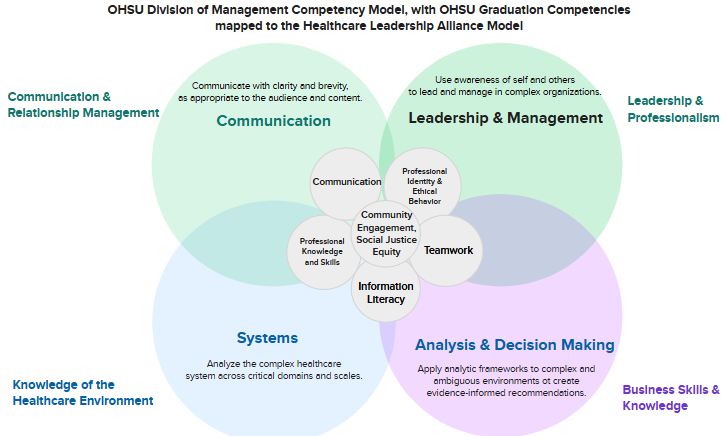
The competency model illustrates how these core domains and supporting competencies are integrated throughout the curriculum. Courses, assignments and assessments are designed to help students build and demonstrate proficiency in these areas as they prepare for leadership roles in healthcare organizations. -
Learning Goal 1 – Systems
Analyze the complex healthcare system across critical domains and scales.
- Evaluate relevant stakeholders in the US healthcare system.
- Analyze risks and benefits of proposed solutions across a health system.
- Propose solutions to address inequities.
- Assess the impact of healthcare policy on operations.
Learning Goal 2 – Analysis & Decision Making
Apply analytic frameworks to complex and ambiguous environments to create evidence-informed recommendations.
- Compose actionable problem or need statement.
- Incorporate social and economic factors into decisions.
- Formulate actionable, evidence-informed recommendations.
- Render a financial decision to a business question.
Learning Goal 3 – Leadership & Management
Use awareness of self and others to lead and manage in complex organizations.
- Analyze roles, perspectives and agendas of self and others.
- Integrate multiple perspectives to more fully analyze an organizational situation.
- Propose plans for ethical action based on values.
Learning Goal 4 – Communication
Communicate with clarity and brevity, as appropriate to the audience and content.
- Compose a written message that is clear, concise, logical, and relevant to the situation.
- Deliver a spoken message that is clear, concise, logical, and appropriate to the audience.
- Provide evidence using appropriate citations.
- Create visuals that support the communication.
Explore the MSHA Curriculum
The MSHA program includes 12 required courses totaling 54 credits.
Courses are designed to build knowledge progressively across health care systems, leadership, financial management, and strategy.
Interested in the MSHA Program?
Schedule an advising appointment or request information to learn how the MS in Healthcare Administration can help you build leadership skills in health care operations.