Total Worker Health® Courses

Total Worker Health® is defined as policies, programs, and practices that integrate protection from work-related safety and health hazards with the promotion of injury and illness prevention efforts to advance worker health and well-being. Because the Total Worker Health (TWH) approach is not one size fits all, we offer various levels of training for a diverse audience and its needs.
Total Worker Health® is a registered trademark of the U.S. Department of Health and Human Services (HHS). Participation by the Oregon Institute of Occupational Health Sciences does not imply endorsement by HHS, the Centers for Disease Control and Prevention, or the National Institute for Occupational Safety and Health.
Total Worker Health® Alliance Curriculum
A series of Total Worker Health-focused courses designed to meet the standards of the National Institute for Occupational Safety and Health’s Total Worker Health approach and features.
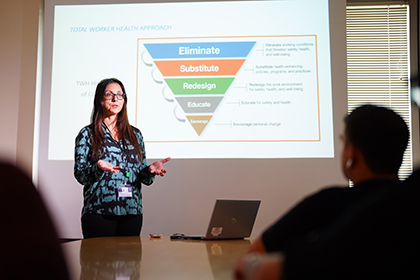
Total Worker Health® Professional Certificate
This professional certificate program is hosted by the University of Washington (UW), Northwest Center for Occupational Health and Safety, in close collaboration with the Oregon Healthy Workforce Center, the UW Pacific Northwest OSHA continuing education program, and Portland State University’s Industrial/Occupational Health Psychology and Total Worker Health programs.
The certificate program is designed to equip working professionals with a deep and practical understanding of the Total Worker Health approach. Participants who complete the program will acquire competency to begin implementing Total Worker Health concepts and principles within organizations. The program provides information on the key determinants of physical and psychological health encountered at work and the knowledge to foster systems changes to address these determinants from an organizational level by building effective interdisciplinary workplace teams and more integrated and evidence-informed solutions.
To obtain this professional certificate, participants need to complete a 26-hour virtual course in Total Worker Health® : Advancing Worker Well-being in the Workplace, plus other related courses in safety and health management, supervisory duties, leadership development, ergonomics, root cause analysis, and industrial hygiene.

Upcoming Total Worker Health® courses and meetings
Total Worker Health®: Advancing well-being in the workplace
This 26- hour course involves completing 10 hours of virtual instructor-led class time and 16 hours of self-paced e-learning over 6 weeks. Enrolled participants are required to follow the sequence of the self-paced modules using Canvas Learning Management System and to attend three pre-scheduled virtual instructor-led sessions using Zoom Video Conference format. Class sizes are small to allow unique attention to each participant's needs and one-on-one interaction with the instructors (maximum 20 students). No prior knowledge of Total Worker Health is required, but enrolled students should be familiar with the field of occupational health and safety. This course is offered twice a year: in the Spring and the Fall.
This course serves as the key required course for individuals enrolling in the joint UW DEOHS CE/OHWC Total Worker Health Certificate Program. Individuals not seeking the Certificate may enroll and attend the course as a standalone.

Have questions? Contact:
Katia Costa-Black, Ph.D.
Senior Manager for Education and Partnerships
Oregon Institute of Occupational Health Sciences
Email: costabla@ohsu.edu
Learn more about our work

Newsletter
Explore professional development opportunities, the latest updates from the Institute, Oregon Healthy Workforce Center and Occupational Public Health Program, a research snapshot, and upcoming occupational health-focused events.

Blog
The Oregon and the Workplace Blog features the latest OccHealthSci research, professional development opportunities, and valuable insights from disciplines associated with occupational health, safety, and well-being.

Podcast
The What's Work Got to Do with It podcast, produced by OccHealthSci, brings together occupational health, safety, and well-being experts to discuss the latest topics relating to worker health, well-being, and safety in Oregon and beyond.