Homer Lab: Coccidioides Fungal Pathogenesis
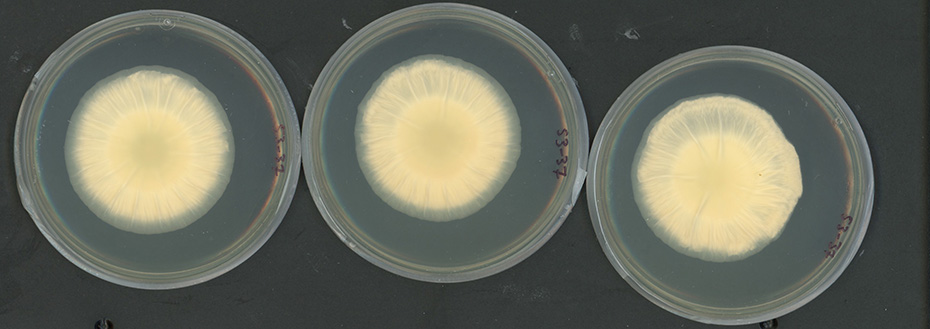
In the Homer Lab, we study the biology and pathogenesis of fungal pathogens. People are constantly exposed to fungi since they are everywhere in the environment, and rates of fungal infections are climbing. Fungi are eukaryotes, like humans, so it’s very challenging to kill fungal pathogens without harming patients. Antifungal treatments have many side effects and fungal infections cause high mortality.
We focus on the fungus Coccidioides, which causes the infection called valley fever, or coccidioidomycosis. Coccidioides can infect people with normal and compromised immune systems.
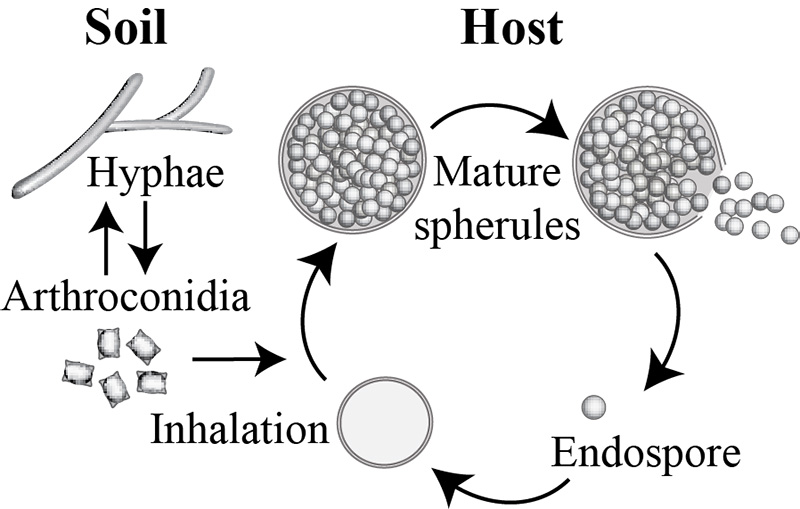
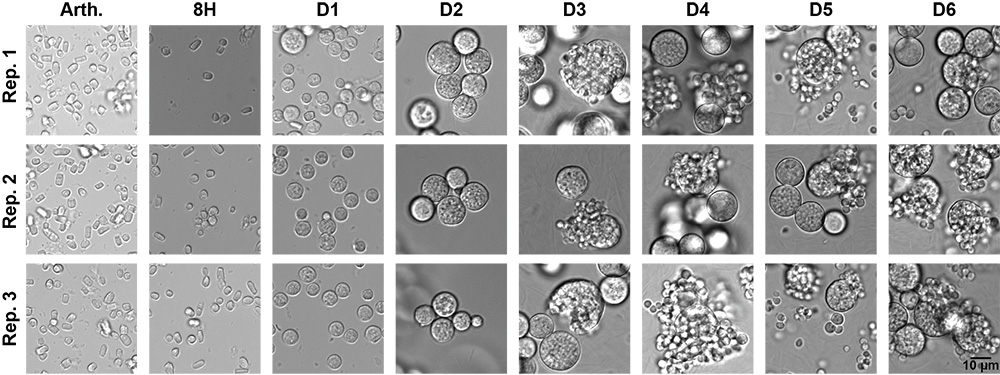
Coccidioides is a major fungal pathogen that causes high mortality and morbidity. Despite this, there are few treatments for valley fever. This is because Coccidioides grows as a unique form in its hosts called the spherule. Since no other known organism makes spherules, most spherule biology remains unknown.
Our goal is to leverage the power of genetics, biochemistry, and genomics to understand the biology of the spherule and uncover drug targets, so we can develop better treatments for patients infected with valley fever.
You can:
Research projects
The Homer Lab’s projects aim to uncover information about Coccidioides biology and host-pathogen interactions that could lead to new treatments for valley fever.
Coccidioides Life Cycle
Characterizing the role of secreted proteases in spherule development
We study two secreted protease families encoded by the Coccidioides genome that we hypothesize are important for virulence. Protease inhibitors are excellent treatments for other infections and diseases, but their promise has not yet been applied to fungal infections.
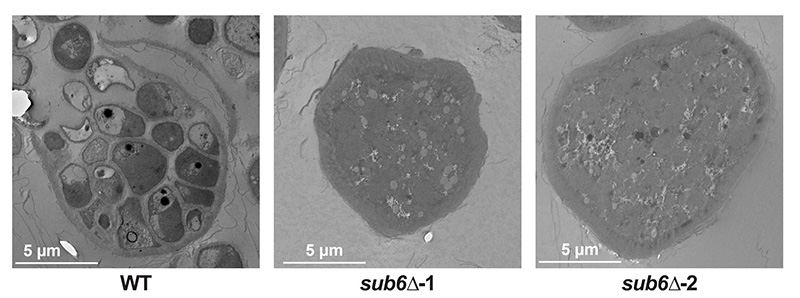
We seek to develop a protease inhibitor to treat valley fever. We use CRISPR/Cas9 to delete each protease from the genome and use the resulting protease mutants to determine the role of the protease in spherule development and virulence. For proteases that play key roles in Coccidioides biology, we determine the substrate of that protease by performing in vitro experiments with recombinant proteases.
These findings will be a critical foundation for developing therapeutic protease inhibitors, in collaboration with experts in drug design.
Discover novel secreted virulence factors in Coccidioides
We systematically profile the secreted effectors Coccidioides uses during infection.
Many plant fungal pathogens use a suite of secreted effector proteins to manipulate the host during infection. Bioinformatic analysis shows that human fungal pathogens like Coccidioides have similar secreted effectors. We use genetics to create a collection of deletion mutants, each lacking individual secreted proteins, and perform high-throughput screens to determine which secreted factors are required for virulence.
This will uncover new aspects of host-pathogen interactions and reveal additional candidate drug targets. We will study these discoveries in greater detail in future projects.
Publications
The Homer Lab builds on the foundation of Dr. Homer’s Coccidioides research during her postdoctoral fellowship. Find more publications by Dr. Homer.
Transcriptomic atlas throughout Coccidioides development reveals key phase-enriched transcripts of this important fungal pathogen
PLOS Biology 2025
Homer CM, Voorhies M, Walcott K, Ochoa E, Sil A
Optimizing in vitro spherulation cues in the fungal pathogen Coccidioides
mSphere 2025
Homer CM, Ochoa E, Voorhies M, Sil A
Meet our team
The Homer Lab is led by Dr. Christina Homer, an expert in fungi like Coccidioides and Cryptococcus neoformans.
Scientists in the Homer Lab work together to uncover the mysteries of fungal infection, while sharing their passions and hobbies outside the lab. We welcome people from diverse backgrounds and lived experiences and offer an inclusive work environment.
-
-
Appointments and titles
- Assistant Professor of Medicine, Division of Infectious Diseases, School of Medicine
- Assistant Professor of Molecular Microbiology and Immunology, School of Medicine
-
Areas of interest
- Coccidioides pathogenesis
- Cryptococcal pathogenesis
- Endemic fungi
- Fungal infections in immunocompromised hosts
- Antifungal drug development
- Antifungal drug resistance
- Fungal infection diagnostics and treatment
-
Gabriela Rios-Sotelo, Senior Research Assistant
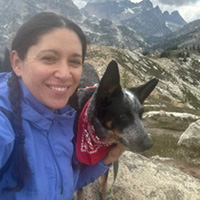
Research interests: Infectious disease, host–pathogen interactions, immunology, molecular biology, wildlife disease and translational biomedical research.
Outside of lab I enjoy: Hiking, camping, exploring the outdoors, spending time with my dog, traveling and thrift shopping.
Favorite microorganism: Pseudogymnoascus destructans, the fungus that causes white-nose syndrome in bats.
Elaine Ballinger McIntyre, Assistant Staff Scientist
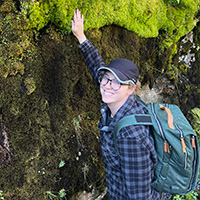
Research interests: Antimicrobial drug discovery and more generally, translational medicine.
Outside of lab I enjoy: Spending time outside, cooking and knitting!
Favorite microorganism: the streptomyces genus as a whole. I'm a big fan of their secondary metabolites for medicine (antibiotics!) and everyday life (geosmin!)
Contact us
Mailing address
Homer Lab
3181 SW Sam Jackson Park Rd.
Portland, OR 97239
Mail code: L220-RJH 6564
Join us
We are recruiting collaborative and rigorous:
- Graduate students
- Postdoctoral fellows
- Part-time research associates to develop bioinformatic pipelines (open to undergraduate students)
If you are interested, email homerc@ohsu.edu. Please include:
- CV
- Specific scientific interests
- Why you are interested in joining our lab