Hybridoma Generation
Phase 1. Immunization and Serum Testing
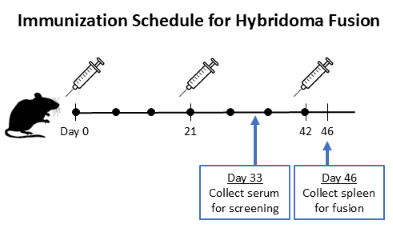
3 Balb/c mice are injected with selected antigen at 0 and 21 days. On day 33, serum is collected and tested for antibody titer by selected assay. The mice with highest titers are used to derive hybridomas.
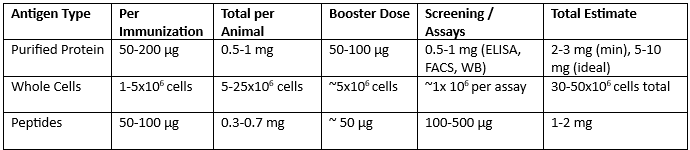
Antigen types:
- Purified Protein Antigen
- Whole Cells (Live or Fixed)
- Synthetic Peptide Antigen
General Notes:
- All immunogens should be endotoxin-free and highly pure.
- Peptides must be conjugated to a carrier molecule (e.g., to KLH) to be immunogenic.
- Appropriate adjuvants (e.g., Alum or CPG) will be used to enhance the immune response.
- Cell-based immunization is ideal for membrane proteins or native conformation targets.
- Screening requires both target and negative control samples.
-
- For complex targets or highly homologous antigens (e.g., self-antigens, tissue-specific isoforms, or tumor-specific markers), subtractive immunization may be employed.
- This method involves pre-tolerizing the mouse to non-target antigens (e.g., normal tissue or cell lines) prior to immunization with the desired target antigen (e.g., diseased or transformed tissue)
Benefits of Subtractive Immunization:
- Enhances specificity by reducing the immune response to shared or background antigens.
- Improves success in generating monoclonal antibodies against:
- Rare epitopes
- Disease-specific antigens
- Minor variants (e.g., isoforms, mutations)
- Reduces downstream screening workload, as fewer irrelevant or cross-reactive clones are produced.
Phase 2. Fusion and Hybridoma Screening
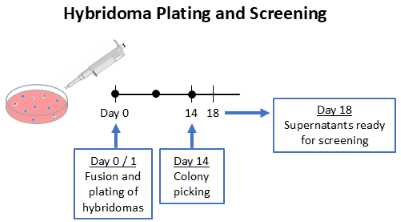
One mouse (the best responder) is injected on day 43 or later as a final boost. 4 days later, spleen cells are fused with SP2/0 mouse myeloma cells. Hybridomas are assayed 18-20 days later by selected assay (ELISA, FACS, IHC, western blot, etc.). All antibodies are made available as culture supernatants for client screening.
Phase 3. Hybridoma selection and preservation
Client selects antigen specific hybridomas after screening, and the selected hybridoma cell lines will be grown up and frozen in liquid nitrogen.
-
Day 0 First antigen immunization
Day 21 Second antigen immunization (21 days after 1st immunization)
Day 33 Serum collection (PI testing or Core testing)
Day 42 Spleen immunization (21 days after 2nd immunization), PI or Core tests serum for immune response and selects mouse for fusion
Day 46 (Day 0) Fusion Part 1 – Fuse spleen and myeloma cells
Day 47 (Day 1) Fusion Part 2 – Methylcellulose plating
Day 60 (Day 14) Colony picking (~13-14 days after plating)
Day 66 (Day 18) Supernatants ready for screening (~4 days after plating)
Day 70 Screening results available (from PI or from Monoclonal Core), Core expands useful clones for cryopreservation
Day 77 Cryopreservation (faster-growing clones ~1 week)
Day 84 Cryopreservation (slower-growing clones ~2 weeks)
-
Day 0 Negative immunization
Day 1 First cyclophosphamide treatment
Day 2 Second cyclophosphamide treatment
Day 21 First positive immunization
Day 42 Second antigen immunization (21 days after 1st immunization)
Day 54 Serum collection (PI testing or Core testing)
Day 63 Spleen immunization (21 days after 2nd immunization), PI or Core tests serum for immune response and selects mouse for fusion
Day 67 (Day 0) Fusion Part 1 – Fuse spleen and myeloma cells
Day 68 (Day 1) Fusion Part 2 – Methylcellulose plating
Day 81 (Day 14) Colony picking (~13-14 days after plating)
Day 87 (Day 18) Supernatants ready for screening (~4 days after plating)
Day 91 Screening results available (from PI or from Monoclonal Core), Core expands useful clones for cryopreservation
Day 98 Cryopreservation (faster-growing clones ~1 week)
Day 105 Cryopreservation (slower-growing clones ~2 weeks)
Timeline Considerations
- Mouse orders placed on a Monday or Tuesday will typically arrive at OHSU the following Tuesday (7-8 days later). Orders placed from Wednesday to Friday will typically arrive on the second Tuesday (11-13 days later).
- Mice are stressed by shipping. Because stress hormones will inhibit a strong immune response, we typically recommend at least one week between arrival and the first immunization.
- We generally recommend a single serum collection ~10-14 days after the second immunization. A pre-bleed serum sample, taken before the first immunization, can be collected for comparison purposes if desired. If necessary, an additional immunization can be performed before the fusion.
- If hybridoma supernatants will be screened by the customer, it is helpful to coordinate the timing of the fusion so that screening will be performed shortly after supernatants are ready. We generally recommend that screening occur within ~7-10 days.