M.S. in Medical Physics
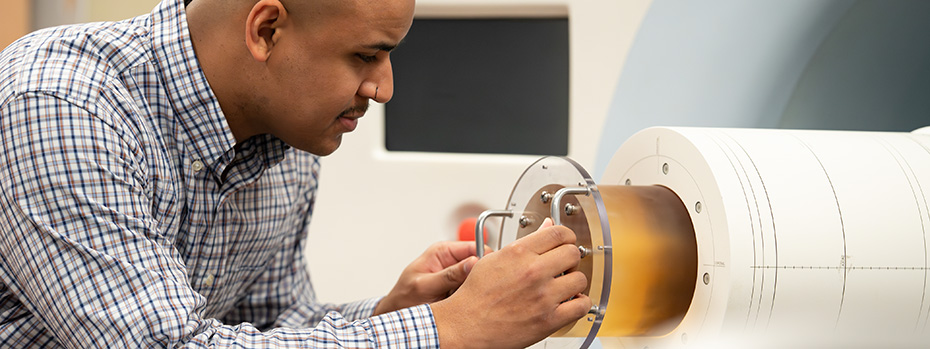
The M.S. in Medical Physics at OHSU prepares you for clinical residencies, careers in research or industry, or further study in radiation therapy or diagnostic imaging physics.
Why earn your M.S. in Medical Physics from OHSU?
Join the only CAMPEP-accredited medical physics program in the Pacific Northwest.
- High residency placement. Every student who applied for residency in 2026 matched.
- State-of-the-art facilities. Train on advanced imaging and radiation equipment. See our facilities.
- Cutting-edge research. Carry out original research that addresses current challenges in medical physics and supports advances in patient care.
- Expert faculty. Work with faculty leaders who conduct clinically relevant research and provide mentorship and career guidance. Meet our faculty.
- Small cohorts with peer mentoring. Collaborate closely with classmates to build skills and professional relationships.
Virtual open house
Join us to learn more about the program, meet faculty and current students, and get your questions answered.
Scholarships
OHSU offers a variety of scholarships that can help fund your education.
Admission and application requirements
Admissions requirements
To apply, you must have:
- A bachelor’s degree in physics or a related field such as engineering, biophysics, biomedical sciences or math
- Prerequisite coursework completed
- A 3.0 GPA or higher
- GRE scores (no minimum scores required)
How to Apply
- Applications open Sept. 1 and are due Jan. 15.
- Create an online account and select “Medical Physics MS/MMP.”
- Enter past coursework.
- Submit a personal statement, resume, GRE scores and three letters of reference.
- Answer application questions.
- Send transcripts to the School of Medicine graduate admissions office.
The program may have limited spots available after the Jan. 15 deadline. Email mpadmissions@ohsu.edu to check availability.
Tuition and scholarships
- Cost: $686 per credit for Oregon residents and $1,096 for non-residents.
- Scholarships: OHSU offers a variety of scholarships that can help fund your education.
Prerequisite coursework
Before you apply, you need to complete:
- Two introductory physics courses (at least 3 semester credits each)
- Three advanced physics courses (year 3 or 4 level) that would be required as part of a physics major curriculum (at least 3 semester credits each)
Examples of approved advanced physics courses:
- Electricity and magnetism
- Atomic or modern physics
- Quantum mechanics
- Optics
- Nuclear physics
- Heat and thermodynamics
- Advanced mechanics
Courses in engineering, chemistry, health or medical physics don’t meet this requirement.
Degree requirements
You need 61 credits to earn your M.S. in Medical Physics degree. This includes 7 credits for thesis research and thesis defense.
- Program length: 21 months
- Minimum GPA: 3.0
You must complete all degree requirements within six years.
Sample curriculum and class schedule
-
Year one (all medical physics students)
Fall Winter Spring Summer MP 507: Matriculation Seminar (1 credit) MP 535: Rad Shielding and External Dosimetry (3 credits) MP 507: Diagnostic Physics Journal Club (0 credits - observe) MP 536: Advanced Radiation Detection (Summer A) (3 credits) MP 521: Radiological Anatomy and Physiology (3 credits) MP 541: Diagnostic Physics I (3 credits) MP 507: Therapy Physics Journal Club (0 credits -observe) MP 545: Diagnostic Physics Practicum (Summer B) (3 credits) MP 531: Radiophysics (3 credits) MP 561: Therapy Physics I (3 credits) MP 542: Diagnostic Physics II (3 credits) MP 565: Therapy Physics Practicum (Summer B) (3 credits) IPE 501: Interprofessional Education (.25 credits) IPE 501: Interprofessional Education (.25 credits) MP 562: Therapy Physics II (3 credits) BSTA 525: Introduction to Biostatistics (4 credits) MP 570: Radiation Biology (3 credits) MGRD 650: Practice and Ethics of Science (1 credit) IPE 501: Interprofessional Education (.25 credits) -
Year two (radiation therapy physics track)
Fall Winter Spring MP 503: Thesis (1 credit) MP 503: Thesis (2 credits) MP 503: Thesis (4 credits) MP 543: Advanced Diagnostic Imaging (MRI) (3 credits) MP 538: XRT/RPT Dosimetry Lab (2 credits) MP 507: Diagnostic Physics Journal Club (1 credit) MP 544: Nuclear Medicine Imaging (3 credits) MP 564: Therapy Physics Lab II (2 credits) MP 507: Therapy Physics Journal Club (1 credit) MP 563: Therapy Physics Lab I (2 credits)
Student research
How thesis research works
You'll have time to explore the field before committing to a research topic.
Fall term: Take the Matriculation Seminar (MP 507) to understand the roles of diagnostic imaging physicists and radiation therapy physicists. You will also begin connecting with faculty to learn about available research projects.
Winter and spring terms: Work on smaller research projects to present at conferences and become familiar with a topic before choosing your thesis project and mentor.
Summer term: Complete a hands-on practicum in both diagnostic radiology and radiation medicine where you'll:
- Meet potential thesis advisors
- Learn about ongoing research projects
- Work directly with imaging and therapy equipment
- Shadow day-to-day clinical procedures
Fall term (second year): After exploring both specialties, you’ll select a research mentor and research topic that matches your interests.
Recent thesis projects
-
2025 thesis projects
- The use of hierarchical modeling in prostate stereotactic body radiation therapy, by Chancelor Christensen, M.S. (2025)
- Evaluation of metabolic activity diffusion imaging in resected human glioma, by Jackson Herb, M.S. (2025)
- Evaluating deformable image registration for cumulative dose estimation in gynecologic brachytherapy, by Emma Kurth, M.S. (2025)
- A comparative analysis of skin sparing optimization in head and neck cancer treatments, by Robert Morkeh, M.S. (2025)
- Longitudinal analysis of functional effort correction to assess lung damage after radiation therapy, by Justin Reel, M.S. (2025)
- Validation of small field treatment planning using Brainlab elements, by Hung Tran, M.S. (2025)
-
2024 thesis projects
- Multi-parametric MRI fingerprinting analysis of pancreatic lesions with ferumoxytol contrast for correlation with vascular structure, by Zachary Barton, M.S. (2024)
- Functional effort correction of the lungs in radiation therapy longitudinal studies, by William Bethard, M.S. (2024)
- Effect of reducing imaging time points in lutetium-177 vipivotide tetraxetan dosimetry, by Evan Dodson, M.S. (2024)
- Radiomic analysis and comparison of metal artifact reduction algorithms in computed tomography, by Alex Lindgren-Ruby, M.S. (2024)
- Technique optimization for adult computed tomography guided biopsy and drainage procedures with phantom and clinical dose metric analysis, by Rachel Malinowski, M.S. (2024)
Scholarly activity
Presentations
Present your research at national conferences like the American Association of Physicists in Medicine annual meeting, the northwest chapter meetings and OHSU’s annual Research Week.
-
2025 presentations
- Clinical I-131 Dosimetry: Audit, Review, and Evaluation, presented by Colin Doyle at the AAPM meeting, July 2025
- Lu-177 Recovery Coefficients Using Tc-99m Surrogate Method: Intra- & Inter-Scanner Comparison, presented by Benjamin Piacitelli at the AAPM meeting, July 2025
- Automated Classification of the Right Superior Lobe Branching Using 3D CNN Models, presented by William Bethard at the NWAAPM chapter meeting, May 2025
-
2024 presentations
- Radiomic Analysis and Comparison of Metal Artifact Reduction Algorithms, presented by Alex Lindgren-Ruby at the NWAAPM spring chapter Meeting, May 2024
- Dose Reduction in Interventional CT Procedures by Optimizing Helical Scan Parameters, presented by Rachel Malinowski at the NWAAPM spring chapter meeting and OHSU Research Week, May 2024
- Evaluating the Impact of Frame Duration Shortening on Dosimetry for 177Lu-PSMA Radiopharmaceutical, presented by Zachary Barton at the NWAAPM spring chapter meeting, May 2024
- Revealing Lung Damage Through Effort Correction, presented by Will Bethard at the NWAAPM spring chapter meeting, May 2024
- Validating Retrospective SPECT Frame Duration Shortening Using Phantom Measurements, presented by Zachary Barton at OHSU Research Week, May 2024
Awards
The program recognizes students every year for academic excellence and contributions to the field.
-
Recent award recipients
The Radiant Student Award recognizes a first-year student who shows exceptional potential in research, academics, peer mentorship, outreach or community building.
- Benjamin Piacitelli, June 2025
The Academic Excellence Award honors second-year students who excel academically.
- Chancelor Christensen, June 2025
- Justin Reel, June 2025
Cohort experience
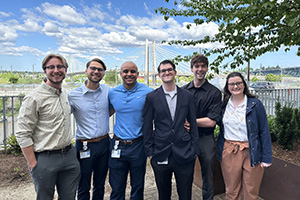
With cohorts of about five to eight students, you’ll work closely with classmates in labs, courses and research projects. Faculty know every student by name and provide one-on-one guidance throughout the program. The close-knit environment supports strong professional relationships that last beyond graduation.
From day one, you'll connect with second-year students through the peer mentoring program. Your peer mentors share knowledge about graduate life at OHSU, offer advice on coursework and help you adjust to the program. Through biweekly meetings, you'll have direct access to students who understand what you're going through.
Student groups
Students connect beyond the classroom through the Association of Medical Physics Students (AMPS). AMPS is a student-run group that brings medical physics students together and raises awareness of the field.
AMPS hosts activities that support your professional development and build community, including:
- Guest lectures
- Social gatherings
- Presentation practice sessions
- Board exam prep workshops
- CV and interview prep sessions
- Volunteer and outreach opportunities
M.S. in Medical Physics FAQs
Is the OHSU M.S. in Medical Physics CAMPEP accredited?
Yes. The OHSU M.S. in Medical Physics is CAMPEP accredited.
What bachelor’s degrees does OHSU accept for the M.S. in Medical Physics program?
OHSU requires a bachelor’s degree in physics or a related field. If your degree is not in physics, you need coursework equivalent to a physics minor. See the full prerequisite coursework.
Related fields include:
- Engineering
- Biophysics
- Biomedical sciences
- Math
- Physical sciences
- Computer science
- Other STEM fields
Does the M.S. in Medical Physics prepare me for a clinical residency?
Yes. The program prepares you to become a competitive applicant for CAMPEP-accredited clinical residencies.
You will:
- Complete CAMPEP-required coursework in diagnostic and therapy physics
- Gain hands-on clinical experience
- Conduct faculty-mentored thesis research
How long does the OHSU M.S. in Medical Physics take to complete?
The OHSU M.S. in Medical Physics is a 21-month program.
You start in September and finish in June of your second year. All students complete the same core coursework in year one, then choose a track in radiation therapy physics or diagnostic imaging physics in year two.
What do graduates of the M.S. in Medical Physics go on to do?
Graduates pursue different paths depending on career goals.
Many go on to:
- Clinical medical physics residencies
- Further graduate training, such as a Ph.D. in medical physics
- Medical physics roles in hospitals and health systems
- Positions in industry related to medical imaging or radiation therapy
Course descriptions
-
MP 507: Matriculation Seminar
Students attend this presentation seminar to learn about topics and faculty in the Medical Physics Program. All incoming students must complete this seminar.
-
MP 521: Radiological Anatomy
Students study anatomy and physiology with correlating images for use in medical physics. The course meets AAMP requirements for cross-sectional anatomy and CAMPEP standards for anatomy and physiology in graduate programs.
-
MP 531: Radiophysics
Students explore ionizing radiation and its use in medicine. They study radiation production, interactions with matter and measurement techniques. Students must complete this course before other medical physics courses.
-
MP 535: Radiation Shielding and External Dosimetry
Students learn principles of shielding for neutron and gamma radiation. They apply external dosimetry techniques for neutrons, photons and charged particles to practical problems. The course emphasizes analytical, numerical and computer solutions.
-
MP 538: External Beam Radiation Therapy/Radiopharmaceutical Therapy Dosimetry Lab
Students deepen their understanding of radiation biology and dosimetry from prerequisite courses. They perform XRT dose calculations, quantitative imaging, RTP dosimetry methods and uncertainty analysis in the lab.
-
MP 561: Therapy Physics I
Students study radiation physics for clinical radiation oncology. They perform dosimetric calculations and treatment planning for external beam therapy, brachytherapy, electron and photon beams. They apply special radiotherapy techniques and practice clinical radiation protection and quality assurance.
-
MP 541: Diagnostic Imaging I
Students learn how to produce and use ionizing radiation in medicine. They study X-ray production, spectrum characteristics and imaging for general radiography, mammography, and fluoroscopy, including interventional procedures.
-
MP 507: Seminar Therapy
Students present current topics in radiation therapy and therapeutic radiological medical physics.
-
MP 570: Radiation Biology
Students study the effects of ionizing radiation on living organisms. They explore radiation protection, radiation-induced injury and radiobiological models. They apply organ/tissue arrangement, linear energy transfer, DNA damage mechanisms and biologically effective dose in clinical scenarios.
-
MP 562: Therapy Physics II
Students continue exploring radiation physics in clinical radiation oncology. They calculate doses for external beam therapy, brachytherapy, electron and photon beams and apply special techniques. They practice clinical radiation protection and quality assurance.
-
MP 542: Diagnostic Imaging II
Students study computed tomography (CT) and ultrasound (US). They practice X-ray production, detection and image processing for CT and apply acoustic physics to US imaging. They perform clinical radiation protection and dosimetry for diagnostic imaging.
-
MP 507: Seminar Imaging
Students present current topics in diagnostic radiology and diagnostic medical physics.
-
MP 536: Advanced Radiation Detection
Students explore nuclear radiation detection and measurement. They operate laboratory instrumentation, apply detectors for alpha, beta, gamma and neutron radiation, use liquid scintillation equipment and Bonner spheres and investigate radiation interactions with matter.
-
MP 565: Therapy Physics Practicum Therapy
Students observe clinical procedures in radiation medicine to integrate principles from their courses. They participate in dosimetry, physics, CT simulation and linear accelerator activities during patient treatments.
-
MP 545: Diagnostic Imaging Practicum Imaging
Students observe imaging modalities in clinical settings. They participate in radiography, fluoroscopy, emergency department, OR, interventional radiology, CT, US and PET procedures.
-
MP 546: Diagnostic Physics Lab I
Students practice diagnostic imaging physics across radiology, interventional radiology and cardiac catheterization labs. They test and troubleshoot general X-ray, portable X-ray, fluoroscopy, mammography and ultrasound equipment.
-
MP 547: Diagnostic Physics Lab II
Students practice diagnostic imaging physics in radiology, interventional radiology, cardiac catheterization labs and other clinical areas. They test and troubleshoot CT equipment, primary interpretation displays and dental imaging systems.
-
MP 563: Therapy Physics Lab I
Students apply therapeutic radiation physics in clinical radiation oncology. They deliver treatments, plan algorithms, follow quality assurance protocols and use special radiotherapy techniques.
-
MP 543: Advanced Diagnostic Imaging
Students learn magnetic resonance imaging (MRI) principles. They study nuclear magnetic resonance, advanced MRI techniques, clinical applications and testing requirements.
-
MP 564: Therapy Physics Lab II
Students apply therapeutic radiation physics for SRS, ARC QA, adaptive radiotherapy, eye plaque brachytherapy and HDR brachytherapy.
-
MP 544: Nuclear Medicine Imaging
Students study radionuclides in medical imaging. They operate detectors and imaging systems, including collimators, scintillation probes, cameras, SPECT, PET and hybrid systems such as SPECT/CT, PET/CT and PET/MRI.
-
MP 503: Thesis Hours
Students complete thesis research under faculty guidance.
Schedule a visit
Schedule an in-person or virtual visit to learn more. Email us at mpadmissions@ohsu.edu.
Contact us
- Email mpadmissions@ohsu.edu
- Call 503-494-7461
Hear from students
“The program here at OHSU is outstanding. The curriculum provides exceptional clinical experience, and prepares you for your next steps, whether you choose to pursue a Ph.D. or residency.”
— Colin Doyle, M.S. in Medical Physics student