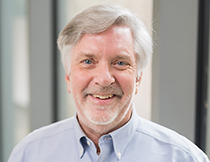
The OHSU Library is pleased to announce a new oral history interview with Peter Barr-Gillespie, Ph.D., conducted by Bonnie Nagel, Ph.D., and recorded on October 2, 2025. Barr-Gillespie is a neuroscientist who served as Chief Research Officer from 2019 to 2025. His work has advanced understanding of sensory transduction and shaped research administration at OHSU.
Early Life and Path to OHSU
Barr-Gillespie grew up in Bellevue, Washington, and began his academic journey at Reed College, where a chemistry major led to an interest in neuroscience. Graduate studies at the University of Washington focused on visual transduction, and his postdoctoral work with Jim Hudspeth at University of California San Francisco and University of Texas Southwestern Medical Center marked a turning point. There, he shifted to auditory research, studying the molecular mechanisms of sensory cells critical for hearing.
After faculty appointments at Johns Hopkins University, Barr-Gillespie joined OHSU in 1999 as Associate Professor of Otolaryngology and Senior Scientist at the Vollum Institute. His laboratory endeavors to find how sensory cells in the inner ear allow humans to perceive sound from the outside world. Over his career, he has published extensively on the biochemistry and cell biology of hearing and balance.
Leadership and Service
Barr-Gillespie’s career expanded beyond the lab when he directed the Neuroscience Graduate Program and later served as Associate Vice President for Basic Research. In 2019, he became OHSU’s first Chief Research Officer, overseeing research strategy and administration. In this interview, he reflects on guiding the institution through challenges such as the COVID-19 pandemic and recent shifts in federal funding.
Reflections and Priorities
The conversation also explores mentorship, family, and the evolving balance between science and administration. Barr-Gillespie shares insights on the resilience of science as a self-correcting endeavor and his plans to wind down his lab while prioritizing time with family.
Read (or watch) the full interview and explore over 150 others in the OHSU Oral History Program’s online collection.