For Patients: Multiple Sclerosis Research
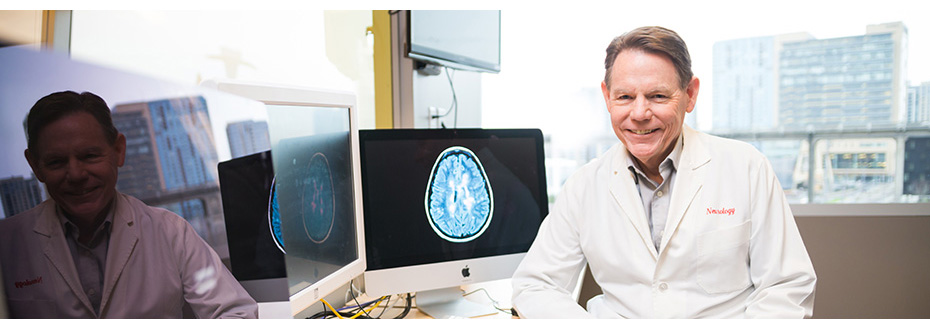
The OHSU Multiple Sclerosis Center is at the forefront of research to understand, treat and find a cure for multiple sclerosis. We have a team with dozens of scientists who:
- Have developed promising new treatments for MS that are being tested in patients.
- Are making strides that could lead to treatments to repair myelin, the nerve covering affected in MS and related disorders.
- Work with other top MS centers around the world, so we can advise patients about the latest advances.
- Offer patients access to clinical trials to test new therapies.
- Are international leaders in understanding how lifestyle changes and complementary medicine affect MS.
Research excellence
National leadership: Our experts are among the top MS researchers in the United States. Their work earns sought-after grants from the National Institutes of Health, the National Multiple Sclerosis Society and many other organizations.
Collaborative research: We belong to the prestigious Consortium of MS Centers and to the Race to Erase MS Center Without Walls, a network of the nation’s top MS research institutions.
Respected authors: Our team members have published hundreds of articles in leading scientific journals to share breakthroughs.
Future scientists: In partnership with the VA Portland Health Care System MS Center of Excellence, we offer fellowships in MS and neuroimmunology to train the next generation of clinician-scientists.
Clinical trials
Clinical trials enable our scientists to test ways to prevent, identify and treat MS and related diseases. We offer clinical trials to study all types and stages of MS. If you are a potential candidate for a clinical trial, your care team will discuss options with you.
Learn more about clinical trials at the OHSU Brain Institute.
MS clinical research
OHSU's MS Center and Knight Cancer Institute are among 21 centers taking part in a clinical trial of stem cell transplant to treat highly active multiple sclerosis. The BEAT-MS study compares two treatments:
- Chemotherapy followed by autologous hematopoietic stem cell transplant, a type of bone marrow transplant.
- The best medicines for relapsing MS (“best available therapy”).
In a person with MS, the immune system doesn’t work properly. This damages the brain and nervous system. The trial aims to see if the transplant “reboots” the immune system.
Vijayshree Yadav, M.D., M.C.R., FANA, FAAN, is the lead MS neurologist. Richard T. Maziarz, M.D., is the lead transplant doctor conducting the study at OHSU.
Research suggests vascular diseases such as high blood pressure, diabetes and heart disease can worsen MS. We don’t know why. Vijayshree Yadav, M.D., M.C.R., FANA, FAAN, leads a team using advanced 7 Tesla MRI technology to see how brain changes linked to vascular disease affect MS. Our early data suggests there are changes in how the brain converts and uses energy (metabolism) in people with MS with vascular diseases. These studies may help us better understand disease progression in MS and lead to treatments that can slow MS.
Elizabeth Silbermann, M.D. is studying whether we can track MS progression by how vascular diseases affect blood vessels in the retina, at the back of the eye. The study uses cutting-edge technology called ocular coherence tomography angiography to measure retina vessel damage in people with MS. Silbermann is working with the OHSU Casey Eye Institute's David Huang, M.D., Ph.D., co-inventor of ocular coherence tomography.
Lipoic acid is available as a dietary supplement. OHSU researchers found its potential as an MS treatment when studying it in mice almost two decades ago. In 2017, Rebecca Spain, M.D., M.S.P.H. and her research team showed lipoic acid can slow brain atrophy (shrinking) and disability in patients with secondary progressive MS. Now Dr. Spain and her team are leading a larger five-year study on the effects of lipoic acid on people with progressive MS. The results will be available in early 2024.
People with MS can experience physical disability when they lose myelin, the covering for nerve fibers. Lindsey Wooliscroft, M.D., M.Sc., M.C.R. is leading research to see whether regular aerobic exercise can increase the effectiveness of myelin repair medications. (Learn about one clinical trial participant’s experience with exercise and MS symptoms.)
When Vijayshree Yadav, M.D., M.C.R., FANA, FAAN started treating patients with MS, they kept asking whether changing their diet could help them feel better. Her research has shown that a low-fat diet can play a role in managing MS symptoms, including fatigue. Yadav’s research found a very low-fat, vegan diet significantly improved fatigue.
More than half of people with MS fall each year, and many are hurt. Fear of falling and overall balance problems may keep MS patients from activities they enjoy. Michelle Cameron, M.D., M.C.R., PT, studies falls and imbalance in people with MS. Her research seeks to prevent falls through medication, education and exercise.
Understanding MS and similar diseases
OHSU researchers shared groundbreaking research in 2019 showing that a compound can trigger myelin repair in mice. Damage to myelin, the covering for nerve fibers, is at the heart of MS and related disorders. No medication exists yet to repair myelin in humans. Researchers hope they can eventually show that the compound that worked in mice can also work in humans, with few side effects. The study’s authors included Dennis Bourdette, M.D., Tom Scanlan, Ph.D. and Meredith Hartley, Ph.D.
A research team led by Kelly Monk, Ph.D., is studying zebrafish to better understand myelin biology. Monk, a global expert on glial cells and myelin production, and her team believe that understanding how these cells work can open the door to treatments that repair myelin. Damage to myelin, the covering for nerve fibers, is at the heart of MS and related disorders.
Ben Emery, Ph.D., leads a team at OHSU’s Emery Lab working to learn how myelin is produced. The team uses genetically modified mice and other methods to understand the genetic pathways and cells behind myelin creation. The team hopes to shed light on how myelin loss affects health, and how to promote myelin repair. Damage to myelin, the covering for nerve fibers, is at the heart of MS and related disorders.
OHSU scientists Gary Westbrook, M.D., and Eric Gouaux, Ph.D., led development of an animal model to help them study the brain illness described in “Brain on Fire,” an award-winning memoir adapted for a 2016 film. They developed mice that model the disease, a form of autoimmune encephalitis called anti-NMDA encephalitis. MS and autoimmune encephalitis both involve inflammation of the brain and spinal cord. (Story and video: Puzzling brain disease could now be better diagnosed, treated.)
Arthur Vandenbark, Ph.D., and Dennis Bourdette, M.D., have identified cytokines (proteins that play a role in the immune system) and genetic markers that may play a role in progressive MS. This is a severe form of the disease in which symptoms worsen over time. The findings could lead to a test for those at risk of progressive MS, possibly helping doctors to slow or stop the illness. The findings also shed light on risk factors for progressive MS.
Our experts found that macaque monkeys at OHSU’s Oregon National Primate Research Center naturally develop a disease like MS. The disease is most likely caused by an unusual virus. We are working to see whether a similar virus may be present in people with MS. As we learn more, it could lead to new treatments.
Learn more
The following centers and labs do research related to MS and other illnesses.
- Advanced Imaging Research Center
- Balance Disorders Laboratory
- Emery Lab, led by Ben Emery, Ph.D.
- Gouaux Lab, led by Eric Gouaux, Ph.D.
- Jungers Center for Neurosciences Research
- Logan Lab, led by Mary A. Logan, Ph.D.
- Monk Lab, led by Kelly Monk, Ph.D.
- Neuroimmunology Research Laboratories, at the VA Portland Health Care System, bring together immunologists, neuroscientists and molecular biologists to better understand MS causes and how to protect nerves from damage.
- Oregon National Primate Research Center
- Tykeson Multiple Sclerosis Research Laboratory is dedicated to studying how the immune system causes MS and developing treatments to control disease-causing white blood cells. Immunologists, neuroscientists and molecular biologists work together toward eventually curing MS. The laboratory is named for Donald Tykeson and his family, who helped establish the laboratory with a generous gift.
- Westbrook Lab, led by Gary L. Westbrook, M.D., M.S.E.
Our experts publish research in leading scientific journals and other publications. Their work is widely cited by other top researchers. Highlights include:
- Cross-sectional survey of complementary and alternative medicine used in Oregon and southwest Washington to treat multiple sclerosis: a 17-year update, Multiple Sclerosis and Related Disorders, March 2020
- Effect of High-Intensity Exercise on Multiple Sclerosis Function and Phosphorous Magnetic Resonance Spectroscopy Outcomes, Medicine & Science in Sports & Exercise, July 2019
- Lipoic Acid and Other Antioxidants as Therapies for Multiple Sclerosis, Current Treatment Options in Neurology, June 2019
- Myelin repair stimulated by CNS-selective thyroid hormone action, The Journal of Clinical Investigation, April 2019
- MIF and D-DT are potential disease severity modifiers in male MS subjects, Proceedings of the National Academy of Sciences of the United States of America, October 2017
- Lipoic acid in secondary progressive MS, Neurology; Neuroimmunology & Neuroinflammation, September 2017
- Advances in myelinating glial cell development, Current Opinion in Neurobiology, February 2017
- The contemporary spectrum of multiple sclerosis misdiagnosis, Neurology, September 2016
- Low-fat, plant-based diet in multiple sclerosis: A randomized controlled trial, Multiple Sclerosis and Related Disorders, July 2016
- Immunopathology of Japanese macaque encephalomyelitis is similar to multiple sclerosis, Journal of Neuroimmunology, December 2015
Find more of our published work on MS and other topics on OHSU Experts.
For patients
- Referral: To become a patient, please ask your doctor for a referral.
- Questions: For questions or follow-up appointments, call 503-494-7772.
Location
Center for Health & Healing Building 1, eighth floor
3303 S.W. Bond Ave.
Portland, OR 97239
Free parking for patients and visitors
Refer a patient
- Refer your patient to OHSU.
- Call 503-494-4567 to seek provider-to-provider advice.
Brain/nerve clinical trials
Clinical trials allow patients to try a new test or treatment.