Biomedical Engineering Ph.D. Program: An Overview
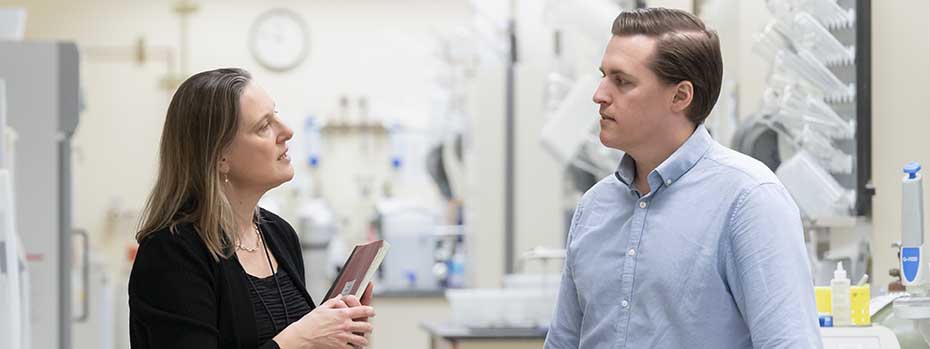
Your research, in close collaboration with a faculty mentor, is the heart of OHSU’s doctoral program in biomedical engineering. As a Ph.D. student, you will work side by side with leading scientists from our BME department, as well as the Knight Cancer Institute, the Knight Cardiovascular Institute, the Casey Eye Institute, and other departments throughout OHSU, Oregon’s only academic medical center.
You’ll dive into research training right away with placement into a faculty mentor’s laboratory starting on Day One. Our Ph.D. program offers flexibility to support your individual training needs as you discover your own scientific passions.
As a Ph.D. student at OHSU, you will learn:
- Biomedical engineering concepts and skills
- How to develop a hypothesis or model design
- How to design, conduct and interpret your own research
- Doctoral-level written and verbal communication skills
- Professional conduct and ethical behavior
You will also have opportunities for:
- Building your knowledge in a specialized area you choose
- Finding your professional identity
- Teamwork and collaboration with diverse scientists, clinicians and engineers
- Innovation and entrepreneurship
- Community engagement
Join our program
Your research career starts here.
Learn more
School of Medicine Graduate Studies
Who should apply to the program?
We welcome students with backgrounds in all fields of engineering as well as related biomedical fields, such as biology, chemistry, data science and computer science.
Full-time students earn a competitive monthly stipend. All tuition and university fees are covered.
115
Students in the BME program
4.8 years
Average time to degree
3.5
Average incoming GPA
Female students: 49%
Male students: 51%
17%
Students were first-generation in college
In-state students: 24%
Out-of-state students: 33%
International: 42%
What support do students receive?
Your faculty mentor will meet with you regularly to provide guidance and advise you during the first year and beyond. You will discuss coursework, academic performance and research opportunities.
In your first semester, we will pair you up with a senior student from the Biomedical Engineering Society (BMES) Student Chapter based on similar research interests. Student mentors help you transition into the program, direct you to OHSU resources and provide support throughout your studies.
Your Dissertation Advisory Committee (DAC) will support you once you begin your thesis research. This committee – made up of experienced faculty you select – meets every six months and is invaluable to your success.
What facilities does OHSU offer?
As a Ph.D. candidate at OHSU, you will have access to an extraordinary network of research facilities.
Lab spaces: Our biomedical engineering labs are located in buildings on the South Waterfront and Marquam Hill areas of campus, all filled with state-of-the-art equipment.
Research support: OHSU has 19 modern Research Cores and Shared Resources that provide access to the latest technology and equipment to support your research. Highly trained staff provide quality technical assistance, specialized and widely used scientific procedures, access to informational cataloging and/or retrieval of animal data and previous scientific findings.
Some of our highly used research cores include:
- Advanced Imaging Research Center
- Bioinformatics
- Integrated Genomics Laboratory
- Multiscale Microscopy Core
Primate center: The Oregon National Primate Research Center, one of the seven National Primate Research Centers supported by the National Institutes of Health, is also available for responsible nonhuman primate research.