Faculty careers
Find professor, physician and APP faculty jobs at OHSU.
Questions?
Email us at deptofneuro@ohsu.edu
Work and learn with neuroscience leaders
The OHSU Department of Neurology is one of the nation’s top neurologic research and training programs, with one-of-a-kind laboratories and nine fellowship programs.
Through 10 divisions and sections and special programs, we drive discovery in neurology subspecialties and provide life-saving therapies to patients in Oregon and beyond.
Join us as a faculty member or learner to shape the future of neurology.

Meet our faculty
We train learners, conduct research and provide neurological care at 16 hospitals and clinics.
![Desktop computer screen shows a magnified image of sensory cells for sound and balance in the inner ear.]](/sites/default/files/2026-03/2018_10_neu_liedtke_143.jpg)
Explore research
Discover breakthroughs that lead to treatments and clinical trials you won’t find anywhere else.

Find fellowships
Apply to one of nine nationally recognized neurology subspecialty fellowships in clinical care and/or research.
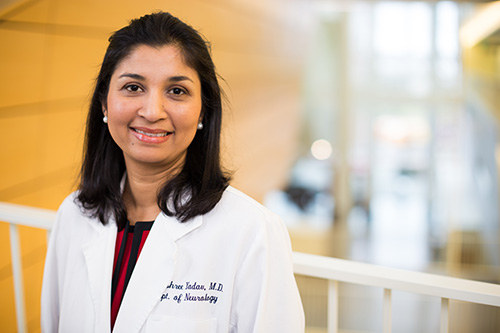
“We are regularly ranked among the top neurology programs nationally for a reason. We offer comprehensive care, a huge number of clinical trials, and some of our research labs have a worldwide reputation for innovation.”
Continuing medical education
Attend grand rounds and more.
About the Neurology Department
OHSU has a tradition of excellence in neurology medicine, research and education that stretches back more than 40 years.
Faculty in 10 subspecialties care for patients, train learners and develop breakthrough therapies for Alzheimer’s disease, epilepsy, movement disorders, multiple sclerosis, stroke and more.
Clinical care
We provide leading-edge neurology care for patients in Portland and throughout the Pacific Northwest. Our programs include:
- Comprehensive clinical care for neurologic subspecialties
- Telehealth programs with 16 regional hospitals
- Health services for rural and underrepresented communities in Oregon
Neuroscience research
The majority of our faculty conduct research. We work closely with neuroscientists on basic science research through OHSU’s Jungers Center for Neurosciences Research. This is unique among medical schools.
We have also pioneered a variety of treatment and research approaches, including:
- World’s first deep brain stimulation implant, launching a new era of surgical treatments for Parkinson’s disease and movement disorders.
- Nation’s first incisionless surgery for Parkinson’s disease to reduce tremors and muscle stiffness.
- First regional telestroke service and national leader in enrolling stroke patients in life-saving clinical trials.
- First real-time data system to monitor aging patients at home.
Education and training programs
We offer subspecialty clinical and research fellowships for early-career physicians who want to specialize in brain and spinal cord disorders and diseases. We also train the next generation of neurologists in our neurology residency program.
By the numbers


Be part of something bigger
Life in Portland

Neurology in the news
Culture and benefits
We foster a culture of curiosity, collaboration, innovation and accessibility in the neurology department. You can expect our leaders to demonstrate the spirit of equality and inclusion found across the School of Medicine and OHSU.
Along with a welcoming work environment, we offer generous employee benefits, and a chance to work and learn in the natural beauty, cultural vibrancy and outstanding food scene of the Portland area.
Community impact
Philanthropy helps drive innovation and supports 13 endowed faculty positions.
We support our community in return. We design research programs that offer new tools and support to the elderly. We offer all Oregonians clinical trial participation to get treatments they can’t access anywhere else. Every day, we support neurologists who treat patients in every corner of Oregon, Washington and Idaho.