DMD Program Curriculum

OHSU DMD
The predoctoral dental curriculum leads to the award of the doctor of dental medicine (DMD) degree. The objectives of the curriculum are the education of competent general practitioners of dentistry and preparation for life-long learning and advanced training. Health care is more than a collection of knowledge and skills; dental professionals need certain personal qualities to meet the needs of their patients and the standards of their peers.
The school fosters each student’s commitment to supporting high ethical values, a liking for people and for unselfish service, an understanding of human relations, the ability to communicate, and a broad understanding of the community’s and nation’s health goals.
The curricula of the School of Dentistry prepare both its doctoral and advanced specialty education graduates to become licensed professionals in their respective dental discipline.
Enhancement of knowledge and development of technical skills are not the only aims of the curriculum. The ethical standards, social responsibilities and humanitarian attitudes characteristic of the healing professions are fostered in courses addressing ethics, the behavioral aspects of the dentist-patient relationship, and social and economic problems in dental care delivery. Courses in practice management instruct students in practical and legal aspects of dental practice.
The purpose of the dental education program is to impart scientific knowledge and clinical skills needed in the practice of the dental profession, to instill standards of professional conduct as a way of life and to promote a dedication to continuous, life-long professional study and self- improvement.
Table of Contents
Curriculum by Academic Year
Year 1

The first year begins with an introduction to professionalism, dental history, and a cadaveric gross anatomy course. Courses in biochemistry, physiology, histology, neuroscience, dental anatomy, head and neck anatomy and inflammation follow to build on the sciences needed to provide oral health care. Students are introduced to the fundamentals of the oral examination, oral radiology, dental materials, periodontology and prevention of dental diseases.
Year 2
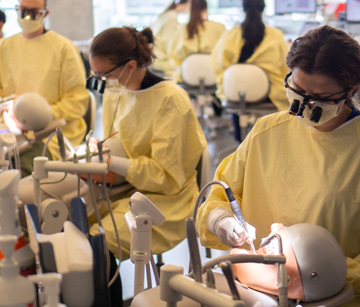
The second year emphasizes the development of the skills needed for dental techniques and the fundamentals for the dental sciences. This includes didactic and laboratory courses in facial growth, fixed and removable prosthodontics, operative dentistry, oral surgery, Periodontology, and Endodontology, as well as clinical work in periodontology and operative dentistry. The second year also continues the study of basic science: microbiology, immunology, pathology, nutrition, and pharmacology. The curriculum includes courses on caries, occlusion, and pain and anxiety control.
Years 3 and 4

The emphasis during the third and fourth years is on clinical practice, supported by lecture and seminar sessions dealing with the diagnosis of oral disease, application of dental materials, treatment planning and clinical treatment procedures. Experience is provided in employing chair-side assistance from dental auxiliaries. Students develop competency in general dentistry by treating patients in the dental clinics and off-site community clinics. Also, opportunities exist for dental students to participate in supervised programs that afford educational experiences off campus.
Licensure
The curricula of the School of Dentistry prepare both its doctoral and advanced specialty education graduates to become licensed professionals in their respective dental discipline.
Applicants to our professional programs should become familiar with the unique licensure requirements of the state(s) in which they would like to practice prior to application to OHSU. While OHSU prepares our graduates for licensure, OHSU does not guarantee licensure. There are situations in which dental school and dental specialty graduates are denied a license to practice. Applicants with a criminal history or applicants who falsify any portion of an application for licensure are examples of reasons a license to practice dentistry or a dental specialty could be denied.
In order to become a licensed general dentist, all fifty US states require a doctoral dental degree from an American Dental Association (ADA) Commission on Dental Accreditation (CODA) accredited dental school. In addition, applicants for dental licensure must present passing Part I and Part II scores on the ADA's National Board Dental Examination (NBDE). All predoctoral students enrolled at OHSU must pass both Part I and II of NBDE in order to earn their doctoral dental degree. Finally, all graduates seeking licensure must successfully pass a clinical exam and a jurisprudence exam of the state in which application is being made. Some states administer their own state board exam while most states contract with regional testing agencies. Oregon contracts with Western Regional Examining Board (WREB). Other states may substitute an accredited postgraduate dental education program of at least one year of length in place of a clinical licensing exam.
There is great variation among US states when it comes to dental specialty licensure. It is strongly recommended that applicants review specialty licensure requirements of the state(s) in which they would like to practice. In order to become a licensed dental specialist, most US states generally require the completion of an advanced specialty certificate program from an American Dental Association (ADA) Commission on Dental Accreditation (CODA) accredited Advanced Specialty Education Program. A US dental degree may not be required in all US states in order to acquire a specialty license. Some states require Part I and Part II of the NBDE and others may not. OHSU only admits dental specialty applicants who are graduates of ADA/CODA accredited dental schools. As a result, OHSU dental specialty graduates generally fulfill the basic licensure requirements of all US state specialty licensing boards.
Back to the top
DMD Program Competencies
SOD Student Learning Outcomes
DMD Competency Philosophy- download
The practice of dentistry requires a firm foundation in the basic sciences enabling the dentist to discriminate between normal anatomic, histologic and developmental variation and pathological alteration. The dentist must have knowledge of anatomy, histology, embryology, genetics, physiology, neuroscience, biochemistry, biomaterials, microbiology, pharmacology, pathology and behavioral science sufficient to understand the basis for clinical diagnosis and treatment. Knowledge of basic science and the ability to apply that knowledge critically is the foundation of the dental health care professions.
(CODA Standards 2-6, 2-11, 2-12)
The Graduate of the OHSU School of Dentistry is competent to:
- Apply established and emerging scientific principles fundamental to healthcare in the prevention, diagnosis, and management of oral and systemic disease and the promotion and maintenance of oral health in patients and populations.
- COMMUNICATE with patients and health care professionals in a culturally sensitive, ethical, and professional manner to determine the values, needs, and preferences related to oral and systemic health.
- Through a systematic and comprehensive PATIENT ASSESSMENT, identify and record all relevant findings related to the patient’s social, physical, behavioral/psychological, and oral health status.
- GENERATE working/differential DIAGNOSES with supporting prognosis statements that reflect and are consistent with the assessment data, and communicate this information to the patient.
- SELECT the SEQUENCED TREATMENT PLAN in consultation with the patient that addresses each diagnosis and reflects therapies supported by evidence and including prognoses to restore health that is congruent with patient needs, patient preferences, clinical standards, and provider’s skill.
- PROVIDE or MANAGE PATIENT CARE that is of high quality, compassionate, ethical, based upon the best current evidence, and employs sound business practices.
- EVALUATE and MANAGE the OUTCOME of the treatment provided and utilize these evaluations to direct professional development.