Water Birth
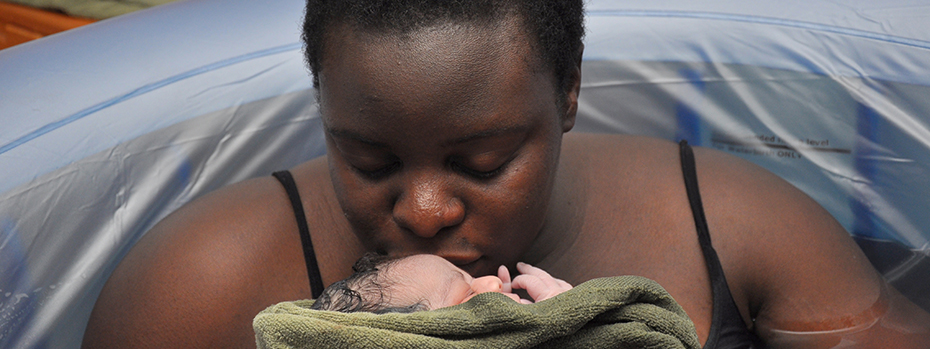
OHSU was the first hospital in Portland to offer water birth, an option that offers many women relief. You’ll find:
- Certified nurse-midwives with more than 20 years of water birth experience.
- An excellent safety record and high levels of patient satisfaction.
- Access to the resources and expert doctors at OHSU, Oregon’s top hospital, if needed.
What is water birth?
Water birth is the process of laboring and/or giving birth in a tub of warm water. Many women find that sitting or floating in water during labor helps them relax and manage pain. Some women choose to give birth in the water. Others only labor in the tub.
At OHSU, water birth is an option only if you choose delivery with our highly skilled nurse-midwives.
Complete care
- We follow rigorous guidelines to prevent infection.
- We use monitors that work underwater to track your baby’s heart rate.
- We are family-friendly and welcome your partner and doula.
What to expect at OHSU
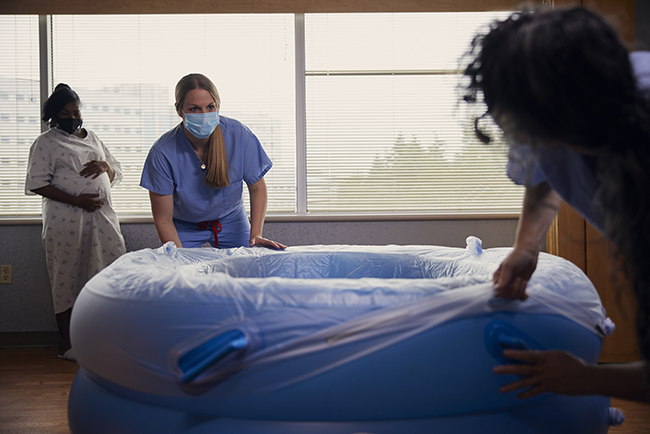
If you have chosen water birth with a nurse-midwife, a freestanding tub will be set up in your private birthing suite.
The tubs have a soft floor, high soft sides and a built-in seat. Water is kept warm. The tubs offer plenty of space for your partner. Every birthing suite also has a jetted tub and shower to help you manage labor pain.
Water birth videos
These videos are required viewing if you plan to labor or give birth in the tub. Watch to learn about:
- The benefits of being in water for labor and/or birth
- The guidelines for use of the tub
- Safety issues
Water immersion: Watch this video if you plan to labor in the tub, even if you don’t plan to give birth there.
Water birth: Watch this video if you plan to give birth in the tub.
Water birth benefits
Experts agree that laboring in water is safe and offers benefits. They disagree on whether there’s enough evidence that giving birth in water is safe.
- The American College of Obstetricians and Gynecologists recommends against water birth until there’s more data.
- Other experts, though, say studies already show that water birth with a trained professional is no riskier than a traditional birth.
- You can have the benefits of laboring in water even if you decide not to give birth in the water.
- Many risks of immersion and water birth — such as slips, falls and dehydration — are easy for your nurse-midwife to manage.
At OHSU, we’re committed to helping you understand the research so you can choose the best option for you. We’ve been doing water births with excellent patient outcomes since 1997. Find links to more information in our “Learn more” section below.
Benefits of laboring in water
- A positive birth experience: Women who have labored or given birth in water say they had less pain and a greater sense of control.
- Less pain medication: Some studies show that women who labor in water need less pain medication and may have a shorter first stage of labor.
- Relaxation: Floating in water can be soothing for many women. Your muscles don’t have to work as hard to support you. You can change position more easily. Being relaxed lowers stress hormones. This can give you a sense of reduced pain, and it may help your labor along.
- Improved blood flow: Soaking in warm water up to your shoulders can reduce your blood pressure. Better blood flow may protect your baby against stress during labor.
- Comfortable temperature: Being in water heated to your body temperature can help keep you from becoming chilled or overheated.
Possible benefits of giving birth in water
- Shorter pushing stage: More research is needed, but some women report that being in water shortens the pushing stage of labor.
- Fewer episiotomies: Giving birth in water may mean you’re less likely to need a surgical cut to enlarge the opening of your vagina. More research is needed, though.
Water birth safety concerns
Healthy babies begin to breathe only when they feel air on their mouth and nose. They do not try to breathe underwater.
Our nurse-midwives will make sure that you have your bottom and hips completely underwater when your baby is born. This prevents your baby from trying to take a breath. We lift your baby gently to the surface within seconds of being born. Then the baby starts breathing safely.
A change in your baby’s heart rate can be a sign of difficulty coping with labor. All babies are monitored during active labor with a waterproof Doppler.
For water births, we use a Doppler (like the fetal heart tones device used in prenatal care to check the baby’s heart rate) or continuous electronic heart rate monitors. If we see signs that your baby is having a problem, we will have you leave the tub.
If the cord tears, the baby could lose blood. Your nurse-midwife will be careful not to tug the cord as she lifts your baby out of the water.
If the umbilical cord is wrapped around the baby’s neck during birth, we may have to unwrap it or move the baby through it. We may ask you to change position or stand up.
Infection can come from two sources:
- Germs you carry into the pool
- Germs in the tub or water
Our safety precautions include:
- Our tubs contain chlorinated city water. During birth, you may lose fluid from your bag of waters, or pass urine, blood or stool into the tub. Research shows that most germs do not live long in chlorinated water.
- We use a new tub liner and hose for each patient.
- Tubs are cleaned with special products after each use.
- Your nurse-midwife will wear gloves to prevent cross-infection.
Water birth FAQ
There is no extra cost to use the water birth tub.
You must be a patient of OHSU’s nurse-midwifery practice to have a water birth with us.
To make an appointment with a nurse-midwife, please call the OHSU Center for Women’s Health at 503-418-4500.
To be approved for a water birth, you need to have a normal, low-risk pregnancy.
This means:
- You have not had a C-section.
- You are carrying one baby.
- You are at least 37 weeks pregnant when you go into labor.
- You have no sign of high blood pressure or gestational diabetes.
- Your baby is in a head-down position (not breech or transverse).
- You and your baby have no other health problems.
If you qualify for a water birth, you will need to:
- Watch our water immersion and water birth videos. (See above.)
- Have a hepatitis C test.
- Sign a consent form. This includes agreeing to get out of the tub if your nurse-midwife asks.
The nurse-midwife will lift the baby out of the water 5 or 10 seconds after birth. She will make sure not to tug on the cord, and she will untangle it if necessary. She may ask you to change position or stand up.
As soon as the baby is out of the water, you will hold your baby skin-to-skin to keep the baby warm and to promote breathing.
You will come out of the tub. Any problem for you or the baby will be handled the same way as with a traditional labor. When needed, all labor and delivery patients at OHSU have fast access to:
- Monitors
- Medications
- Anesthesiologists
- Childbirth specialists
- Newborn specialists
- A state-of-the-art NICU (neonatal intensive care unit)
We keep the water temperature close to your body temperature, about 98 degrees. This makes sure that your baby doesn’t get overheated. We encourage you to drink plenty of clear fluids to stay hydrated and comfortable.
Experts recommend that you get in the tub when your cervix is at least 4 centimeters dilated. Some research suggests that getting in earlier may slow labor.
If your labor slows while you’re in the tub, it’s a good idea to get out and walk around for 30 minutes or so.
Yes. Your partner should bring a swimsuit.
Learn more
- Certified nurse-midwife Michele Megregian on water birth, water immersion and safety
- Waterbirth International
- How valid are the common concerns raised against water birth? A focused review of the literature, Women and Birth
- Birth, Bath, and Beyond: The Science and Safety of Water Immersion During Labor and Birth, The Journal of Perinatal Education
- Doctors Say Don’t Give Birth to Baby in a Tub, But Midwives Disagree, National Public Radio
- Committee Opinion; Immersion in Water During Labor and Delivery, American College of Obstetricians and Gynecologists
For patients
Call 503-418-4500:
- To schedule an appointment.
- If you’re pregnant, to schedule a free 20-minute “Get to Know You” appointment.
Learn about our midwifery care at Hillsboro Medical Center (formerly Tuality).
Location
Parking is free for patients and their visitors.
Kohler Pavilion, seventh floor
808 S.W. Campus Drive
Portland, OR 97239