Herbert Memorial Lecture
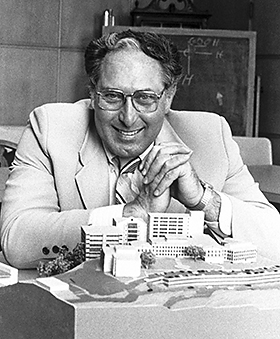
The Herbert Memorial story
The Herbert Memorial Lecture is given annually in honor of the Vollum's founding director, Edward Herbert. This event is sponsored by Cell Signaling Technology, which is directed by Michael Comb, a former Herbert graduate student. Each year, an outstanding scientist is invited to engage in discussion and fellowship with Vollum faculty and students, as well as to give an open talk to the university. Invited speakers embody the values of thorough, far-reaching, and elegant scientific investigations, for which Dr. Herbert was well known. They include Nobel Laureates Rod MacKinnon, Phillip Sharp, Erwin Neher, and Richard Axel.
The Vollum Institute has fulfilled its founders' aspirations by becoming a world-class neuroscience research institute that stands today as a testimony to his vision.
Dr. Herbert was posthumously elected to the National Academy of Sciences after his death on February 19, 1987.
Download Dr. Herbert's obituary (125 KB) written by John Adelman for the National Academy of Sciences.
2026 Herbert Memorial Lecture
June 11, 2026
Joanna Wysocka, Ph.D.
Lorry Lokey Professor and Professor of Developmental Biology
Chemical and Systems Biology
Stanford University
Hosted by: Marc Freeman, Ph.D., Director and Senior Scientist, Vollum Institute & Kelly Monk, Ph.D., Co-Director and Senior Scientist, Vollum Institute
Past Herbert Memorial speakers
-
2025
“MicroRNAs and the regulation of developmental timing”
Victor Ambros, Ph.D.
2024 Nobel Prize in Physiology or Medicine
Principal Investigator, Silverman Professor of Natural Sciences
Molecular Medicine
Umass Chan Medical School2024
"Human brain chimeroids as avatars to study interindividual variation in response to disease risk"
Paola Arlotta, Ph.D.
Golub Family and Harvard Professor of Stem Cell and Regenerative Biology, Chair of HSCRB, Neuroscience Program Co-Leader, Department of Stem Cell and Regenerative Biology at Harvard Medical School2023
"How Nature and Nurture Conspire to Regulate Brain Development and Plasticity"
Michael Greenberg, Ph.D.
Nathan Marsh Pusey Professor of Neurobiology, Department of Neurobiology at Harvard Medical School2020–2022: The Herbert Memorial Lecture was on hiatus during the Covid pandemic.
-
2019
"Primary cilia: What do they do, how do they work?"
David Clapham, M.D., Ph.D.
HHMI Janelia Research Campus, Boston Children's Hospital, Harvard Medical School2017
"Re-writing the language of life: Impacts and challenges of DNA editing"
Jennifer Doudna, Ph.D.
HHMI, University of California, Berkeley2016
"Illuminating biology at the nanoscale with single-molecule and super-resolution imaging"
Xiaowei Zhuang, Ph.D.
HHMI, Harvard University2015
"TRP channels of the pain pathway: Connecting physiology to atomic structure"
David Julius, Ph.D.
University of California, San Francisco2014
"Phosphoinositide signaling in the control of membrane dynamics and interactions"
Pietro DeCamilli, M.D.
HHMI, Yale University School of Medicine2013
"Modulating the gain of channels, cascades, and circuits"
Richard Tsien, Ph.D.
New York University Langone Medical Center2012
"Novel neural messengers of life and death"
Solomon H. Snyder, M.D.
Johns Hopkins University School of Medicine2011
"Information processing and integration of the basal ganglia"
Shigetada Nakanishi, M.D., Ph.D.
Osaka Bioscience Institute2010
"The emergence and function of spinal motor circuits"
Thomas Jessell, Ph.D.
HHMI, Columbia University Medical Center -
2008
"Making an Effort to Listen: Mechanical Amplification by Myosin Molecules and Ion Channels in Hair Cells of the Inner Ear"
A. James Hudspeth, M.D., Ph.D.
The Rockefeller University2007
"Watching the Brain Compute and Tracing Its Wires: New Methods to Solve Old Riddles"
Winfried Denk, Ph.D.
Max-Planck Institute for Medical Research2006
"An Rb/E2F/DP Complex and Chromatin Remodeling Antagonize a Ras Pathway during C. elegans Vulva Development"
Robert Horvitz, Ph.D.
HHMI, Massachusetts Institute of Technology2005
"Oxygen Sensation: Unconventional Signaling for an Unconventional Sense"
Cori Bargmann, Ph.D.
HHMI, The Rockefeller University2004
"The Atomic Basis of Selective Ion Conduction in Potassium Channels"
Rod MacKinnon, M.D.
HHMI, The Rockefeller University2002
"RNA Splicing and RNA Interference"
Phillip A. Sharp, Ph.D.
Massachusetts Institute of Technology2001
"Ca2+ Signals Controlling Neurotransmitter Release and Short Term Synaptic Plasticity"
Erwin Neher, Ph.D.
Max-Planck Institut für Biophysikalische Chemie2000
"The Return of the Human Genome"
Sydney Brenner, Ph.D.
Molecular Sciences Institute, Inc. -
1999
"The Molecular Biology of Smell"
Richard Axel, M.D.
HHMI, Columbia University1998
"Potassium Channel Regulation"
Lily Jan, Ph.D.
HHMI, University of California, San Francisco1996
"Trimeric G Proteins: Structure and Function"
Henry Bourne, M.D.
University of California, San Francisco1995
"ARIA: A Protein that Promotes the Maturation of Synapses"
Gerald D. Fischbach, M.D.
Harvard Medical School1991
"New Aspects of Peptide Hormone Biosynthesis"
Donald F. Steiner, Ph.D.
HHMI, University of Chicago