Jungers Center Symposia
Protein Modifications and Pathways to Neurodegeneration
1:00 - 4:00 p.m., June 17, 2025
Location: Richard T. Jones Hall 4320
Recording available to OHSU attendees
Featured speakers:
- Stuart A. Lipton, M.D., Ph.D.
Professor and Founding Director, Neurodegeneration New medicine Center
The Scripps Research Institute
"'Dark' Pathways of Protein Transnitrosylation Injure Synapses in Alzheimer’s Disease: Mechanism and Potential Treatment" - Alice S. Chen-Plotkin, M.D.
Professor of Neurology
University of Pennsylvania
"From Screens to Mechanisms in Parkinsons Disease" - Lorraine Kalia, M.D., Ph.D.
Associate Professor of Neurology
University of Toronto
"Interaction between alpha-synuclein and ESCRT: a potential therapeutic target for Parkinson's disease” - Tony Wyss-Coray, Ph.D.
Professor of Neurology
Stanford University
"Impaired synaptic protein turnover with aging and neurodegeneration"
Past Jungers Symposia
2024 Proteinopathies in Neurodegenerative Disease
Featured speakers:
- Virginia Lee, Ph.D.
University of Pennsylvania
Transmission of Misfolded Proteins in Neurodegenerative Disorders: A Common Mechanism of Disease Progression - Susanne van Veluw, PhD.
Harvard Medical School
Mechanisms of microvascular injury in cerebral amyloid angiopathy - Vikram Khurana, M.D., Ph.D.
Brigham and Women’s Hospital and Harvard Medical School
The Systems Cell Biology of Alpha-Synuclein: From New Functions to Targeted Therapeutics - Michelle Gray, Ph.D.
University of Alabama at Birmingham
Astrocyte-interneuron interaction in Huntington’s disease
2023 Neurodegeneration & Repair Mechanisms
Recording available to OHSU attendees
Featured speakers:
- Martha Bhattacharya, Ph.D.
Brigham and Women’s Hospital and Harvard Medical School
Genetic Analysis of Parkonism - Kelvin Luk, Ph.D.
University of Pennsylvania
Can alpha-synuclein propagation patterns predict disease trajectory? - Trent Watkins, Ph.D.
University of California at San Francisco
Harnessing Cellular Stress Signaling for Neuroprotection and Repair - Mel Feany, M.D., Ph.D.
Brigham and Women’s Hospital and Harvard Medical School
Genetic Analysis of Parkonism
2022 Neurovascular Interactions
Recording available to OHSU attendees
Featured speakers:
- Richard Daneman, Ph.D.
University of California, San Diego
Regulation of the Blood-Brain Barrier in Health and Disease - Cam Ha Tran, Ph.D.
University of Nevada, Reno
The Role of Neuromodulatory Signaling in Neurovascular Coupling - Harald Sontheimer, Ph.D.
University of Virginia
Glial, Neuronal, Vascular Interactions in Neurological Disease
2021 Wrapping the axons: The mysteries of myelination
Recording available to OHSU attendees
Featured speakers:
- Mikael Simmons, M.D.
Institute of Neuronal Cell Biology, Technical University of Munich
Mechanisms of remyelination and neuroprotection - Wendy Macklin, Ph.D.
Anschutz Medical Campus, University of Colorado
A clinically relevant demyelination/remyelination model: Role of microglia - Michelle Monje, M.D., Ph.D.
Stanford University
Neuron-glia interactions in health and disease: From cognition to cancer - Stephen Hauser, M.D.
Weill Institute for Neurosciences, University of California, San Francisco
Multiple sclerosis: Past, present and future
2019 Glial-Neuronal Interactions in Health & Disease
Featured speakers:
- Aakanksha Singhvi, Ph.D.
Fred Hutchinson Cancer Research Center
Molecular mechanisms of glia-neuron interactions in C. elegans - James Salzer, M.D., Ph.D.
New York University
Axo-glial interactions & the assembly of myelinated fibers - Sarah Kucenas, Ph.D.
University of Virginia
Migratory neural crest cells phagocytose cellular debris in the developing nervous system - Beth Stevens, Ph.D.
Harvard University
Microglia function & dysfunction in Alzheimer's Disease
2016 RNA Granules: From Synaptic Plasticity to Neurodegeneration
Featured speakers:
- Kelsey Martin, M.D., Ph.D.
Professor of Biological Chemistry, Psychiatry and Biobehavioral Sciences Exec Vice Dean and Assoc Vice Chancellor, David Geffen School of Medicine, UCLA
Spatial regulation of gene expression during synaptic plasticity - Jennifer Darnell, Ph.D.
Research Associate Professor
Laboratory of Molecular Neuro-oncology
Rockefeller University
Translational Control by the Fragile X Mental Retardation Protein: Targets and Mechanism - Benjamin Wolozin, M.D., Ph.D.
Department of Pharmacology and Neurology Laboratory of Neurodegeneration Boston University School of Medicine
Stress granules and Neurodegeneration: A molecular network underlying neurodegeneration - J Paul Taylor, M.D., Ph.D.
Chair, Cell and Molecular Biology, St Jude’s Children’s Research Hospital Investigator, HHMI
Perturbed RNA granule dynamics in ALS and related diseases
2015 Jungers Center Plenary Lecturer
Featured speaker:
- Moritz Helmstaedter
Dr. med., Dipl.-Phys., Department of Connectomics, Max Planck Institute for Brain Research, Frankfurt, Germany
Connectomics - the dense reconstruction of neuronal circuits
2014 Jungers Center Symposium - The genetics and genomics of neuropsychiatric disease
Featured speakers:
- James Lupski, M.D., Ph.D.
Baylor College of Medicine
Personal Genomes and Clan Genomics - Stephan Züchner, M.D., Ph.D.
University of Miami
From new tools to discovery: the contribution of rare genomic variation to disease
2013 Jungers Center Symposium- Neurodegeneration: New Mechanisms and New Insights
Featured speakers:
- Karen Duff, Ph.D.
Columbia University
Propagation of Alzheimer's pathology through the brain-mechanistic insights and therapeutic opportunities - Gary Bassell, Ph.D.
Emory University
mRNA traffic, local translation and neurodegenerative disease - Aaron Gitler, Ph.D.
Stanford University
High-throughput genetic screens to define mechanisms of human neurodegenerative diseases Don Cleveland, Ph.D.,University of California, San Diego
From Charcot to Lou Gehrig: Mechanism and therapy in ALS and beyond
2012 Jungers Center Symposium - New Imaging Technologies, New Insights into the Brain
Featured speakers:
- Jeff Lichtman, M.D.
Harvard University
Using connectomics to reveal circuit motifs - Tim Holy, Ph.D.
Washington University
Getting a feeling for the circuit: Imaging neuronal ensembles with Objective-Coupled Planar Illumination Microscopy - Tianyi Mao, Ph.D.
Vollum Institute
Imaging of Functional Connectivity in Cortical and Subcortical Circuits - Tim Murphy, Ph.D.
University of British Columbia
In Vivo Imaging of Cortical Circuits, Before, During and After Ischemia
2011 Jungers Center Symposium - Repairing the nervous system: Lessons from flies, fish, and mice
Featured speakers:
- Michael Coleman, Ph.D.
Babraham Institute, Cambridge
From long-lived axons to a short-lived protein: WldS and Nmnat2 - Christine Beattie, Ph.D.
Ohio State University, Columbus
Modeling human motoneuron diseases in zebrafish: Approaches and outcomes - Aaron DiAntonio, Ph.D.
Washington University, St. Louis
The axonal injury response: Lessons from flies and mice - Tony Wyss-Coray, Ph.D.
Stanford University
A novel role for TGF-beta signaling in adult neurogenesis
2010 Jungers Center Symposium - Glial-Neuronal Interactions: Implications for Neurologic Diseases
Featured speakers:
- Klaus-Armin Nave, Ph.D.
Max-Planck-Institute of Experimental Medicine, Göttingen
Myelination and the glial support of axon function - Elior Peles, Ph.D.
Weizmann Institute
How Schwann cells assemble Nodes of Ranvier - William S. Talbot, Ph.D.
Stanford University
Glial development and myelination in zebrafish - Jonah Chan, Ph.D.
University of California, San Francisco
Maximizing the myelinogenic potential of individual oligodendrocytes for repair
2009 Jungers Center Symposium - Axonal Degeneration and Regeneration: Towards an understanding of the pathogenesis of multiple sclerosis, Alzheimer's and related diseases
Featured speakers:
- Marc Freeman, Ph.D.
University of Massachusetts
Axon auto-destruction and glial immune functions during Wallerian degeneration - Julie Pinkston-Gosse, Ph.D.
Genentech
Common mechanisms of axonal degeneration and regeneration block - Marie Filbin, Ph.D.
Hunter College
Signaling axonal regeneration in the adult CNS - Martin Kerschensteiner, Ph.D.
Ludwig-Maximilians University, Munich
In vivo pathogenesis of immune-mediated axon damage
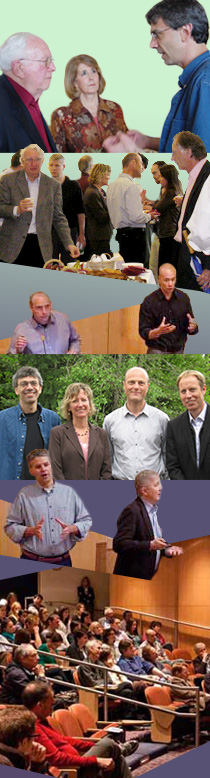
Scenes from past symposia