Academic Assessment

We are always learning new ways to improve health care and health equity in our communities. However, the lessons we learn only have an impact if we can teach them to the next generation effectively. Academic assessment is how we measure efficacy and improve health sciences education at OHSU.
OHSU assesses student learning outcomes through the measurement of graduation core competencies shared across all our academic programs.
On this page, we'll cover:
How does assessment benefit students?
- Promoting equity: Clear and measurable learning goals help all students understand what’s expected from day one through graduation.
- Proving education quality: We share assessment outcome data so prospective students know our programs are worth their time, effort and money.
- Aligning goals: We use outcome data to make sure programs and services meet student needs as the health care field evolves.
How does assessment work at OHSU?
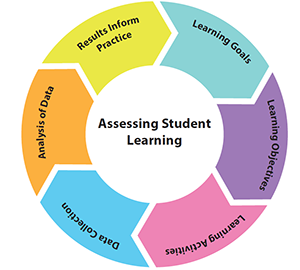
Academic assessment at OHSU is a continuous process of improvement where last year’s data informs this year’s plan. Data comes from student learning outcomes — what our students learn and how we know they understand key topics.
Our faculty and university leadership work together to identify student learning outcomes, measure student performance and identify changes that will improve programs and student resources.
Annual assessment process
Assessment starts at the beginning of each academic year. On Nov 1, faculty from each program submit a report on the previous year’s assessment data and a plan for the upcoming year’s assessment activities. The OHSU Assessment Council reviews these and provides feedback by March 1.
-
Aligning to core competencies
Each student learning outcome fits into one of seven OHSU core competencies — domains of knowledge, skill or ability critical to success for health professionals. We use core competencies to guide educational improvement by aligning what students need, how programs teach and OHSU’s mission.
Core competencies (revised 2024)
- Professional knowledge and skills: Graduates show competence in the core knowledge, skills and practices as defined by the discipline, professional licensing or accreditation organization while being open to new perspectives, additional voices and changes in schools of thought that impact the core knowledge, skills and practices in the discipline.
- Professional identity and ethical behavior: Graduates show competence in discipline-specific behaviors, norms and ethics while also recognizing and challenging racist professional expectations which can cause undue burden and/or deny the full humanity of ourselves, our peers and our patients.
- Information literacy: Graduates recognize the power of information in educating, influencing and understanding the world, while seeking and amplifying missing perspectives; and, with this lens, can locate, critically evaluate and effectively use information to participate in decision-making, quality improvement and broader scholarly discourse.
- Communication: Graduates communicate effectively and equitably with diverse individuals, organizations and communities to support stakeholder decision-making and promote culturally responsive exchanges of information.
- Teamwork: Graduates work effectively within collaborative, interprofessional environments while acknowledging positionality and intentionally making space for diverse perspectives.
- Community engagement, social justice and equity: Graduates apply principles of social justice, equity and/or anti-racism through community-engaged practice, service or scholarship.
- Patient centered care (clinical programs only): Graduates collaborate with diverse individuals, families and communities to provide quality trauma-informed care that is anti-racist and respectful of and responsive to preferences, needs, attitudes, beliefs and values.
-
Planning assessments
Each program’s assessment plan details student learning outcomes and how they will be assessed. The Assessment Council reviews plans based on assessment planning criteria. Student learning outcomes must:
- Be clearly written, such that non-experts can understand them.
- Be communicated to students on the program or department website.
- Reflect differences between learning levels (such as certificate versus terminal degree) or specializations.
- Align to core competencies — at least one outcome must align with each of the seven core competencies.
- Align to OHSU’s Evidence of Learning and Impact Framework, which allows for varied approaches to assessment (including knowledge, competence, performance, impact of learning on the student and intended impact of learning on others).
-
Collecting assessment data
During each academic term, faculty collect data by performing assessment activities. To best assess program efficacy, activities should balance direct or indirect, quantitative or qualitative and objective or subjective measures across these categories:
- Assessment of knowledge, such as essay questions or oral exams.
- Comprehensive review, such as dissertations or portfolios.
- External performance observation by community members such as patients or employers.
- External review of student work, such as research approval or national assessments.
- Impact data, such as patient health metrics or changes to procedure or policy.
- Institutional satisfaction or demographic surveys on topics such as course evaluation or community food insecurity.
- Internal performance observation during simulations, clinics or research activities.
- Presumptive assessment due to a lack of contrary evidence, such as having no professionalism citations.
- Self-assessment, such as interviews or journals.
Faculty use numerous tools to inform assessment activities and collect results, including but not limited to:
- The OHSU assessment handbook, which provides practical information for all things assessment.
- The assessment app, where faculty document their assessment plans and results.
- Our learning management system, which is a digital platform for course management, testing and student interaction.
- The Teaching and Learning Center, which includes ongoing and archived lectures on a wide range of assessment topics.
-
Ensuring OHSU-wide, equitable input
Groups at every level of the institution contribute to academic assessment, from students to executive leadership. Diverse input leads to a more complete understanding of data and more effective program changes.
These groups regularly share assessment feedback with faculty:
- The Assessment Council oversees the annual assessment process.
- The Faculty Senate and Academic Program Review Committee together oversee evaluation of overall program quality every five years. These academic program reviews inform and are informed by assessment.
- The Office of Educational Improvement and Innovation informs every aspect of assessment and provides support services to faculty and students. Services span six areas: mentoring and career design; space and technology for focus and teamwork; educator excellence; information literacy and knowledge management; assessment and evaluation; and creative and scholarly storytelling.
- The All-Hill Council and Student Services Workgroup give students a voice in program and service changes.
- Curriculum sub-committees from each school provide specialized input on recommended changes to a program’s curriculum.
- The offices of Academic Affairs, Finance, and Marketing and Strategic Communications provide specialized input and strategic support when programs change.
- The Office of the Provost, OHSU Board and university president provide annual review and oversight on strategic direction.
Equity principles
We ask all participants to root their feedback in principles of equity. Using these principles, we can better identify and reduce disparities that arise from social determinants of health.
- We move forward by working together. Open-mindedness and inclusion underlie our approach to discovery, innovation and healing.
- We strive to dismantle systemic racism and inequality. Power, privilege and positionality impact how people function and interact in the world.
- We are committed to lifelong learning. Staying informed allows us to adapt as scientific knowledge and best practices evolve.
-
Analyzing and reporting results
Each year, faculty analyze the data and feedback from the previous year and report their findings. The Assessment Council and other relevant groups review reports based on assessment reporting criteria:
Did students meet student learning outcome targets? If not, why?
For each assessment activity, faculty define a target level of achievement (such as 85% of students will pass their licensure exam on the first attempt). Assessment reports identify which targets have been met, explain why targets were not met or partially met and propose improvements.
Who outside the program provided assessment feedback and how?
Reports include details on the groups and people who gave input during that year. Ideally, faculty seek regular feedback from staff, students, alumni, external stakeholders, employers and other faculty members.
How did data and feedback inform potential improvements to education at OHSU?
Assessment reports show how proposed changes to programs, courses or assessment activities are data-informed. Faculty also address the previous year’s Assessment Council recommendations.
-
Making changes to improve education
Assessment reports also include an action plan that specifies what’s required to realize proposed changes. The Assessment Council and all other relevant groups review action plans in detail before approval.
Once the action plan is approved, the groups work together to implement the changes and realize a better vision of health sciences education at OHSU. The assessment process concludes, and the next cycle begins.
Faculty resources and support
Assessment at OHSU begins and ends with our faculty members. The Assessment Council provides resources to help faculty plan effectively and make impactful changes.
- The Teaching and Learning Center offers workshops, modules and other resources about teaching, learning and assessment. Topics range from course and program assessment planning to digital accessibility, student engagement, addressing bias and more. Faculty can also request a consultation for tailored, expert guidance on these topics.
- The Assessment lending library lends faculty resources for deeper exploration of assessment topics.
How has OHSU used assessment data to improve education?
OHSU uses assessment data to make evidence-based changes to academic programs, student services, institutional practices and the assessment process itself.
Find past assessment reports in our digital collections archive
-
Academic programs
Assessment directly improves our academic programs through changes to courses, curriculum, learning activities and assessment activities.
Some of the most recent highlights include:
- 91% of programs used assessment data to improve or maintain the achievement of student learning outcomes.
- 93% of B.S. nursing students passed senior-level credentialing examinations on the first attempt.
- 100% of D.M.D. students passed senior-level credentialing examinations on the first attempt.
- 83% of pharmacy students passed senior-level credentialing examinations on the first attempt.
- 99% of M.D. students passed senior-level credentialing examinations on the first attempt.
- 100% of M.D. graduates matched to a residency program.
-
Student services
The Assessment Council surveys students and works with student representatives to better understand how to improve services and resources. These services offer vital support for student learning, well-being and community.
Some recent highlights include:
- 100% of Central Student Services units created, followed and reported on a continuous assessment plan mapped to meaningful OHSU and/or professional standards.
- The OHSU library opened a new study room, expanded access to journals, created an interlibrary loan service and improved website usability.
- The financial aid office started the awarding process six weeks earlier and hired more staff to improve response times.
- Student Affairs improved communication around student services, activities and intramural sports.
-
Institutional practices and culture
Assessment requires an institutional environment that fully embraces data-driven change. We both cultivate expertise in areas that inform assessment and foster a culture of inquiry, scholarship and collaboration.
Some recent highlights include:
- Faculty provided feedback that they did not feel equipped for difficult conversations around diversity, equity, inclusion and anti-racism. We developed the Fostering Respectful and Equitable Education initiative to provide professional development in these areas.
- New faculty needed guidance around assessment and OHSU values. We improved faculty onboarding communications to help new faculty align with our mission and approach to assessment.
- OHSU researchers wanted in-house opportunities to develop mentoring skills and qualify for federal training grants. We developed the Mentorship Academy.
-
Assessment process
We also search for ways to improve the assessment process itself. We’ve made major changes to assessment over its history at OHSU, leading to more accurate data and more impactful improvements to education.
Some recent highlights include:
- In 2017, Constance Tucker, vice provost for Educational Improvement and Innovation, introduced a new assessment process. The process aligns student learning outcomes and core competencies to better meet NWCCU accreditation standards.
- In 2019, we launched a new in-house assessment data platform, which aims to make analysis more efficient, accurate and accessible. Features include standardized queries, automated calculations and easier data exports.
- In 2022, we revised the list of assessment methods to reduce complexity and better align methods with core competencies.
- In 2022 we replaced Moore’s Framework with the more effective Evidence of Learning and Impact Framework. This approach to measuring outcomes includes equity lenses for participation, satisfaction and achievement.
For faculty
Faculty can find support, resources and tools for assessment through the Educational Improvement and Innovation page on O2.
-National Institute for Learning Outcomes Assessment
Assessment awards
Each year, the Assessment Council awards six badges to programs for thoughtful, innovative and excellent assessment work. These awards recognize the unique contributions our faculty members make to sustaining and improving a culture of assessment at OHSU.
2025 award recipients
Transparency in Program Outcomes
Equity in Assessment
Stakeholder Engagement
Excellence in Program Assessment
- M.P.H. in Biostatistics
- M.S. in Biostatistics
- Ph.D. in Clinical Psychology
- Dietetic Internship Graduate Certificate
- D.M.D.
- M.S. in Healthcare Administration
- M.B.A. in Healthcare Management
- M.P.H. in Health Management and Policy
- M.P.H. in Health Promotion
- M.S. in Human Nutrition
- M.D.
- M.S. in Medical Physics
- B.S. in Nursing
- D.N.P. in Pediatric Primary Acute Care
- Physician Assistant
- B.S. in Radiation Therapy
Scholarship of Assessment
No recipients this year.
Excellence in Student Services Assessment
No recipients this year.