Distance Learning Programs
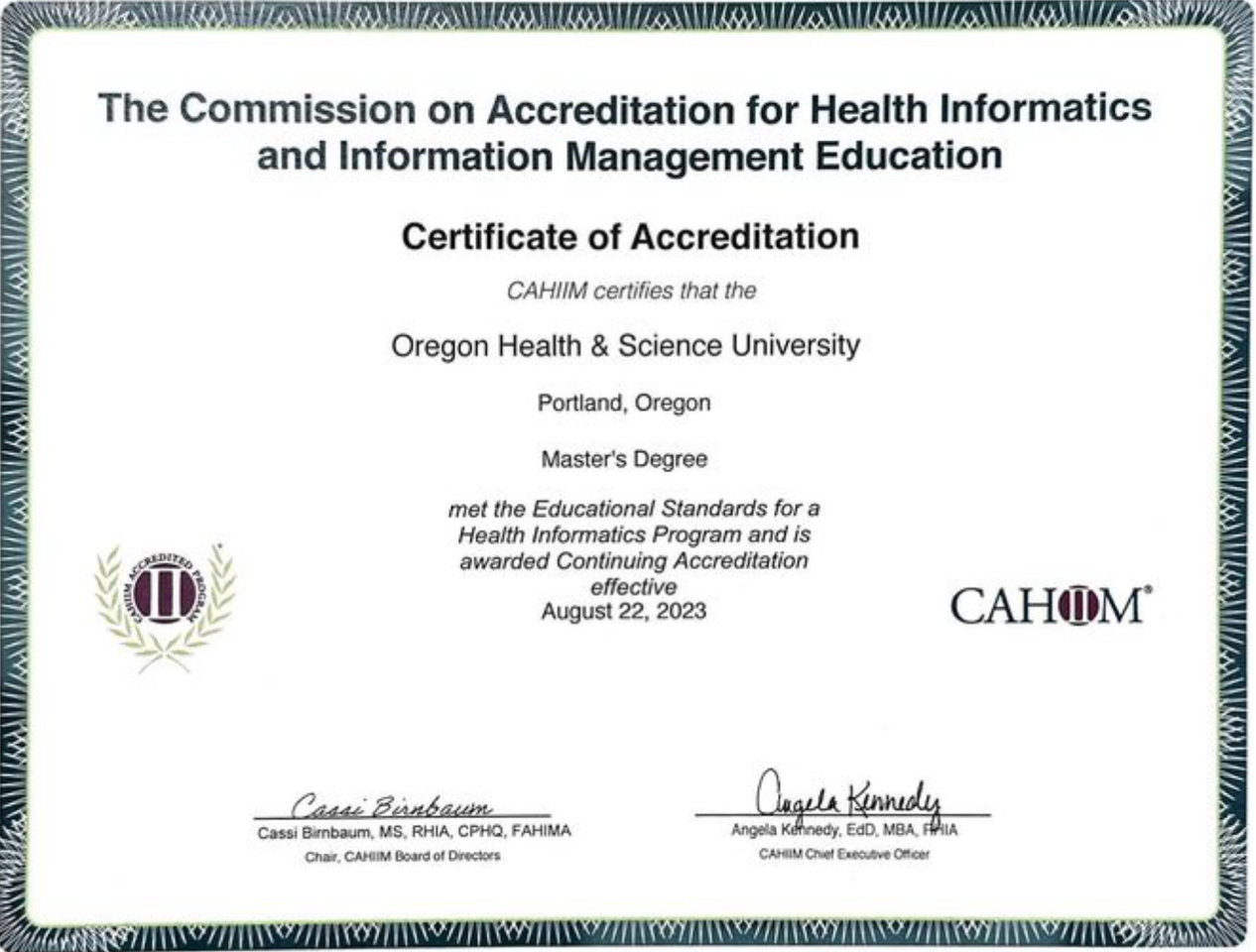
Three of our programs include a distance learning option. The AMIA 10x10, Graduate Certificate, and Master of Biomedical Informatics programs are all available via our distance learning system. For more information on any of these options, please see the corresponding synopsis below.
As of Fall of 2008, our Graduate Certificate program in Health Information Management is available to distance learners as well.
Graduate Certificate in Biomedical Informatics
The goal of the OHSU Graduate Certificate in Biomedical Informatics is to provide knowledge and skills in the application of information technology (IT) to healthcare. Graduates of the program have taken on additional IT responsibilities in their existing careers or embarked upon new careers as developers and managers of healthcare IT systems. In the program, individuals with a variety of background stake courses in medical informatics, management, and related areas to gain the expertise necessary to assume positions that require a thorough understanding of both IT and the healthcare environment.
The program is geared to meet the educational needs of both healthcare and non-healthcare professionals seeking additional training in information management and technology. This is accomplished by providing students with a theoretical and practical understanding of the role of information in healthcare; a sound basis for implementing, developing, maintaining, and managing information resources and systems in health care; and skills in the management of health information, technology, and decision making.
The program may serve as an entry point for enrollment into the Master of Biomedical Informatics (MBI) or Master of Science (MS) in Biomedical Informatics programs. Additionally, members of AMIA, HIMSS, and AMDIS are eligible for a 5% discount on tuition in this program.
[in-depth description]
Graduate Certificate in Health Informatics Management
Health Information Management is based on the philosophy of quality healthcare through quality information. Quality information is essential to all aspects of today's healthcare system. Health information management (HIM) is the body of knowledge and practice that insures the availability of health information to facilitate real-time healthcare delivery and critical health-related decision making for multiple purposes across diverse organizations, settings and disciplines (AHIMA, 2007).
The curriculum includes a unique blend of Health Information Management foundation coursework and Biomedical Informatics with an underpinning of ethical decision-making in health information collection and dissemination.
Certificate courses are offered via distance learning. Courses can be taken on campus as well.
Master of Science in Biomedical Informatics
The OHSU Master of Science (MS) in Biomedical Informatics is an on-campus program requiring a master's thesis. The primary goal of the program is to educate the future developers and managers of health care information systems, as well as researchers in bioinformatics. The program also allows those who already have a doctoral degree to pursue research interests in medical informatics, preparing them for research positions in academia or industry. Since 1996, over 100 students have matriculated. Most have gone on to assume jobs in industry and academia at such institutions as OHSU, the National Library of Medicine, Cerner Systems, Epic Systems, Vanderbilt University, WebMD, Kaiser-Permanente, and Protocol Systems.
Within the Masters Program, there are two courses of study that students may pursue - a track in Bioinformatics and a track in Medical Informatics. There is some amount of overlap between the two, and they have several courses and electives in common; however, students are expected to select one of these two concentrations as their primary focus.
Bioinformatics deals with the analysis, handling, and comprehension of the large amounts of data produced by advanced techniques employed used in modern biological research (especially genomics, proteomics, and molecular and cellular biology). Our Bioinformatics track offers a rigorous, interdisciplinary submersion in statistics, algorithms, research methods, biology, and computation, with special attention paid to the areas that these competencies overlap (i.e. - computational biology). Students are thus given the knowledge and skills to become successful researchers and analysts within the field.
The track in Medical Informatics gives students a solid grounding in medical informatics, health and medicine, computer science, and research methods. Students in our MS program are prepared to assume positions that require a thorough understanding of both information technology and the health care environment. Although the curriculum has a large core of courses, it can be individualized so that those with a prior background in one area (i.e., a health care professional or computer scientist) can focus on other areas to strengthen the breadth of their knowledge.
[in-depth description: bioinformatics track]
[in-depth description: medical informatics track]
Master of Biomedical Informatics
The MBI is identical to the Master of Science (MS) in Medical Informatics Program with the exception that a thesis is not required. Instead, students are required to take additional elective courses and complete a Capstone Project. Additionally, where the MS is an on-campus only program, students earning an MBI may study either on-campus or through our distance learning system.
[in-depth description: bioinformatics track]
[in-depth description: medical informatics track]
Doctor of Philosophy in Biomedical Informatics
We seek individuals with a variety of backgrounds who desire to obtain a strong technical grounding in medical informatics, health and medicine, computer science, and research methods so that they may assume positions that require a thorough understanding of information technology, health, and biomedicine. The major goal of the program is to develop independent researchers, dedicated teachers, and imaginative leaders in health care, academia, and industry.
DMICE's PhD in Biomedical Informatics offers students the knowledge base of biomedical informatics and the skills to carry out research in this area. The knowledge base primarily builds from coursework and experiences already in the OHSU master's degree programs, enhanced with more advanced courses. The emphasis is on research at a level that will allow students to make novel contributions to the field through the requirements of a doctoral dissertation.
A unique aspect of the program is the requirement for advanced training in a cognate area such as Computer Science, Biomedical Engineering, Environmental Science Engineering, Public Health, Nursing, System Science, Anthropology, or Education. Courses for the cognate area can be taken from the OHSU School of Science & Engineering or nearby Portland State University.
[in-depth description]
Fellowship Opportunities at OHSU
OHSU offers predoctoral and postdoctoral research training fellowships in biomedical informatics. Support for the programs comes from the National Library of Medicine, Kaiser-Permanente, and the U.S. Department of Veterans Affairs. By providing a structured research experience with the option of coursework and/or pursuit of a degree, the program prepares fellows to undertake independent biomedical informatics research in the academic community, or to assume leadership positions in the growing number of hospital and/or commercial efforts in biomedical informatics.
Fellows engage in a rigorous and dynamic program of study. Although they survey the field broadly during their fellowship, they also focus on and complete a significant research project which is presented in both oral and written form. All classes within the department are made available to fellows, as well as courses throughout OHSU and our consortium of nearby universities. Fellows often take part in one of several seminar series, including the Division of General Internal Medicine seminar series and the department's own weekly seminar which features a range of speakers from both within and without the department.
[in-depth description]
AMIA-OHSU 10x10 Certificate in Biomedical Informatics
The introductory-level, distance learning program at OHSU is the 10x10 Program. Run in partnership with the American Medical Informatics Association (AMIA), this program aims to train individuals at the Expert level. The 10x10 moniker comes from a goal to train 10,000 health care professionals by the year 2010 in basic informatics so they can be local experts representing users in their communities. This course, which is administered by AMIA, is an adaptation of the introductory course in the OHSU curriculum, with an addition of a 1-2 day in-person session covering additional material in an interactive manner. Although 10x10 does not grant degrees, the course can be used for subsequent credit in the other OHSU programs pending successful completion of a final exam (which is not otherwise required in 10x10).
[in-depth description]