2013

“I’ll do it during winter break.”

My wife heard this phrase a lot between August and December. It was used for everything from getting the baby’s room done to washing the car. Really it was an attempt by me to prioritize things without ignoring them completely. . . So naturally, come winter break, my honey-do list was enormous.

I managed to get 80% of the projects done: baby room mostly set up, laundry room ceiling framed and drywalled, new floors in the office, car not washed. Not too bad for a guy who also managed to squeeze in a double-header movie day in as well.

I’m nervous though.

Nervous because I don’t think this way of prioritizing is going to work very well anymore. I can’t exactly postpone taking step 1 of the boards, and I can’t exactly postpone spending time with our new baby boy (who we’re expecting at the end of February or so).  So what is going to give? I’m not sure, but I know that people have done it, and that they’ve even done it with more responsibilities than I have. Reading blogs like the one Dr. Alison Christy posted (titled “Balancing Act”) makes me realize that it is possible, and that things probably won’t be getting any calmer for a long time.

Fortunately, being excited is overriding the being nervous: Excited to take the USMLE step 1, excited to start 3rd year clerkships, excited to meet my son for the first time, excited to start our family. 2013 will be a good year!

Academia vs. Industry: Double-post edition

During job interviews—at least in the tie-wearing, business-jargon-having corporate world—prospective employers generally ask something like: Where do you see yourself in five years?

I base this observation on rumor, speculation, and reading Dilbert cartoons, well, because I’m a newly minted grad student. I have no experience with the corporate world.

Besides, the career trajectory of a researcher, not unlike Calvinist doctrine, is subject to predestination: I know where I’ll be in five years. Most likely, I’ll have just graduated with my PhD and, having accepted a post-doc position, will probably spend another five years somewhere else doing research. Successful business majors, eat your heart out.

At this point, however, this career trajectory becomes less prescribed. After the post-doc position, the researcher’s career path bifurcates into two separate yet equally important groups: the academics who investigate problems, and the industry members who profit from the discoveries. These are their stories. *clang clang*

Read more…

I survived ACLS

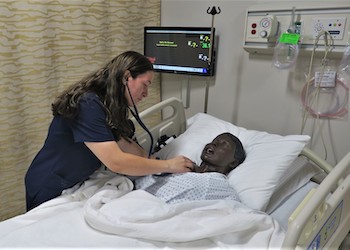
“Your patient is a 58 year old male presenting with chest pain 8/10, pulse is 190, BP 80/70 and respirations 20,” the instructor said. “Suddenly he snorts and collapses; you see this rhythm. What do you want to do?”

I swallowed and looked down at the greyish plastic face of the mannequin and watched as little black lines squiggled their way across the EKG monitor with an impending sense of doom. Somebody call a code, I think I’m having a heart attack!  SVT, V-tach, PEA, Amiodarone, Adenosine, Atropine…my brain raced through a jumble of names and symptoms and algorithms.  Just like an episode of ”ER”, the world suddenly seemed to move in slow motion around me.  The sound of my own heart thundered in my ears.  I was running my first simulated major code!

For the first three days of Christmas break, I decided to tackle the challenge of Advanced Cardiac Life Support (ACLS) certification. I signed up for the course eager for a chance to learn more about EKG interpretation and to practice more advanced nursing skills. I was not disappointed.  The challenge on day one was absorbing a mountain of information and forcing myself to sit still for the better part of 8 hours. After deciphering what must have been miles of rhythm strips, I was still at a loss to identify runs of PAC’s from third degree heart block. I left, slightly disheartened (pun intended) with rhythm strips and terminology scrambled in my mind and all over my notebook. I had even drawn a bundle branch block on the back side of my hand when the margin of my paper was full.

Read more…

Surviving the s#*t storm

We’re all familiar with success. A resume composed entirely of failures doesn’t get you into a graduate degree program. We’ve been on honor rolls, dean’s lists, members of academic honor societies, and won our fair share of awards. Let’s face it, that’s the only way you get accepted to a place like OHSU; if your parents’ refrigerator had arms, it would reach out and pat you on the back. But is that still the case? Mostly, our lives are no longer dominated by consistent graded feedback. Yet, even when they are, the academic rigor has escalated exponentially. No longer does merely “showing up” guarantee a B. Instead, the quality of competition is enhanced and fewer recognitions are available. The form and frequency of performance feedback has shifted during graduate school, and how we handle this change greatly impacts our long-term motivation and thus, success.

In high school, I supplemented graded feedback with weekly successes on the ice rink, the soccer field, or the volleyball court. Then in college, I stoked the competitive fire by competing on our college hockey team and in weekly intramurals. This meant that a poor test performance, or a competitive loss could be volleyed by a decent grade in another class or a win on the ice. These multiple pathways to achieving successes were important for preventing the negative feedback loop by which a series of failures seemed to always beget another. But the greater independence inherent in obtaining a graduate degree is accompanied by infrequent and inconsistent feedback, now limited to grant and manuscript submissions, each taking weeks/months before feedback is received. While many find the greater independence refreshing, and we’re grateful to be unshackled by looming exams and persistent evaluations, we also sacrifice the opportunity to experience those mini victories to which we had become conditioned.

Read more…

Why I chose PhD, Part Two

This is the long-awaited conclusion to Part One, the fascinating and hackneyed story of my decision to go to graduate school instead of medical school.

I apologize for the monumental gap between posts. Graduate school is clearly more difficult and time-consuming than I expected, and studying is always more important than short-form navel-gazing. But I wanted to conclude my first post, if only to prevent this response from becoming my Chinese Democracy—eagerly awaited (*cough, cough*) and ultimately somewhat disappointing.

Previously, I mentioned that my interest in graduate school was practically unavoidable, and I used the metaphor of railroad tracks (the iron way!) to characterize its immutability. But coming to this understanding was difficult because I always wanted to be a physician. Medical school became my Polaris, and I navigated my undergraduate course under its direction, shadowing doctors, volunteering at hospitals, joining pre-med clubs. I enjoyed learning about medicine, particularly medical research, and was prepared—confident, even—to fulfill my lifelong dream of becoming a physician.

Read more…

Doing one thing well

As we struggle to finish up our Fall quarter I am sure it leaves many of us feeling that we didn’t do anything well today, this week, or this quarter. We forgot to go back and see a patient, we didn’t call a friend back, we missed an deadline. Why is this? For me it is that I fall into the trap of trying to do too many things simultaneously, I over commit, I make agreements I know will keep me up at night. Or rather, it is a habit. A BAD HABIT at that. It’s a habit that leaves me beating myself up as I attempt to fall asleep.

So how can I change this? The answer is not more half hearted, caffeinated late night multi-tasking extravaganzas. The answer is being PRESENT for the one task at hand. Focusing on the one paper to write, not thinking of the other research we need to do, engaging with the one patient we are seeing at that moment, not the one that is in the operating room, listening to the one person we are having coffee with, not texting and trying to google something. Habits that keep us grounded in the present moment are GOOD HABITS.

This being present in the moment is how we build the habit of doing one thing well. If tomorrow you only focus on doing one thing well what will it be? Will it be focusing on really listening to the patient history for hidden clues, will it be focusing on how you research, focusing on how you talk to a concerned family member, focusing on your suture technique? If we make the conscious choice each day to be present, to the task at hand, then we will have succeeded at many of the tasks set before us, because we will be doing the one at hand well.

I now challenge you to do one thing well today, and tomorrow, and next week.

My heart melted

The first day of my pediatric rotation I was scared. I was scared of the little kids, the dry crusty snot under their noses, the crying, the getting peed on during infant well child exams, the trying to perform an otoscopic exam on a screaming child; all of it. I went home that first day realizing that kids aren’t just little adults. That night I memorized milestones from my Bright Futures pocket book, reviewed all the different viral exanthems, and discovered that the first-line treatment for every bacterial infection in pediatrics is amoxicillin (not really, but it seemed like it). My second day, I was more prepared. I wasn’t going to let the little buggers or their parents phase me. I figured out how not to get peed on, that an otoscopic exam will go smoothly if you tell the kiddo you want to check for the bunny rabbit that hopped into their ear, and that parents understand you are a student and are ok if you don’t know everything.

Slowly, but surely during the course of my rotation my confidence working with children grew. A turning point came during the second week of my rotation. My preceptor and I walked into a room to talk to a mom about her 7-week-old baby that we were working up for fussiness. The mom had brought her two other daughters with her to the appointment. About a minute into the visit her 16-month-old shuffled up to me, looked up into my eyes, and held out her arms. And might I add, she had the above mentioned dry crusty snot under her nose. To give you a little bit of background on my experience with children, I have close to none. My only experience has been when I was a volunteer reader for a Head Start program where the preschoolers would climb all over me trying to get the best view point to see the book. So when this little girl held up her arms to me, I didn’t know what to do. I looked at my preceptor then looked at the mom. They didn’t give my any hints. The girl was still staring at me, so I picked her up. She then rested her head on my shoulder, and it was at this point that my heart completely melted. Any lingering doubts about wanting children of my own in the future vanished. I ended up holding this snot crusted little girl on my hip for the entire visit. And when I had to set her down she started crying. My heart melted a second time.

This rotation ended up being one of the most rewarding I have experienced so far. I feel a lot more confident when it comes to major developmental milestones, rashes, respiratory infections, diarrhea, and when I should definitely be worried about a kid. I am not afraid of the cheeky little buggers anymore and most importantly, I am not afraid of snot. I just need to remember to wash my hands afterwards.

Conference season cool down

Imagine a student’s brain as a goldfish (not a very complimentary metaphor). Next, imagine the (although obviously false) claim that a goldfish can expand concordant to the environment it’s placed in. That is precisely how I felt upon my return from the Oregon Public Health Association and American Public Health Association annual conferences earlier this year. My gratitude for the privilege of graduate school education, as well as the financial ability to travel (and the incredible “couch-surfing” generosity of family and friends) cannot be overstated. It made all the difference for my attendance at the Corvallis, Oregon and San Francisco, California “meetings of the minds.”

Although the OPHA conference was only two days and APHA only five, I feel as if these opportunities have afforded me the equivalent of a full term in my regular studies. Below are a few highlights from the innovative presentations I was able to attend…plus a really funny cat picture.

Oregon Public Health Association

  • “The built environment is social policy in concrete.” –Richard Jackson, Chair of Environmental Sciences at the UCLA School of Public Health

Read more…

The first days are the hardest days?

This article is about growing older. Today is my birthday, so this feels like an appropriate topic.

With each year that passes, the tasks we are responsible for are altered. This is especially true in medical education, which is filled with a number of landmark exams, clinical experiences, a residency match, and a few graduations. Eventually (hopefully) you get to the top of the totem pole and are a real life, do-it-yourself-without-supervision attending physician, but until that time, the train is constantly moving and it doesn’t stop for anybody.  In my relatively short time here at OHSU, I have had the opportunity to meet and interact with people in all stages of this medical school track. Through these conversations, I have found that what changes even more than the ‘things’ we are responsible for is the outlook that we develop toward both the milestones we have accomplished and the undertakings still ahead of us.

In my family, I am the eldest of three children. As most people have probably noticed, when you’re growing up, everything your younger sibling does seems easy. The way I see it, there are two reasons for this. The first is obvious; you grow older and wiser with each year, so what was difficult when you were eight years old isn’t difficult at all when you’re eleven. So when you see your little brother struggling with long division, instead of remembering when long division was new and pretty tough, you think, ‘wow what’s wrong with this kid, nothing could be easier than long division.’ It’s more than just an age thing though, too. I think tasks just seem easier looking back than they actually were. When you look back at something you have already accomplished or mastered, you view it as completed, and by definition it is doable. Things seem really easy once they’re done.

Read more…

Brain-changer

This much is certain: Medical school is changing my brain.

I see this manifested daily in the way my language and understanding of language is changing. A few examples: a couple weeks ago, holding a human brain in my hands in anatomy lab, absolutely dumbfounded and awestruck, I could barely form a sentence. This, as a lifetime talker, a worshipper of language, was a shock. In the same week, while taking a history in a women’s health clinic, I asked, “So, how has everything been in the last year in your, um, you know, your, um, lady parts?” (I know the words, I just couldn’t find them fast enough. Thankfully, we both laughed.) The first time I heard my preceptor say “proximal,” I blushed, surprised to hear a word in real life I had just learned in my school life. Since the third week of August, I am dreaming and mumbling under my breath in Latin. Levator labii superioris alaeque nasi. Salpingopharyngeus. Flexor digitorum profundus.

The language of medicine, as I am learning, is wonderful, mysterious, frustrating. Studying for an exam in our Principles of Clinical Medicine course, I was struck by the acronyms we had digested over the last three months: BATHE, AIDET, CAGE, PARQ, RULE, the list goes on. These all have something to do with talking to patients; not only are we learning how people talk (man, it’s complicated, a jumble of nerves and muscles), but we are learning how to talk to people as a means of becoming a physician. Some days I come home and, talking to my husband, I feel as if I’ve emerged from another word, one that’s hidden or secret or completely invented. Others, like during my own, recent doctor’s appointment, I feel as if I finally understand what all the fuss is about. This field is complicated, and the learning seriously does not stop from the moment you put on that white coat, which is glorious and exhausting and humbling. It’s no wonder that most days I feel like I’m learning a foreign language in a country that doesn’t speak the language I’m trying to learn.

StudentSpeak

StudentSpeak

Ever wondered what life is like as a student at OHSU? What does it take to become a researcher? Just how gross is gross anatomy? Welcome to the blog that answers these – and many other – questions. It’s students writing first-hand about their commitment to careers in science and health care. It’s honest about the challenges as well as the joys. It’s not always pretty. But it is our story. Thank you for sharing it with us. And please, let us know what you think.

Read more

Participation Guidelines

Remember: information you share here is public; it isn't medical advice. Need advice or treatment? Contact your healthcare provider directly. Read our Terms of Use and this disclaimer for details.

News & Social Media

School of Medicine
Facebook
SoM News

School of Nursing
Facebook
Nursing News

godaddy web stats